
Table of Contents
A flexible magnet pick up tool helps when the route to a dropped steel part is curved rather than straight. Bend the shaft to follow the available space, bring the magnet gently into contact with the part, then withdraw along a route wide enough for both the tool and the recovered object. The difficult part is often getting the bolt back out, not touching it.
Before reaching into a gap, locate the object and stop anything that could move, start or become energised around the tool. Do not fish blindly inside operating machinery or an open electrical enclosure. A dropped bolt may be annoying, but pushing it into a fan, belt path or exposed terminal creates a different problem.
Find the bolt before choosing the route
Use a torch, mirror or suitable inspection camera to see where the part has landed. Try looking from the side as well as from above. The nearest opening may not provide the easiest route. A bolt visible through a narrow slot might be easier to recover through a wider opening a few centimetres away.
Notice whether the bolt is loose on a surface or trapped under another component. A pickup magnet is useful for lifting a loose object, but it is not a pry bar. If the bolt is wedged, pulling harder may detach the magnet or move the surrounding part. You may need to remove an access cover using the equipment's service procedure rather than trying to drag the object through an impossible gap.
Also identify what surrounds it. A steel panel can attract the magnet before it reaches the bolt. Wiring, hoses and sharp edges can catch the shaft. A useful route avoids these obstacles rather than relying on the flexible shaft to squeeze through everything it encounters.
Check that the object is magnetic
Steel bolts usually respond well, but aluminium, brass and some stainless fasteners do not. If you have another identical bolt, test it outside the gap. That quick check can save repeated attempts with a tool that cannot grip the object in the first place.
An oily surface, rust, a rounded head or a small contact point can reduce effective holding. A magnet lifting a clean flat steel piece in ideal conditions may hold a dropped bolt less securely at an angle. Treat the tool's stated lifting capacity as conditional information, not a guarantee that every object of that weight can be recovered through a cramped route.
For a nonmagnetic part, a suitable mechanical claw, access from below or removal of a nearby cover may be more effective. Choose the method for the object. Do not keep tapping at a brass nut with a magnet because the handle is already in your hand.
Shape the shaft outside the opening
Form a gentle curve that resembles the route you can see. Avoid a sharp kink unless the tool is designed for that movement. A kink can damage the shaft or make it harder to control. A flexible tool that keeps its shape is useful for reaching around an obstruction, but each model has its own bend limits.
Aim the tip so it approaches an exposed face of the bolt rather than pushing against its side. If the magnet arrives at the wrong angle, it can roll or slide the object farther away before it grips. Withdraw and change the curve instead of trying to reshape the shaft forcefully against components inside the gap.
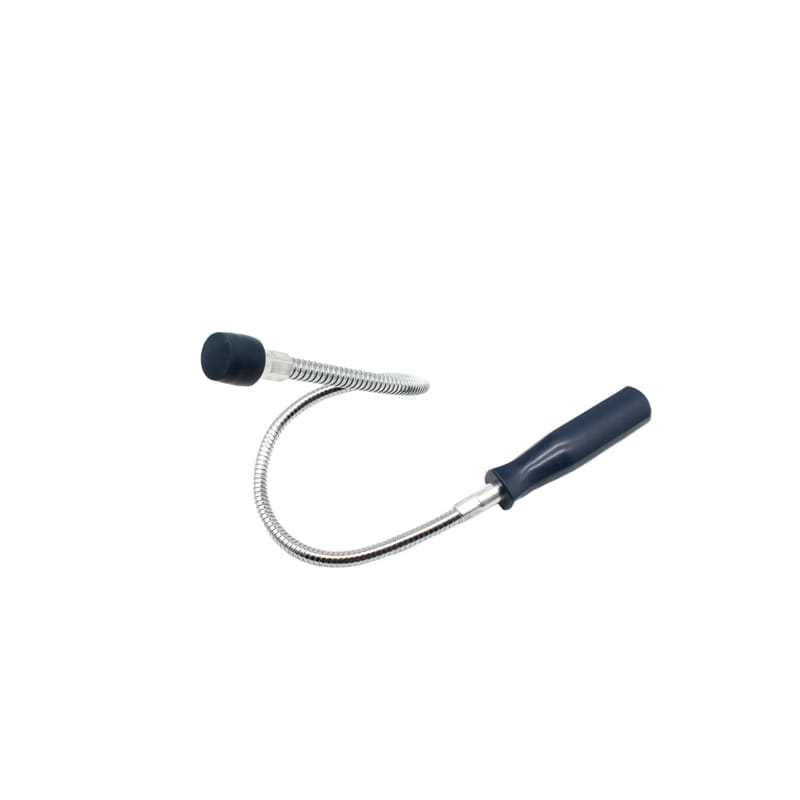
The shaft and head on 5LB Flex Magnetic pick up Tool illustrate the two dimensions that matter: how the tool bends and how large its tip is. A long flexible shaft does not help if the magnet head cannot pass the opening. Measure or compare the head size before working it into a tight space.
Make contact without chasing the part
Advance slowly while watching the tip. If the magnet catches the surrounding steel, do not yank it sideways through cables or hoses. Back it away along a clear path and adjust the approach. A small change in curve can move the magnetic head away from an interfering panel.
Once the tip meets the bolt, pause. Lift a small amount to confirm that the object is attached rather than merely being pushed. If you can choose the contact point, a broad face is generally easier to hold than the edge of a thread or the corner of a head. Let the magnetic grip establish itself before beginning the withdrawal.
Keep the part in view as long as possible. If it disappears behind an obstruction during removal, slow down. The bolt may need to rotate through the opening, and a sudden pull can knock it free. A tool that reached through a hole alone may no longer fit with the bolt attached across its end.
Plan the exit as carefully as the entry
Imagine carrying a long chair through a doorway: touching the chair is easy, but its orientation determines whether it comes out. A bolt on the end of a pickup tool can create the same small-scale problem. Its head or shank may stick out beyond the magnet and catch an edge.
Look for a wider route before lifting. If possible, bring the bolt to an accessible area where you can take it by hand or with a suitable gripping tool. Avoid holding a recovered part over another open cavity while changing your grip. Set a tray nearby so there is an obvious place to put it immediately.
If the bolt falls off repeatedly at the same obstruction, change the recovery route. Repeating the same pull with more speed is unlikely to improve the geometry. You may be able to turn the object gently while it remains visible, or you may need more access. Stop before an easy retrieval becomes a search deeper inside the equipment.
| What stops the retrieval? | What to check | A better response |
|---|---|---|
| Magnet sticks to the surrounding panel | Tip path is too close to steel | Re-form the curve outside the gap |
| Part moves away before attaching | Tip approaches from the side | Approach a visible face more gently |
| Magnet will not hold the object | Material or contact may be unsuitable | Test an identical part; consider a claw |
| Tool returns but bolt catches the opening | Exit is too narrow for the combined shape | Choose a wider route or accessible handover point |
| Shaft snags while withdrawing | A hose, edge or bracket is in the path | Stop and inspect rather than pulling blindly |
Be especially cautious around an engine
Switching off an engine removes rotation, but heat and stored energy can remain. Let the working area reach a safe condition and follow the vehicle's procedure where isolation is required. Do not put a pickup tool near a cooling fan that could start automatically or through exposed high-voltage areas.
If a fastener has fallen into an intake opening, timing area or another internal cavity, do not start or rotate the engine to “shake it loose.” Locate and recover it through an appropriate procedure. A magnet that comes back empty does not prove the object has disappeared harmlessly. Confirm the actual part is recovered and inspect the opening before closing the job.
Where you cannot establish its location, seek suitable assistance rather than continuing to probe. An inspection camera or additional disassembly may be necessary. The goal is not just to retrieve something metallic; it is to account for the particular part that was dropped.
After recovery, check the tool and the hardware
Inspect the recovered bolt for damage or missing washers. If it arrived with a washer attached, separate and count the pieces before reinstalling them. A bolt recovered from dirty water, grit or a contaminated area may need cleaning or replacement under the repair instructions; retrieval alone does not make it ready for reuse.
Wipe the magnet and shaft so collected filings do not transfer to the next job. Check that the head remains secure and the flexible section has not developed a kink or loose area. Store the tool where the tip will not continually collect sharp swarf. For examples of flexible and telescoping designs, see Lisle's pickup-tool range. The best design is the one that matches the route, not simply the longest one.
Quick answers
Will a flexible pickup magnet go around a sharp right-angle corner?
Only if its bend radius and head size allow the route. A flexible shaft still has physical limits. Do not kink it sharply or force it against hidden components.
Can it retrieve a stainless steel screw?
That depends on the stainless grade and the available contact. Test an identical screw when possible. Some stainless fasteners are only weakly magnetic or effectively nonmagnetic.
Why can I reach the bolt but not pull it back through the hole?
The bolt changes the shape at the tip. Its head or length may be wider than the opening in that orientation. Find an exit that accommodates both pieces.
Should I use the magnet to pull a wedged bolt free?
A pickup tool is not a general pulling or prying tool. If the object is trapped, improve access and identify what is holding it rather than relying on magnetic force.
Can I leave a dropped bolt if the magnet cannot find it?
Not where it could enter moving parts or damage equipment. Locate and account for it using a suitable inspection or access method before returning the equipment to service.