
Table of Contents
A brake pad thickness gauge compares the remaining friction material with a known thickness. The friction material is the part that wears against the disc; the metal backing plate behind it is not included in that measurement. Check the actual number on the gauge and compare the result with the vehicle's service information, rather than treating its colour as a universal replacement rule.
The gauge can help you understand pad wear, but it cannot give the whole braking system a clean bill of health. Uneven wear, damaged components, unusual noises and braking symptoms still need attention even if one visible pad looks thick. The most useful reading is an honest measurement of the relevant pad area, not a reassuring colour found through the easiest gap.
Know the three surfaces you are looking at
The brake disc, also called the rotor, is the rotating metal surface. The pad's friction material sits against it when the brake is applied. Behind the friction material is the backing plate, which supports the pad. From an awkward angle, the dark friction material and metal plate can look like one thick block.
Use good lighting and identify the boundary between the two before measuring. An inspection mirror may help with a hidden edge. Do not insert a gauge into a random opening simply because it seems to match the thickness you expected. If the pad's edge cannot be seen well enough, the access is inadequate for a confident reading.
Decorative slots or grooves in the pad can also be confusing. A groove may provide a visual clue, but it does not replace the manufacturer's measurement and inspection instructions. Some pad designs have different features, and a worn-looking groove should not be interpreted using a rule taken from a different pad.
Use a comparison blade without forcing it
A common gauge has a set of labelled leaves or stepped ends. Each provides a thickness reference. Position the appropriate part against the exposed friction-material thickness as intended by the gauge's design. The aim is to compare dimensions, not to wedge the tool between the pad and disc or pry anything apart.
Choose the reference that best matches what you can actually see and reach. If the pad appears between two steps, record that limitation instead of inventing a precise decimal value. A comparison gauge is not automatically a precision measuring instrument, especially when access forces it to sit at an angle.
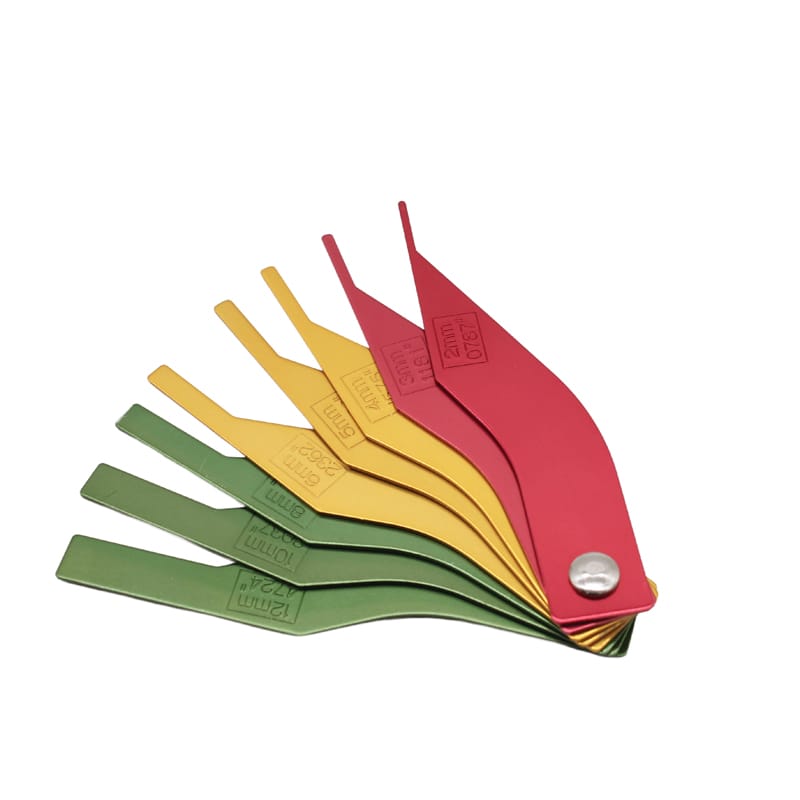
An example such as Brake Pad Thickness Gauge shows the range of comparison leaves. Some designs have straight and offset tips to improve access. Lisle's combination gauge description illustrates that distinction; being able to reach without wheel removal on some vehicles does not mean the same method works on all vehicles.
Read millimetres before reading colours
Red, yellow and green are convenient visual categories on many gauge sets. They are not a single braking standard shared by every vehicle. Different sets may use different steps or labels, and the decision to replace a pad still depends on the applicable service limit and its condition.
Suppose your gauge indicates a remaining thickness close to one of its marked steps. Write down the thickness estimate and which pad it refers to. “Outer front-left pad: approximately this marked value” is more useful than “brakes are green.” The first statement can be checked later; the second hides both the measurement and the part that was inspected.
Avoid converting the reading into a promised number of miles. Wear depends on driving conditions, braking habits, vehicle use and the condition of the brake assembly. A pad that is currently above its service limit may still need monitoring or replacement planning. The gauge tells you about current thickness, not a guaranteed future lifespan.
The inner pad may tell a different story
Many brake assemblies have an inner and an outer pad. They do not always wear equally. The outer pad may be easy to see through the wheel while the inner pad is hidden. Reporting the outer reading as though it describes both pads can miss the thinner one.
Inspect the locations required by the vehicle's procedure. If access to the inner pad is blocked, record it as not measured rather than estimating from the outer pad. Further access may require wheel removal or other service work. Anyone doing that work needs the correct vehicle support and repair procedure; never work beneath a vehicle supported by a jack alone.
Also look along the pad rather than checking only one convenient end. A pad can wear at an angle, leaving one area thicker than another. The thickest visible spot is not the measurement that should reassure you. Uneven wear is a finding to investigate, not a reason to average the thick and thin areas into an acceptable-looking number.
Thickness and condition are separate questions
A pad can have material remaining and still be unsuitable because it is damaged, contaminated or wearing abnormally. Likewise, a vibration or pulling complaint may involve more than pad thickness. The gauge does not inspect the disc surface, measure disc thickness or establish whether a caliper moves correctly.
If the friction material appears cracked, detached, heavily contaminated or unusually uneven, have the brake assembly assessed. Do not wipe away the evidence and rely on a colour category. If you notice a soft pedal, loss of braking, a serious leak or other unsafe braking behaviour, stop using the vehicle and arrange appropriate assistance.
Noise also needs context. A squeal is not a thickness measurement, and the absence of noise does not prove the pads are healthy. Some vehicles have wear indicators or electronic warnings, but those features do not remove the need for the relevant inspection when symptoms or service requirements call for it.
| Observation | What it tells you | What it does not prove |
|---|---|---|
| One pad matches a labelled gauge step | Approximate thickness at that accessible point | Thickness of the hidden pad |
| Outer pad looks substantial | Outer material is visible | Inner wear is equal |
| Pad is thinner at one end | Wear is uneven | The cause of that wear |
| Gauge shows a green-coded step | It matches that set's category | A universal safe remaining mileage |
| Pads have adequate measured thickness | One inspection criterion may be satisfied | Disc, hydraulic and caliper condition are all acceptable |
Make a record that is useful next time
If a technician reports that pads need replacement, ask which pad is thinnest, what the measured thickness is and whether wear is even. These are practical questions that help you understand the recommendation. They do not require you to argue from an internet-wide “replace at this number” rule that may not match the vehicle.
At the next inspection, compare like with like. An old outer-pad estimate and a new inner-pad measurement are not a reliable wear trend. A small difference can also reflect the gauge steps or measurement location. Use the record to guide maintenance, not to pretend that a coarse comparison tool produces laboratory precision.
Keep the gauge ready to give a clear answer
Clean the contact ends and make sure the markings remain readable. Bent, damaged or worn comparison surfaces can undermine the result. Do not use the gauge as a scraper, screwdriver or wedge; its usefulness depends on retaining its intended shape.
Let hot brakes cool before inspection and keep fingers and tools away from moving components. If the only way to get a reading is to force access or work in an unsafe position, stop. A clear “not accessible with this method” is better information than a guessed figure. The purpose of checking thickness is to make the braking condition easier to understand, not to create false certainty from a quick look.
Questions readers ask
Does pad thickness include the metal backing plate?
No. Measure the remaining friction material as specified for the vehicle. Including the backing plate makes a worn pad appear thicker than it is.
Can I check through the wheel spokes?
Sometimes, if the gauge and brake design allow a proper view and contact. If the inner pad or relevant area is hidden, do not assume it matches the visible pad.
Is a red gauge reading the same on every vehicle?
No. Read the marked thickness and compare it with the vehicle’s service requirements. Colour coding is a convenience, not a universal replacement specification.
Can the gauge tell how many miles the pads have left?
No. Future wear depends on use and brake condition. Treat the reading as current inspection information and plan maintenance using the applicable guidance.
Should I ignore a grinding noise if the visible pad looks thick?
No. Noise and braking symptoms need investigation. One visible pad does not establish the condition of the other pad, disc or rest of the assembly.