
Inhaltsverzeichnis
A telescopic magnetic pick up tool works best when you can approach a steel screw along a fairly straight path and bring it back through a clear opening. Extend only as much shaft as you need, touch the part with the magnetic face, and withdraw slowly along the same route. Reaching the screw is only half the job: the screw also needs enough room to pass through the gap while attached to the tip.
If a tool reaches the bottom of a cabinet but drops the screw at the opening, a stronger magnet may not solve the problem. The screw may be hanging sideways, the shaft may be bending against an edge, or the magnetic tip may be sticking to nearby metal. Looking at those three possibilities usually saves more time than repeatedly poking into the same dark space.
Start with a view of the part and its exit
Use a light to locate the screw before extending the shaft. Find out whether it is lying on an open shelf, balanced on a ledge, or lodged behind a pipe. Also look at the route above it. A long screw resting flat may fit through a slot by itself but become too wide when it hangs crossways from a magnetic tip. You need a route for the combined shape of tip and screw.
A small inspection mirror can help when your eyes cannot follow the shaft. Keep the mirror outside the working path where possible. If it blocks the only opening, use it to establish the location, remove it, and then make a controlled retrieval attempt. Continually alternating between checking and moving is preferable to blindly stirring a space that contains wires or fragile plastic.
Do not start a machine or move an assembly to shake a missing fastener loose. If the part has fallen into an engine opening, electrical enclosure or another place where it could cause damage, stop work and establish a reliable way to inspect the whole area. Retrieving one visible screw does not prove that a washer or another small piece came out with it.
Extend the shaft in stages
Telescoping sections give a compact tool useful reach, but full extension leaves a long, slender shaft. Pull the sections out smoothly and keep them aligned. A sudden sideways tug can bend a small tube or make a joint feel loose. Once you have enough reach, stop extending. Extra length increases the amount of movement at the tip without helping the retrieval.
Hold the handle where your wrist can stay relaxed. Resting your forearm on a stable surface can make a distant tip easier to control, provided that surface is safe to lean on. Avoid using the shaft itself as a support or a lever. It is designed to position a magnet, not to pry a screw out from under a heavy object.
If the shaft keeps shortening, check whether you are pushing the tip into something rather than merely touching the fastener. A telescoping tool does not necessarily lock at every length. Excessive forward force may collapse its sections. Approach from a direction where contact is light; if the screw must be pushed free first, use an appropriate separate method after making the area accessible.
What a stated lifting capacity does not promise
A magnet can hold very differently depending on what it touches. A broad, clean steel surface presents a better contact than the narrow edge of a screw head. Rust, dirt, paint and a curved surface can leave a gap. The advertised pull or lifting figure for a particular tool therefore should not be treated as the weight you can reliably retrieve from any position.
For a dropped screw, contact area and orientation usually matter more than its low weight. Touching the head squarely may produce a more stable hold than contacting the end of the thread. Let the part settle on the tip before lifting. If it swings freely, pause near the bottom and try to establish a better attachment while there is still room to recover it if it falls.
The shaft has limits of its own. A magnetic head might attract an object that the extended shaft cannot carry safely sideways. Do not use a small pickup tool to lift a bracket, support a component, or hold a part over someone. Its useful role is retrieving loose small items. If a fastener is still trapped, magnetic attraction does not make it loose.
Check that the object is actually magnetic
Most ordinary steel screws respond to a magnet, but not every metal object does. Aluminium and brass will not behave like steel. Stainless steel varies with its grade and condition, so the word stainless alone does not tell you whether the pickup will work. Test an identical spare if one is available, or gently test the visible object without pushing it farther away.
A weak response can also mean the magnetic face is touching the wrong thing. A steel washer beside a brass fitting may jump to the tip while the fitting remains behind. Check the recovered item rather than assuming that any successful pickup was the missing part. On a repair with several similar screws, compare its length and head to the position it came from.
For a nonmagnetic item, consider a suitable mechanical grabber or opening the access panel. Adhesive improvised on the tip can leave material inside the assembly and may not hold the part during withdrawal. A few minutes spent improving access can be faster than dealing with two lost objects instead of one.
Bring the screw through the gap deliberately
Once the part is attached, lift a short distance and watch how it hangs. Keep the tip away from nearby steel surfaces, which can pull it sideways or trap the screw between the magnet and the surrounding metal. Move slowly enough to stop before a collision. A smooth outward path is more useful than speed, especially near the narrowest point.
If the screw will not pass through the opening, lower it to a safe resting place and rethink the angle. Do not scrape it hard against the edge in the hope that it will rotate correctly. It may detach and land somewhere less accessible. Sometimes changing the approach so the tip contacts the screw head instead of its side reduces the width of the recovered assembly.
Have a tray or clear work surface ready before the tool emerges. Keep the screw over that surface as you separate it from the magnet. Tiny washers can remain hidden on the underside of the head or slide off when you pull the screw away. A final look at both the magnet and the original location helps you finish the retrieval rather than merely interrupt it.
Three situations that call for a different approach
Under a workbench, the easiest route may be from the side rather than down through the clutter above. A short shaft with a clear view gives more control than full extension from an awkward angle. Remove loose obstacles that can be moved safely before attempting the pickup; otherwise the magnet may gather unrelated screws on the way in.
Inside a curved cavity, repeated failure with a straight telescoping shaft is a clue that the shape is wrong for the route. A flexible pickup may follow a bend, while a mechanical grabber may suit a nonmagnetic item. Neither replaces access when the object is wedged or when you cannot confirm what surrounds it. Choose the method around the location, not around the tool already in your hand.
Keep the next retrieval easy
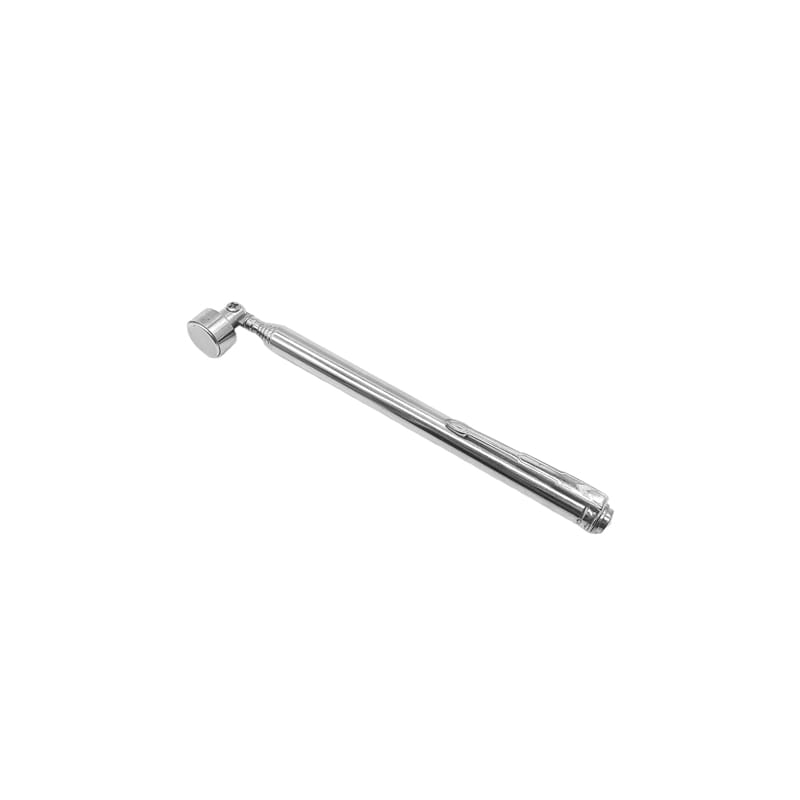
Store it where the magnet will not collect a layer of loose screws and filings. Before another job, check the extended length and head diameter against the space you actually need to reach. The Teleskopisches magnetisches Aufnahmewerkzeug is a product example to compare for shape and access; its published details should decide the usable range, rather than assuming that all telescopic pickups extend equally far.
Most importantly, prevent the repeat drop. Cover openings appropriately during disassembly, keep removed hardware in a shallow tray, and start screws by hand where access permits. A pickup tool is a useful recovery aid, but a clear work area and a planned place for small parts reduce the need to use it.
Schnelle Antworten
Why does the magnetic tip stick to the side before reaching the screw?
The surrounding steel is closer to the magnetic face than the loose fastener. Change the approach so the head has clearance, or improve access. Dragging it down the wall can push the screw farther away.
Can I bend a telescopic pickup to reach around a corner?
Do not bend a rigid telescoping shaft. Its tubes can kink and stop retracting. Use a tool designed with a flexible shaft or open up a straighter access route.
Should I extend every section for a small pickup?
Use only the length needed to reach the item comfortably. A shorter shaft is easier to aim and less likely to flex or collide with the edge of an opening.
Will it retrieve every stainless steel screw?
No. Magnetic response differs between stainless steels. Test an equivalent screw if possible, and use a suitable mechanical retrieval method when the part does not respond reliably.
Why did a very light screw fall off?
A poor contact angle, dirt, a collision or a sideways pull can break the hold even when the screw weighs very little. Establish better contact and plan the withdrawal route before lifting again.