
Elegir el método de retracción del pistón incorrecto puede convertir un servicio de rutina de pastillas de freno en una funda guardapolvo dañada, un pistón desalineado o un mecanismo de freno de estacionamiento inutilizable. La decisión clave no es si una herramienta parece más fuerte que otra. Se trata de si el pistón de la pinza debe moverse hacia atrás, girar mientras se mueve hacia adentro o restablecerse mediante un procedimiento de servicio electrónico del freno de estacionamiento.
Esta guía explica cómo elegir entre a herramienta de retroceso de viento para pinza de freno y un compresor de pistón estándar. Está escrito para talleres de reparación, distribuidores de herramientas automotrices, equipos de compras y marcas de herramientas OEM que necesitan una cobertura de aplicación confiable en lugar de un kit de gran tamaño con funciones de adaptador poco claras.
Conclusiones clave
- Utilice una herramienta de compresión recta sólo cuando el pistón esté diseñado para retraerse linealmente.
- Utilice una herramienta de retroceso de la pinza de freno cuando el pistón deba girar y retraerse al mismo tiempo.
- No asuma que todas las pinzas traseras son de retroceso o que todas las pinzas delanteras son empujadas hacia adentro.
- Los sistemas electrónicos de freno de estacionamiento pueden requerir un paso de modo de diagnóstico o servicio antes de la retracción mecánica.
- Para compras profesionales, la precisión del adaptador, la dirección del husillo, la estabilidad de la carga y la identificación clara importan más que el número de piezas.
Tabla de contenidos
Por qué es importante el método de retracción del pistón
Los pistones de freno de disco se mueven hacia afuera a medida que se desgasta el material de fricción. Las pastillas nuevas son más gruesas, por lo que el pistón debe regresar más dentro del orificio de la pinza antes de que la pinza pueda caber sobre el nuevo juego de pastillas. Ese requisito básico es común en muchos sistemas de frenos de disco, pero el mecanismo que controla el pistón no siempre es el mismo.
Un pistón de empuje necesita una fuerza lineal controlada. Un pistón atornillado incluye un mecanismo de ajuste interno o freno de estacionamiento y necesita rotación y presión hacia adentro simultáneas. Una herramienta de retroceso de la pinza de freno está diseñada para la segunda condición. Aplicar sólo fuerza recta a un mecanismo roscado puede sobrecargar las piezas internas, dañar la cara del pistón o hacer que la herramienta se deslice a través de las muescas.
La terminología de frenado internacional cubre tanto los sistemas de frenado como sus elementos operativos. Los compradores que desarrollen descripciones técnicas de productos pueden utilizar las definiciones de ISO 611:2003 como referencia terminológica general en lugar de basarse en una redacción inconsistente del mercado.
¿qué es una herramienta de retroceso de viento para pinza de freno?
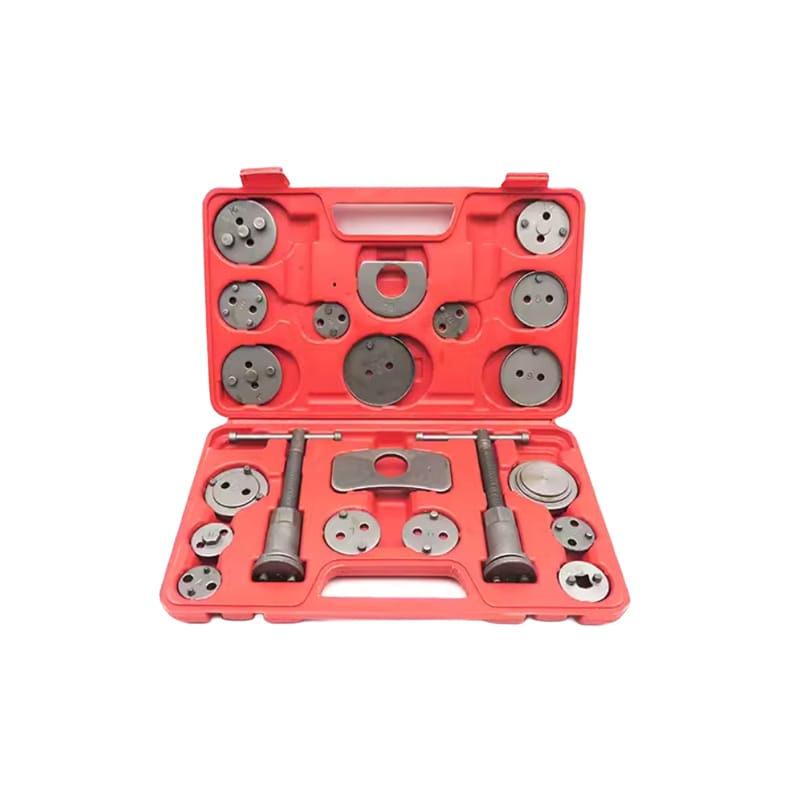
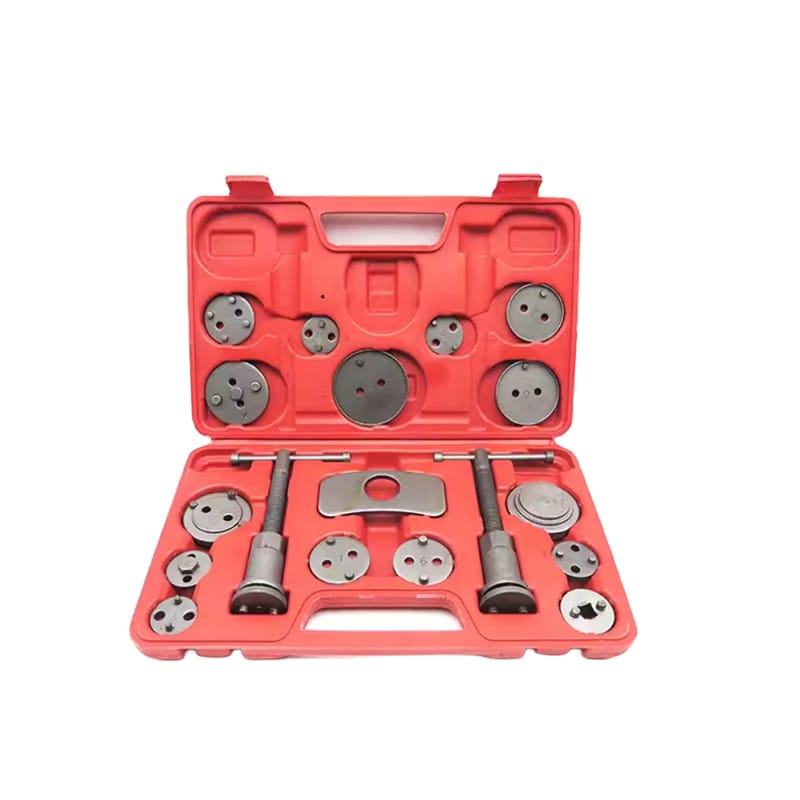
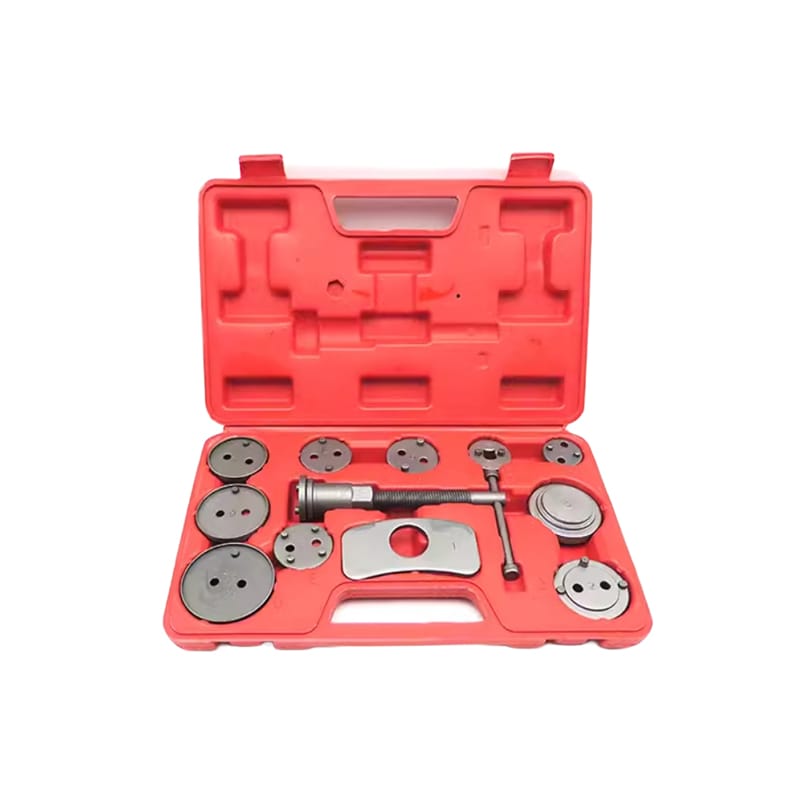
Una herramienta de retroceso de la pinza de freno es un dispositivo de retracción mecánica que aplica presión axial mientras gira el pistón. La mayoría de los kits profesionales utilizan un husillo roscado, una placa de reacción y discos adaptadores intercambiables. El adaptador se acopla a ranuras, orificios, pasadores o huecos en la cara del pistón, mientras que la placa de reacción se sujeta contra el cuerpo de la pinza.
A medida que gira el husillo, la herramienta de retroceso de la pinza de freno mantiene el adaptador acoplado y mueve el pistón hacia adentro en una trayectoria controlada. Esta combinación de rotación y presión es la principal diferencia entre un juego de retroceso y una prensa de pistón básica.
Componentes principales
Un conjunto práctico normalmente incluye:
- Un husillo roscado a la derecha
- Un husillo roscado izquierdo cuando se requiere una cobertura más amplia
- Una o más placas de reacción
- Discos adaptadores con diferentes espacios entre pasadores y patrones de caras
- Un mango, barra en T, accionamiento hexagonal o extremo operativo compatible con trinquete
- Un estuche moldeado con tabla de identificación del adaptador
El número de adaptadores sólo es útil cuando cada adaptador corresponde a un patrón de pistón real. Un juego de herramientas de retroceso de pinza de freno más pequeño y claramente mapeado puede ser más útil que un juego más grande lleno de discos casi duplicados.
¿qué es un compresor de pistón para pinza de freno?
Un compresor de pistón empuja el pistón directamente dentro del orificio. Los diseños comunes incluyen una prensa de tornillo con una o dos placas, un esparcidor de trinquete, una prensa de marco fijo o una herramienta de empuje neumática. Estas herramientas son adecuadas para pistones que no necesitan girar.
Un buen compresor distribuye la presión a través de la cara del pistón y ayuda a mantener el pistón cuadrado hasta el orificio. Generalmente es más rápido que una herramienta de retroceso de pinza de freno en pinzas de empuje simples porque no es necesario ningún patrón de adaptador para acoplar el pistón.
Sin embargo, no se debe seleccionar un compresor sólo porque el pistón parezca difícil de mover. La resistencia puede provenir de corrosión, un pistón atascado, una manguera bloqueada, un freno de mano inédito o un procedimiento de servicio incorrecto. Más fuerza no sustituye a identificar el mecanismo.
Herramienta de respaldo de viento para pinza de freno versus compresor de pistón
| Punto de selección | Herramienta de respaldo de viento para pinza de freno | Compresor de pistón |
|---|---|---|
| Movimiento del pistón | Rotación más desplazamiento hacia adentro | Viaje directo hacia adentro |
| Aplicación típica | Pistones atornillados y algunas pinzas de freno de estacionamiento integradas | Pistones de empuje |
| Método de contacto | El adaptador estampado se acopla a la cara del pistón | Pistón de contactos de placa plana o esparcidor |
| Control de dirección | Puede requerir husillo derecho o izquierdo | Generalmente dirección neutral |
| Requisito de adaptador | Alto | Bajo a moderado |
| Principal riesgo de compra | Mal ajuste del adaptador o falta la dirección del husillo | Fuerza desigual o rango de apertura insuficiente |
| Best workshop role | Mixed rear-caliper service | Fast front-caliper and standard push-in service |
| Best distributor strategy | Application-mapped kit | Several capacities and plate styles |
Neither tool is universally better. A workshop servicing a varied vehicle population usually needs both. A distributor should therefore avoid presenting a brake caliper wind back tool as a universal replacement for every piston compressor, or a flat press as suitable for every rear caliper.
For a broader review of complete kit planning, see the existing Guía de compra del kit de herramientas para pinzas de freno.
Cómo identificar un pistón de empuje o de retroceso
Correct identification should happen before force is applied. The following clues are useful, but the vehicle service information remains the final reference.
Examine the Piston Face
A plain, broad piston face often indicates a push-in design. Two notches, multiple holes, pins, or a patterned face may indicate that a brake caliper wind back tool adapter is required.
This visual check is helpful but not absolute. Some designs use unusual faces, and some fixed multi-piston calipers require a spreading tool rather than a traditional screw press.
Check the Parking-Brake Mechanism
A rear caliper with an integrated mechanical parking-brake mechanism is more likely to use a screw-in piston. The external lever, cable connection, or integrated actuator can be a clue that the piston has an internal adjustment mechanism.
Confirm the Service Information
Never choose the direction or adapter from appearance alone when the application is unfamiliar. Confirm:
- Whether the piston pushes or rotates
- The required turning direction
- Whether both sides use the same direction
- Whether an electronic parking-brake service mode is required
- The correct piston orientation after retraction
- Any specified fluid-handling or bleeding procedure
This is especially important for tool distributors creating application charts. A reliable chart should be based on verified fitment data, not copied from another generic set.
Por qué la geometría del adaptador es más importante que el tamaño del kit
The adapter is the working interface between the brake caliper wind back tool and the piston. If the pins are too small, too large, too close, or too far apart, the adapter may sit on the edge of the recess rather than fully engage it.
Poor engagement creates several problems:
- The adapter can slip under load.
- The piston face can become marked or deformed.
- The dust boot can be pinched by a tilted disc.
- The technician may compensate with excessive force.
- The kit may appear compatible on paper but fail in real service.
Professional buyers should evaluate pin diameter, pin height, spacing tolerance, disc flatness, and how securely the disc connects to the spindle. The brake caliper wind back tool should also keep the disc centered as the spindle advances.
A Useful Sample Test
During product evaluation, test several adapters on representative piston patterns. Apply moderate operating load and check whether the disc remains fully seated through multiple turns.
Record any rocking, slipping, bending, or pin deformation. This simple test is more informative than counting how many discs are in the case.
Explicación de los husillos derecho e izquierdo
Many brake caliper wind back tool sets include two spindles because some applications require opposite turning directions. A right-hand spindle advances under normal clockwise operation, while a left-hand spindle advances in the opposite thread direction.
The important point is not that every vehicle uses both. The value is that a mixed-application workshop can maintain inward pressure while turning the piston in the specified direction.
A kit should identify spindle direction clearly through:
- Permanent markings
- Different handle colors
- Engraved arrows
- Separate molded case positions
- A printed instruction chart
Unmarked spindles increase setup time and make operating errors more likely. For OEM packaging, direction identification should appear both on the tool and in the manual.
Los sistemas de freno de estacionamiento electrónico necesitan un flujo de trabajo diferente
An electronic parking brake changes the service process. Depending on the system, the actuator may need to be moved into service mode using a diagnostic function, a vehicle menu sequence, or a specified manual procedure before piston retraction begins.
A brake caliper wind back tool cannot replace that electronic step. If the actuator remains engaged, forcing the piston can overload internal gears or create an incorrect adjustment position.
The safest rule is simple: confirm the approved service procedure before using any mechanical retraction tool on an electronically controlled rear caliper.
After service, some systems also require an initialization, calibration, or apply-and-release cycle. Tool suppliers should make this limitation clear. A mechanical kit may be part of the workflow, but it is not automatically a complete solution for every electronic parking-brake application.
Cómo los talleres deben elegir la configuración de herramienta adecuada
A workshop should select tools according to the vehicles and jobs it actually handles.
General Repair Shop
A mixed repair shop benefits from:
- A standard piston compressor
- A brake caliper wind back tool set with verified adapter coverage
- Both spindle directions where required
- A multi-piston spreading tool
- A caliper support hook
- A brake bleeder or fluid-control setup
- Clear application information
Fleet Workshop
Fleet operations can often use a narrower selection because the vehicle population is known. Instead of buying the largest brake caliper wind back tool set, the workshop can prioritize the exact adapters, opening range, and spindle style needed for the fleet.
This approach reduces unused components, simplifies technician training, and makes replacement inventory easier to manage.
Mobile Technician
Compact storage and fast identification matter more in mobile work. A concise kit with labeled adapters, a strong case, and a ratchet-compatible spindle can reduce setup time.
Loose discs without clear identification are a poor choice for mobile service because missing or mixed adapters may not be noticed until the vehicle is already disassembled.
Training Center
Training environments need visible markings and repeatable operation. The brake caliper wind back tool should make it easy to demonstrate correct engagement, pressure control, spindle direction, and the difference between push-in and screw-in pistons.
Explore the full Brake Tools category when planning a workshop or distributor assortment.
Qué deben inspeccionar los distribuidores y compradores OEM
For B2B buyers, product quality is not defined only by whether one sample completes one brake job. The real question is whether the tool remains consistent across production batches and whether the kit can be explained clearly to end users.
Spindle Strength and Thread Quality
The spindle should turn smoothly under load without excessive play. Inspect:
- Thread form and finish
- Spindle straightness
- Manejar conexión
- Nut or collar fit
- Protección de superficies
- Resistance to galling
- Consistency between multiple samples
A brake caliper wind back tool with rough threads may feel acceptable when unloaded but bind once axial pressure increases.
Reaction Plate Stability
The reaction plate should sit securely against the caliper opening without excessive flex. Check plate thickness, slot dimensions, edge finish, and compatibility with the spindle body.
A plate that bends under load can tilt the spindle and reduce adapter engagement.
Adapter Consistency
Measure pin spacing and disc dimensions across multiple samples, not only one set. Adapter identification should remain permanent after cleaning and normal workshop use.
Where several discs have similar patterns, the markings must be easy to read without removing every component from the case.
Tratamiento superficial
A protective finish helps reduce corrosion during storage and service. Buyers should confirm coating consistency, exposed edges, threaded areas, and whether the finish interferes with adapter fit.
Surface appearance should not be used as a substitute for material control, dimensional accuracy, or functional testing.
Case and Inventory Control
A molded case is part of the product function. It should:
- Hold each part securely
- Show missing components immediately
- Separate left- and right-hand spindles
- Label adapter positions
- Survive repeated opening and transport
- Allow customized branding without hiding technical information
For distributors, a well-designed case can reduce returns caused by lost adapters or unclear kit organization.
Documentación
Instructions should explain selection logic, not merely say “choose the correct adapter.” A professional manual should cover piston identification, adapter engagement, spindle direction, controlled pressure, electronic parking-brake limitations, and post-service checks.
Businesses developing a broader private-label range can review Fengjie Vehicle Tools y contacta con el equipo with target applications, packaging requirements, and preferred kit configuration.
Errores comunes que causan daños a herramientas o calibradores
Using a Compressor on a Screw-In Piston
This is the most important selection error. If the piston is designed to rotate, straight compression can overload the internal mechanism.
When resistance increases unexpectedly, stop and verify the piston design instead of increasing leverage.
Selecting an Adapter That Almost Fits
An adapter that touches the notches is not necessarily engaged. Both pins should seat fully, and the disc should remain stable as pressure increases.
An almost-correct adapter can slip suddenly and damage the piston face or surrounding boot.
Turning Without Inward Pressure
A brake caliper wind back tool must normally maintain contact while rotating. Spinning the piston without controlled inward travel can cause the adapter to walk out of the recesses.
The reaction plate and spindle should remain aligned throughout the operation.
Applying Excessive Force to a Seized Piston
A piston that does not move may have a mechanical or hydraulic fault. Stop and diagnose the cause rather than extending the handle or applying impact force.
Potential causes include corrosion, an unreleased parking-brake mechanism, incorrect spindle direction, a restricted hose, or internal caliper damage.
Ignoring Brake-Fluid Movement
Retracting a piston displaces fluid toward the reservoir. Monitor the fluid level and keep the hydraulic system clean.
NHTSA materials emphasize that contamination or moisture in brake fluid can reduce braking performance and contribute to corrosion, so fluid handling should be treated as part of the service rather than an afterthought.
Allowing the Caliper to Hang From the Hose
Support the caliper independently. The brake hose is a hydraulic component, not a suspension point.
A support hook or suitable hanger helps prevent unnecessary strain while the pads and piston are being serviced.
Un flujo de trabajo de herramienta de retroceso de viento de pinza de freno más seguro
The following workflow is a general planning guide, not a replacement for vehicle-specific service information.
- Confirm the caliper design. Identify whether the piston pushes, rotates, or requires electronic service mode.
- Secure the vehicle. Use the correct lifting points and rated support equipment. OSHA requirements for jacks emphasize load support and the prevention of slippage.
- Inspect the caliper. Check the dust boot, hose, slider condition, piston face, and parking-brake mechanism.
- Support the caliper. Prevent strain on the brake hose.
- Check the reservoir. Monitor fluid level and protect the area from spills.
- Select the adapter. Choose the disc that fully matches the piston pattern.
- Select the spindle direction. Follow verified service information.
- Install the reaction plate. Align the brake caliper wind back tool squarely in the caliper.
- Apply light pressure. Keep the adapter engaged before turning.
- Rotate slowly. Watch for smooth inward travel and stop if resistance becomes abnormal.
- Check boot movement. Make sure the dust boot is not twisted, pinched, or pulled from its seat.
- Confirm the final piston position. Some pistons need a specific orientation to align with pad locating features.
- Complete reassembly. Follow the specified fastener, lubrication, bleeding, and parking-brake procedure.
- Restore pedal and parking-brake function. Perform all required checks before vehicle use.
Creación de una gama completa de herramientas de servicio de frenos
A brake caliper wind back tool works best as part of a structured service range, not as an isolated SKU. Distributors can organize products around actual workshop tasks:
- Piston retraction
- Caliper spreading
- Caliper support
- Hose clamping
- Brake bleeding
- Brake-line cutting and flaring
- Cylinder honing
- Fastener and spring service
- Inspection and cleaning
This task-based structure helps buyers understand why multiple tools are needed and creates more useful product bundles.
For brake-line preparation, the Double Flaring Tool Kit Guide explains another important part of hydraulic brake service.
Preguntas frecuentes
Do All Rear Calipers Need a Brake Caliper Wind Back Tool?
No. Many rear calipers use a screw-in piston, but some use a push-in design or an electronic actuator procedure. Confirm the specific system before selecting the tool.
Can a Piston Compressor Replace a Brake Caliper Wind Back Tool?
Only on a piston designed for straight compression. A compressor does not provide the controlled rotation required by a screw-in piston.
Why Does a Wind-Back Kit Include Many Adapter Discs?
Different piston faces use different pin patterns, spacing, and recess shapes. The adapter must engage securely to rotate the piston without slipping.
A distributor should verify that each included pattern has a defined application rather than treating a higher piece count as the main selling point.
Do I Need Both Left-Hand and Right-Hand Spindles?
A mixed-application workshop may need both. A fleet with a limited vehicle range may need only the direction specified for those vehicles.
Both spindles should be permanently and visibly identified.
Can the Same Brake Caliper Wind Back Tool Be Used on Electronic Parking Brakes?
Sometimes the mechanical tool is used after the system is placed in service mode, but the electronic procedure varies. Always check the approved service information first.
Do not assume that mechanical piston movement automatically resets the electronic actuator.
What Should I Do if the Piston Will Not Move?
Stop applying force. Check parking-brake release, spindle direction, adapter fit, piston corrosion, hose restriction, fluid path, and the correct service procedure.
A tool should not be used to overpower a fault that has not been diagnosed.
Is a Cube-Style Tool Enough for Professional Use?
A cube can fit some piston patterns, but it does not provide the same guided pressure, stability, or adapter range as a complete brake caliper wind back tool set.
It may be suitable for a known limited application, but it is less practical for mixed workshop coverage.
What Matters Most When Sourcing a Wind-Back Kit?
Prioritize verified adapter fit, spindle quality, direction identification, reaction plate stability, durable storage, clear instructions, and batch consistency.
Conclusión
The choice between a piston compressor and a herramienta de retroceso de viento para pinza de freno should begin with the caliper mechanism, not the tool case. Straight push-in pistons need controlled linear force. Screw-in pistons need rotation and inward pressure together. Electronic parking-brake systems may add a service-mode step that no mechanical tool can replace.
For workshops, the most practical setup usually combines a reliable compressor with a well-mapped brake caliper wind back tool kit. For distributors and OEM buyers, the strongest product is not necessarily the kit with the most pieces. It is the kit with accurate adapters, stable loading, clearly marked spindle directions, consistent manufacturing, and instructions that help users choose correctly.
To discuss brake-service tool configurations, wholesale supply, or customized packaging, send your application requirements to Fengjie Tools.