
Elegir el método de retracción del pistón incorrecto puede convertir un servicio de rutina de pastillas de freno en una funda guardapolvo dañada, un pistón desalineado o un mecanismo de freno de estacionamiento inutilizable. La decisión clave no es si una herramienta parece más fuerte que otra. Se trata de si el pistón de la pinza debe moverse hacia atrás, girar mientras se mueve hacia adentro o restablecerse mediante un procedimiento de servicio electrónico del freno de estacionamiento.
Esta guía explica cómo elegir entre a herramienta de retroceso de viento para pinza de freno y un compresor de pistón estándar. Está escrito para talleres de reparación, distribuidores de herramientas automotrices, equipos de compras y marcas de herramientas OEM que necesitan una cobertura de aplicación confiable en lugar de un kit de gran tamaño con funciones de adaptador poco claras.
Conclusiones clave
- Utilice una herramienta de compresión recta sólo cuando el pistón esté diseñado para retraerse linealmente.
- Utilice una herramienta de retroceso de la pinza de freno cuando el pistón deba girar y retraerse al mismo tiempo.
- No asuma que todas las pinzas traseras son de retroceso o que todas las pinzas delanteras son empujadas hacia adentro.
- Los sistemas electrónicos de freno de estacionamiento pueden requerir un paso de modo de diagnóstico o servicio antes de la retracción mecánica.
- Para compras profesionales, la precisión del adaptador, la dirección del husillo, la estabilidad de la carga y la identificación clara importan más que el número de piezas.
Tabla de contenidos
Por qué es importante el método de retracción del pistón
Los pistones de freno de disco se mueven hacia afuera a medida que se desgasta el material de fricción. Las pastillas nuevas son más gruesas, por lo que el pistón debe regresar más dentro del orificio de la pinza antes de que la pinza pueda caber sobre el nuevo juego de pastillas. Ese requisito básico es común en muchos sistemas de frenos de disco, pero el mecanismo que controla el pistón no siempre es el mismo.
Un pistón de empuje necesita una fuerza lineal controlada. Un pistón atornillado incluye un mecanismo de ajuste interno o freno de estacionamiento y necesita rotación y presión hacia adentro simultáneas. Una herramienta de retroceso de la pinza de freno está diseñada para la segunda condición. Aplicar sólo fuerza recta a un mecanismo roscado puede sobrecargar las piezas internas, dañar la cara del pistón o hacer que la herramienta se deslice a través de las muescas.
La terminología de frenado internacional cubre tanto los sistemas de frenado como sus elementos operativos. Los compradores que desarrollen descripciones técnicas de productos pueden utilizar las definiciones de ISO 611:2003 como referencia terminológica general en lugar de basarse en una redacción inconsistente del mercado.
¿qué es una herramienta de retroceso de viento para pinza de freno?
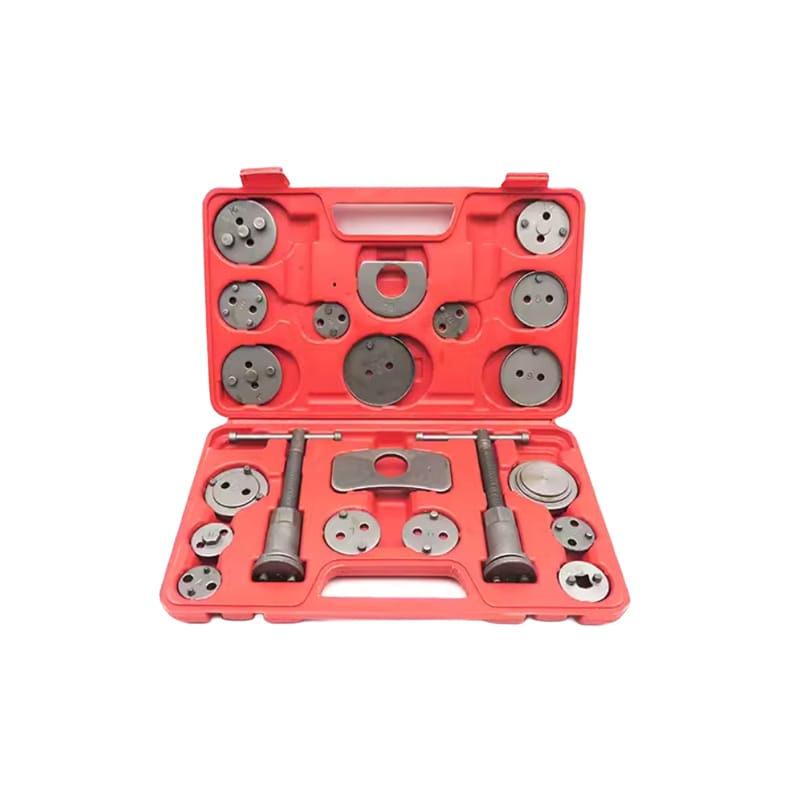
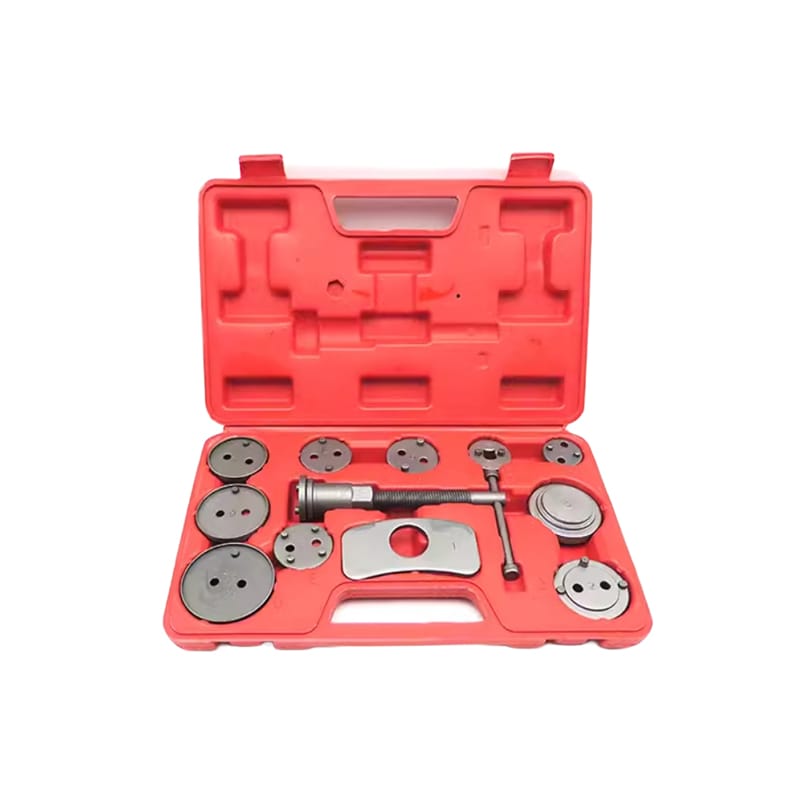
Una herramienta de retroceso de la pinza de freno es un dispositivo de retracción mecánica que aplica presión axial mientras gira el pistón. La mayoría de los kits profesionales utilizan un husillo roscado, una placa de reacción y discos adaptadores intercambiables. El adaptador se acopla a ranuras, orificios, pasadores o huecos en la cara del pistón, mientras que la placa de reacción se sujeta contra el cuerpo de la pinza.
A medida que gira el husillo, la herramienta de retroceso de la pinza de freno mantiene el adaptador acoplado y mueve el pistón hacia adentro en una trayectoria controlada. Esta combinación de rotación y presión es la principal diferencia entre un juego de retroceso y una prensa de pistón básica.
Componentes principales
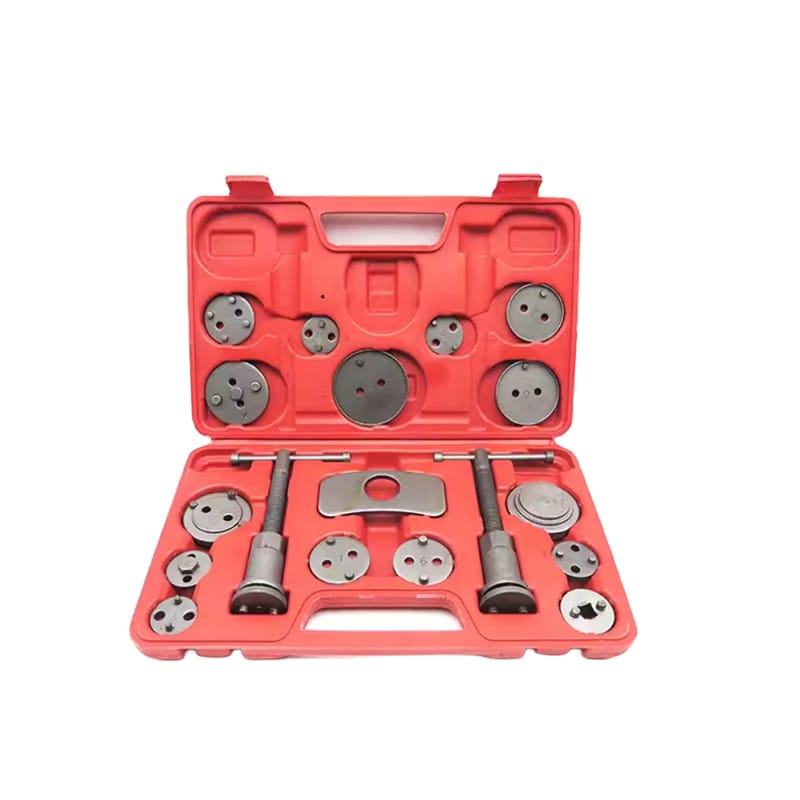
Un conjunto práctico normalmente incluye:
- Un husillo roscado a la derecha
- Un husillo roscado izquierdo cuando se requiere una cobertura más amplia
- Una o más placas de reacción
- Discos adaptadores con diferentes espacios entre pasadores y patrones de caras
- Un mango, barra en T, accionamiento hexagonal o extremo operativo compatible con trinquete
- Un estuche moldeado con tabla de identificación del adaptador
El número de adaptadores sólo es útil cuando cada adaptador corresponde a un patrón de pistón real. Un juego de herramientas de retroceso de pinza de freno más pequeño y claramente mapeado puede ser más útil que un juego más grande lleno de discos casi duplicados.
¿qué es un compresor de pistón para pinza de freno?
Un compresor de pistón empuja el pistón directamente dentro del orificio. Los diseños comunes incluyen una prensa de tornillo con una o dos placas, un esparcidor de trinquete, una prensa de marco fijo o una herramienta de empuje neumática. Estas herramientas son adecuadas para pistones que no necesitan girar.
Un buen compresor distribuye la presión a través de la cara del pistón y ayuda a mantener el pistón cuadrado hasta el orificio. Generalmente es más rápido que una herramienta de retroceso de pinza de freno en pinzas de empuje simples porque no es necesario ningún patrón de adaptador para acoplar el pistón.
Sin embargo, no se debe seleccionar un compresor sólo porque el pistón parezca difícil de mover. La resistencia puede provenir de corrosión, un pistón atascado, una manguera bloqueada, un freno de mano inédito o un procedimiento de servicio incorrecto. Más fuerza no sustituye a identificar el mecanismo.
Herramienta de respaldo de viento para pinza de freno versus compresor de pistón
| Punto de selección | Herramienta de respaldo de viento para pinza de freno | Compresor de pistón |
|---|---|---|
| Movimiento del pistón | Rotación más desplazamiento hacia adentro | Viaje directo hacia adentro |
| Aplicación típica | Pistones atornillados y algunas pinzas de freno de estacionamiento integradas | Pistones de empuje |
| Método de contacto | El adaptador estampado se acopla a la cara del pistón | Pistón de contactos de placa plana o esparcidor |
| Control de dirección | Puede requerir husillo derecho o izquierdo | Generalmente dirección neutral |
| Requisito de adaptador | Alto | Bajo a moderado |
| Principal riesgo de compra | Mal ajuste del adaptador o falta la dirección del husillo | Fuerza desigual o rango de apertura insuficiente |
| Mejor rol de taller | Servicio de pinza trasera mixta | Pinza delantera rápida y servicio push-in estándar |
| Mejor estrategia de distribuidor | Kit de aplicación mapeada | Varias capacidades y estilos de placas |
Ninguna herramienta es universalmente mejor. Un taller que atiende a una población variada de vehículos suele necesitar ambas cosas. Por lo tanto, un distribuidor debe evitar presentar una herramienta de retroceso de la pinza de freno como reemplazo universal para cada compresor de pistón, o una prensa plana como adecuada para cada pinza trasera.
Para obtener una revisión más amplia de la planificación completa del kit, consulte el existente Guía de compra del kit de herramientas para pinzas de freno.
Cómo identificar un pistón de empuje o de retroceso
La identificación correcta debe ocurrir antes de aplicar la fuerza. Las siguientes pistas son útiles, pero la información de servicio del vehículo sigue siendo la referencia final.
Examina la cara del pistón
Una cara de pistón ancha y lisa a menudo indica un diseño de empuje. Dos muescas, múltiples orificios, pasadores o una cara estampada pueden indicar que se requiere un adaptador de herramienta de retroceso de la pinza de freno.
Esta verificación visual es útil pero no absoluta. Algunos diseños utilizan caras inusuales y algunas pinzas fijas de pistones múltiples requieren una herramienta de extensión en lugar de una prensa de tornillo tradicional.
Compruebe el mecanismo de freno de estacionamiento
Es más probable que una pinza trasera con un mecanismo de freno de estacionamiento mecánico integrado utilice un pistón atornillado. La palanca externa, la conexión del cable o el actuador integrado pueden ser una pista de que el pistón tiene un mecanismo de ajuste interno.
Confirme la información del servicio
Nunca elija la dirección o el adaptador únicamente por su apariencia cuando la aplicación no esté familiarizada. Confirmar:
- Si el pistón empuja o gira
- La dirección de giro requerida
- Si ambos lados usan la misma dirección
- Si se requiere un modo de servicio de freno de estacionamiento electrónico
- La orientación correcta del pistón después de la retracción
- Cualquier procedimiento específico de manipulación de líquidos o sangrado
Esto es especialmente importante para los distribuidores de herramientas que crean gráficos de aplicaciones. Un gráfico confiable debe basarse en datos de ajuste verificados, no copiados de otro conjunto genérico.
Por qué la geometría del adaptador es más importante que el tamaño del kit
El adaptador es la interfaz de trabajo entre la herramienta de retroceso de la pinza de freno y el pistón. Si los pasadores son demasiado pequeños, demasiado grandes, demasiado cercanos o demasiado separados, el adaptador puede asentarse en el borde del hueco en lugar de engancharlo completamente.
Un compromiso deficiente crea varios problemas:
- El adaptador puede deslizarse bajo carga.
- La cara del pistón puede marcarse o deformarse.
- La funda guardapolvo se puede pellizcar con un disco inclinado.
- El técnico podrá compensar con fuerza excesiva.
- El kit puede parecer compatible en papel pero fallar en servicio real.
Los compradores profesionales deben evaluar el diámetro del pasador, la altura del pasador, la tolerancia al espaciado, la planitud del disco y la seguridad con la que el disco se conecta al eje. La herramienta de retroceso de la pinza de freno también debe mantener el disco centrado a medida que avanza el eje.
Una prueba de muestra útil
Durante la evaluación del producto, pruebe varios adaptadores en patrones de pistón representativos. Aplique una carga operativa moderada y verifique si el disco permanece completamente asentado durante múltiples vueltas.
Registre cualquier balanceo, deslizamiento, flexión o deformación del pasador. Esta simple prueba es más informativa que contar cuántos discos hay en el estuche.
Explicación de los husillos derecho e izquierdo
Muchos juegos de herramientas de retroceso de pinza de freno incluyen dos husillos porque algunas aplicaciones requieren direcciones de giro opuestas. Un husillo derecho avanza en el sentido normal de las agujas del reloj, mientras que un husillo izquierdo avanza en la dirección opuesta de la rosca.
El punto importante no es que todos los vehículos utilicen ambos. El valor es que un taller de aplicaciones mixtas puede mantener la presión hacia adentro mientras gira el pistón en la dirección especificada.
Un kit debe identificar claramente la dirección del husillo:
- Marcas permanentes
- Diferentes colores de mango
- Flechas grabadas
- Separe las posiciones de las cajas moldeadas
- Un cuadro de instrucciones impreso
Los husillos sin marcar aumentan el tiempo de configuración y aumentan la probabilidad de errores operativos. Para el embalaje OEM, la identificación de dirección debe aparecer tanto en la herramienta como en el manual.
Los sistemas de freno de estacionamiento electrónico necesitan un flujo de trabajo diferente
Un freno de estacionamiento electrónico cambia el proceso de servicio. Dependiendo del sistema, es posible que sea necesario mover el actuador al modo de servicio mediante una función de diagnóstico, una secuencia de menú del vehículo o un procedimiento manual específico antes de que comience la retracción del pistón.
Una herramienta de retroceso de la pinza de freno no puede reemplazar ese paso electrónico. Si el actuador permanece acoplado, forzar el pistón puede sobrecargar los engranajes internos o crear una posición de ajuste incorrecta.
La regla más segura es simple: confirme el procedimiento de servicio aprobado antes de usar cualquier herramienta de retracción mecánica en una pinza trasera controlada electrónicamente.
Después del servicio, algunos sistemas también requieren un ciclo de inicialización, calibración o aplicación y liberación. Los proveedores de herramientas deben dejar clara esta limitación. Un kit mecánico puede ser parte del flujo de trabajo, pero no es automáticamente una solución completa para cada aplicación electrónica del freno de mano.
Cómo los talleres deben elegir la configuración de herramienta adecuada
Un taller debe seleccionar herramientas según los vehículos y trabajos que realmente realiza.
Taller de reparación general
Un taller de reparación mixto se beneficia de:
- Un compresor de pistón estándar
- Un juego de herramientas de retroceso de pinza de freno con cobertura de adaptador verificada
- Ambas direcciones del husillo cuando sea necesario
- Una herramienta de extensión de múltiples pistones
- Un gancho de soporte para pinza
- Una configuración de purga de frenos o control de líquido
- Información clara de la aplicación
Taller de flota
Las operaciones de flota a menudo pueden utilizar una selección más limitada porque se conoce la población de vehículos. En lugar de comprar el juego de herramientas de retroceso de cuerda con pinza de freno más grande, el taller puede priorizar los adaptadores exactos, el rango de apertura y el estilo de husillo necesarios para la flota.
Este enfoque reduce los componentes no utilizados, simplifica la capacitación de los técnicos y facilita la gestión del inventario de reemplazo.
Técnico Móvil
El almacenamiento compacto y la identificación rápida son más importantes en el trabajo móvil. Un kit conciso con adaptadores etiquetados, una carcasa resistente y un husillo compatible con trinquete puede reducir el tiempo de configuración.
Los discos sueltos sin una identificación clara son una mala opción para el servicio móvil porque es posible que los adaptadores faltantes o mixtos no se noten hasta que el vehículo ya esté desmontado.
Centro de formación
Los entornos de entrenamiento necesitan marcas visibles y un funcionamiento repetible. La herramienta de retroceso de la pinza de freno debería facilitar la demostración del acoplamiento correcto, el control de la presión, la dirección del husillo y la diferencia entre los pistones de empuje y de atornillado.
Explora el completo Categoría de herramientas de freno al planificar un surtido de talleres o distribuidores.
Qué deben inspeccionar los distribuidores y compradores OEM
Para los compradores de B2B, la calidad del producto no se define únicamente por si una muestra completa un trabajo de freno. La verdadera pregunta es si la herramienta sigue siendo consistente en todos los lotes de producción y si el kit puede explicarse claramente a los usuarios finales.
Resistencia del husillo y calidad de la rosca
El husillo debe girar suavemente bajo carga sin juego excesivo. Inspeccionar:
- Forma y acabado del hilo
- Estiramiento del husillo
- Manejar conexión
- Ajuste de tuerca o cuello
- Protección de superficies
- Resistencia al irritamiento
- Consistencia entre múltiples muestras
Una herramienta de retroceso de la pinza de freno con roscas rugosas puede parecer aceptable cuando se descarga, pero se atasca una vez que aumenta la presión axial.
Estabilidad de la placa de reacción
La placa de reacción debe asentarse firmemente contra la abertura de la pinza sin flexión excesiva. Verifique el espesor de la placa, las dimensiones de la ranura, el acabado del borde y la compatibilidad con el cuerpo del husillo.
Una placa que se dobla bajo carga puede inclinar el husillo y reducir el acoplamiento del adaptador.
Consistencia del adaptador
Mida el espaciado entre pasadores y las dimensiones del disco en varias muestras, no solo en un juego. La identificación del adaptador debe permanecer permanente después de la limpieza y el uso normal en el taller.
Cuando varios discos tienen patrones similares, las marcas deben ser fáciles de leer sin quitar todos los componentes de la carcasa.
Tratamiento superficial
Un acabado protector ayuda a reducir la corrosión durante el almacenamiento y el servicio. Los compradores deben confirmar la consistencia del recubrimiento, los bordes expuestos, las áreas roscadas y si el acabado interfiere con el ajuste del adaptador.
La apariencia de la superficie no debe usarse como sustituto del control del material, la precisión dimensional o las pruebas funcionales.
Control de Casos e Inventario
Una caja moldeada es parte de la función del producto. Debería:
- Sujete cada pieza de forma segura
- Muestre los componentes faltantes inmediatamente
- Separe los husillos izquierdo y derecho
- Posiciones del adaptador de etiquetas
- Sobrevivir a repetidas aperturas y transportes
- Permitir marcas personalizadas sin ocultar información técnica
Para los distribuidores, un estuche bien diseñado puede reducir los retornos causados por adaptadores perdidos o una organización poco clara del kit.
Documentación
Las instrucciones deben explicar la lógica de selección, no simplemente decir “elija el adaptador correcto”. Un manual profesional debe cubrir la identificación del pistón, el acoplamiento del adaptador, la dirección del husillo, la presión controlada, las limitaciones del freno de estacionamiento electrónico y las comprobaciones posteriores al servicio.
Las empresas que desarrollen una gama más amplia de marcas privadas pueden revisar Herramientas para vehículos Fengjie y contacta con el equipo con aplicaciones de destino, requisitos de embalaje y configuración de kit preferida.
Errores comunes que causan daños a herramientas o calibradores
Uso de un compresor sobre un pistón atornillado
Este es el error de selección más importante. Si el pistón está diseñado para girar, la compresión recta puede sobrecargar el mecanismo interno.
Cuando la resistencia aumente inesperadamente, detenga y verifique el diseño del pistón en lugar de aumentar el apalancamiento.
Seleccionar un adaptador que casi se adapta
Un adaptador que toca las muescas no necesariamente está acoplado. Ambos pasadores deben asentarse completamente y el disco debe permanecer estable a medida que aumenta la presión.
Un adaptador casi correcto puede deslizarse repentinamente y dañar la cara del pistón o la funda circundante.
Girando sin presión hacia adentro
Una herramienta de retroceso de la pinza de freno normalmente debe mantener el contacto mientras gira. Hacer girar el pistón sin un recorrido controlado hacia adentro puede hacer que el adaptador salga de los huecos.
La placa de reacción y el husillo deben permanecer alineados durante toda la operación.
Aplicar fuerza excesiva a un pistón atascado
Un pistón que no se mueve puede tener una falla mecánica o hidráulica. Detenga y diagnostique la causa en lugar de extender el mango o aplicar fuerza de impacto.
Las causas potenciales incluyen corrosión, un mecanismo de freno de mano inédito, dirección incorrecta del husillo, una manguera restringida o daños en la pinza interna.
Ignorar el movimiento del líquido de frenos
Retraer un pistón desplaza el fluido hacia el depósito. Controle el nivel de líquido y mantenga limpio el sistema hidráulico.
Los materiales de la NHTSA enfatizan que la contaminación o la humedad en el líquido de frenos pueden reducir el rendimiento de frenado y contribuir a la corrosión, por lo que el manejo del líquido debe tratarse como parte del servicio y no como una ocurrencia tardía.
Permitir que el calibrador cuelgue de la manguera
Apoye la pinza de forma independiente. La manguera del freno es un componente hidráulico, no un punto de suspensión.
Un gancho de soporte o un colgador adecuado ayuda a evitar tensiones innecesarias mientras se da servicio a las almohadillas y al pistón.
Un flujo de trabajo de herramienta de retroceso de viento de pinza de freno más seguro
El siguiente flujo de trabajo es una guía de planificación general, no un reemplazo de la información de servicio específica del vehículo.
- Confirme el diseño de la pinza. Identifique si el pistón empuja, gira o requiere modo de servicio electrónico.
- Asegure el vehículo. Utilice los puntos de elevación correctos y el equipo de soporte nominal. Los requisitos de OSHA para gatos enfatizan el soporte de carga y la prevención de deslizamientos.
- Inspeccione la pinza. Verifique el guardapolvo, la manguera, el estado del control deslizante, la cara del pistón y el mecanismo del freno de estacionamiento.
- Apoye la pinza. Evite tensiones en la manguera del freno.
- Revisa el depósito. Controle el nivel de líquido y proteja el área de derrames.
- Seleccione el adaptador. Elija el disco que coincida completamente con el patrón del pistón.
- Seleccione la dirección del husillo. Siga la información de servicio verificada.
- Instale la placa de reacción. Alinee la herramienta de retroceso de la pinza de freno directamente en la pinza.
- Aplicar una ligera presión. Mantenga el adaptador acoplado antes de girarlo.
- Gira lentamente. Esté atento a un desplazamiento suave hacia adentro y deténgase si la resistencia se vuelve anormal.
- Verifique el movimiento del arranque. Asegúrese de que el guardapolvo no esté torcido, pellizcado ni arrancado de su asiento.
- Confirme la posición final del pistón. Algunos pistones necesitan una orientación específica para alinearse con las características de ubicación de la almohadilla.
- Reensamblaje completo. Siga el procedimiento especificado de sujeción, lubricación, purga y freno de estacionamiento.
- Restaurar la función del pedal y del freno de estacionamiento. Realice todas las comprobaciones requeridas antes de utilizar el vehículo.
Creación de una gama completa de herramientas de servicio de frenos
Una herramienta de retroceso de la pinza de freno funciona mejor como parte de una gama de servicios estructurada, no como un SKU aislado. Los distribuidores pueden organizar productos en torno a tareas reales del taller:
- Retracción del pistón
- Extensión de calibrador
- Soporte de pinza
- Sujeción de manguera
- Sangrado de frenos
- Corte y abocardado de líneas de freno
- Perforación del cilindro
- Servicio de sujetadores y resortes
- Inspección y limpieza
Esta estructura basada en tareas ayuda a los compradores a comprender por qué se necesitan múltiples herramientas y crea paquetes de productos más útiles.
Para la preparación de la línea de freno, el Guía del kit de herramientas de doble abocardado explica otra parte importante del servicio de frenos hidráulicos.
Preguntas frecuentes
¿todas las pinzas traseras necesitan una herramienta de retroceso de viento para pinzas de freno?
No. Muchas pinzas traseras usan un pistón atornillado, pero algunas usan un diseño de empuje o un procedimiento de actuador electrónico. Confirme el sistema específico antes de seleccionar la herramienta.
¿puede un compresor de pistón reemplazar una herramienta de retroceso de viento de pinza de freno?
Sólo en un pistón diseñado para compresión recta. Un compresor no proporciona la rotación controlada requerida por un pistón atornillado.
¿por qué un kit Wind-Back incluye muchos discos adaptadores?
Las diferentes caras del pistón utilizan diferentes patrones de pasadores, espacios y formas de rebajes. El adaptador debe encajar de forma segura para girar el pistón sin deslizarlo.
Un distribuidor debe verificar que cada patrón incluido tenga una aplicación definida en lugar de tratar un mayor número de piezas como el principal punto de venta.
¿necesito husillos para la mano izquierda y para la derecha?
Un taller de aplicaciones mixtas puede necesitar ambos. Una flota con una autonomía de vehículos limitada puede necesitar sólo la dirección especificada para esos vehículos.
Ambos husos deben identificarse de forma permanente y visible.
¿se puede utilizar la misma herramienta de retroceso de viento con pinza de freno en frenos de estacionamiento electrónicos?
A veces, la herramienta mecánica se utiliza después de poner el sistema en modo de servicio, pero el procedimiento electrónico varía. Siempre verifique primero la información de servicio aprobada.
No asuma que el movimiento mecánico del pistón restablece automáticamente el actuador electrónico.
¿qué debo hacer si el pistón no se mueve?
Deja de aplicar fuerza. Verifique la liberación del freno de estacionamiento, la dirección del husillo, el ajuste del adaptador, la corrosión del pistón, la restricción de la manguera, la trayectoria del fluido y el procedimiento de servicio correcto.
No se debe utilizar una herramienta para dominar una falla que no ha sido diagnosticada.
¿es suficiente una herramienta estilo cubo para uso profesional?
Un cubo puede adaptarse a algunos patrones de pistón, pero no proporciona la misma presión guiada, estabilidad o rango de adaptador que un juego completo de herramientas de retroceso de pinza de freno.
Puede ser adecuado para una aplicación limitada conocida, pero es menos práctico para cobertura de talleres mixtos.
¿qué es lo más importante a la hora de adquirir un kit de respaldo para el viento?
Priorice el ajuste verificado del adaptador, la calidad del husillo, la identificación de la dirección, la estabilidad de la placa de reacción, el almacenamiento duradero, las instrucciones claras y la consistencia del lote.
Conclusión
La elección entre un compresor de pistón y un herramienta de retroceso de viento para pinza de freno debería comenzar con el mecanismo de la pinza, no con la caja de herramientas. Los pistones de empuje rectos necesitan una fuerza lineal controlada. Los pistones atornillados necesitan rotación y presión hacia adentro juntos. Los sistemas electrónicos de freno de estacionamiento pueden agregar un paso en modo de servicio que ninguna herramienta mecánica puede reemplazar.
Para los talleres, la configuración más práctica suele combinar un compresor confiable con un kit de herramientas de retroceso de pinza de freno bien mapeado. Para distribuidores y compradores OEM, el producto más potente no es necesariamente el kit con más piezas. Es el kit con adaptadores precisos, carga estable, direcciones del husillo claramente marcadas, fabricación consistente e instrucciones que ayudan a los usuarios a elegir correctamente.
Para analizar configuraciones de herramientas de servicio de frenos, suministro mayorista o embalaje personalizado, envíe los requisitos de su solicitud a Herramientas Fengjie.