
Table of Contents
A magnetic tool tray can stick firmly to a steel cabinet and still slide when it is loaded. The magnet's attraction pulls toward the surface; it does not make the tray immune to gravity, vibration or a sideways knock. Surface material, contact area, position and the contents all affect how secure it feels.
If your tray keeps moving, empty it before experimenting. Then work through the mounting surface and the contact between them. That is more useful than immediately buying a stronger magnet or assuming the tray is defective. Sometimes the real solution is to lay the tray flat, move it to another part of the trolley, or stop using an open tray to carry heavy tools.
Start with the surface, not the tray
Many workshop cabinets are steel, but not every metal panel is magnetic. Aluminium panels will not provide the same attachment, and stainless steel varies. A surface can also be a thin decorative skin over another material. Test an empty tray in a safe position rather than judging from the panel's metallic appearance.
The surface may be curved, ribbed or interrupted by seams. Those features can keep the magnet's base from sitting flat. A tray touching only along an edge can appear attached while having much less stable support than expected. Move it to a broad, smooth area if the cabinet offers one.
Thick coatings and debris create distance between the magnet and the steel. You should not remove a cabinet's protective coating to improve the attachment. Instead, clean the contact area using a suitable method and choose a location where the tray naturally sits evenly. If the intended surface remains unsuitable, use the tray on the bench.
Pulling away and sliding down are different tests
Pulling a magnet straight away from a clean steel plate is different from asking a loaded tray to stay on a vertical wall. In the second case, the tray also needs resistance to sliding and tipping. A long tool resting across the rim can pull the tray into an awkward position even if the magnet is strongly attracted to the cabinet.
Treat a published magnetic holding figure as a description tied to its test conditions, not a universal carrying capacity. A rating established with flat, clean steel does not tell you exactly what will happen on painted sheet metal with a curved tool hanging over the edge. Follow any stated limits for the tray and its intended position.
This explains a familiar situation: an empty tray feels difficult to remove, yet creeps down the cabinet after you add several sockets. The attraction has not necessarily disappeared. The loaded arrangement is different. Reducing the load or using a horizontal surface may solve the problem more directly than changing the magnet.
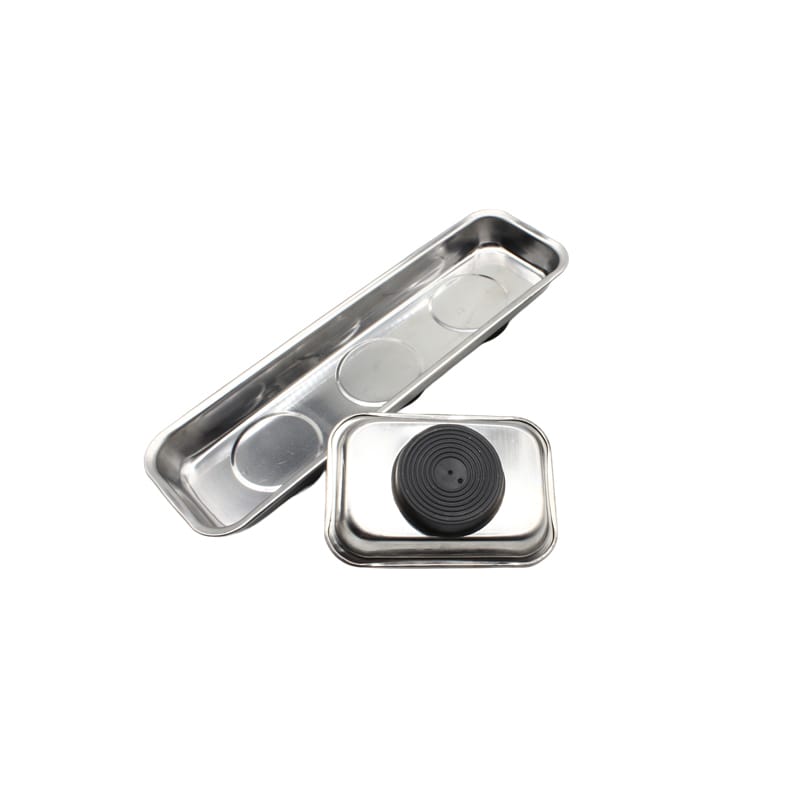
The bowl and base arrangement on Small Rectangle magnetic bowl illustrates why the mounting contact and the storage space should be considered separately. The tray's rim holds loose items when flat; magnetic attraction helps retain suitable hardware. Neither feature turns an open bowl into a secure transport container.
Put it where your movements will not knock it
Avoid drawer fronts, doors and panels you will open repeatedly during the job. A tray attached to a moving drawer may be convenient until the first quick pull scatters its contents. A fixed side panel or the trolley's top is often easier to keep track of, provided it does not interfere with movement around the work.
Keep it out of the path of the tool you are using. A tray near the end of a ratchet swing can receive repeated knocks. A tray close to an air hose may be caught when the hose moves. Before settling on a position, make the normal working movements with the tray empty and look for contact points.
Do not place an open tray above a person or where falling contents could enter machinery. Magnetic retention is not a substitute for a closed container or a properly secured tool-storage system. The same caution applies when moving a trolley across thresholds: the vibration and sudden stops are different from a stationary bench task.
The load should stay low and visible
A layer of screws and washers is easier to manage than a heap of sockets, spanners and fasteners. Heavy or tall objects can change the tray's balance, while stacks prevent the lower parts from making predictable contact. A tool that bridges the bowl may also press against the rim rather than resting securely inside.
If you need storage for full-size hand tools, use a holder intended for them. A magnetic bowl is mainly a convenient place for loose parts during a task. Trying to turn it into a crowded vertical shelf makes both the tools and the fasteners harder to retrieve.
Take the largest object out before reaching for small pieces underneath. Lifting several magnetic parts together can bring an extra washer along unnoticed, then drop it outside the tray. The solution is often less crowding and a more suitable container, not stronger attraction.
Why it can scratch paint despite a soft base
The covering beneath the magnet reduces direct hard contact, but tiny steel chips can collect against it. When the tray slides, those chips become abrasive points against the paint. A clean-looking rubber surface can still have debris around its edges or embedded in a damaged patch.
Lift the tray to reposition it rather than dragging it. Check both the underside and the mounting surface first. If the protective covering is loose, torn or missing, stop attaching the tray to finished surfaces. A temporary pad is not automatically a good repair because it can affect the contact and may not stay in place.
For a freshly painted panel, delicate finish or customer vehicle, a separate protected bench is the more predictable place for loose hardware. You do not gain much by saving a short reach if the placement creates a risk of cosmetic damage. Keep convenience subordinate to what the surface can tolerate.
| Problem | Quick check | Practical response |
|---|---|---|
| Tray will not attach | Is the panel suitable magnetic steel? | Use another surface or lay it flat |
| Empty tray attaches but loaded tray slides | Is the load high, heavy or uneven? | Reduce the contents and change orientation |
| Tray rocks on the panel | Is the base flat against the surface? | Avoid ribs, seams and curves |
| Paint develops fine scratches | Is debris trapped under the covering? | Clean, inspect and stop sliding the tray |
| Parts fall when the cart moves | Are they weakly magnetic or piled up? | Use a closed container for transport |
A simple placement check before a real job
With the tray empty and low enough that a fall would not cause damage, seat it on the proposed surface. Check for rocking and gentle unintended movement. Then add a small, representative quantity of the hardware you intend to hold. This is a practical placement check, not a way to establish a new load rating.
Observe what happens when you reach for a part and when the nearby drawer or door moves. If normal use disturbs the tray, relocate it before the work starts. Do not keep increasing the test load until it drops; the aim is to find a stable working arrangement, not the failure point.
After the task, remove the contents and wipe away debris. Store the tray where it will not collect grinding dust. Inspect the magnet attachment and covering periodically. A loose base or damaged bowl is a repair or replacement issue; repeated repositioning will not restore its condition.
For examples of workshop holders and related tools, Lisle's pickup and workshop inspection range shows how different tools serve different jobs. A tray holds loose parts nearby; a pickup tool retrieves them from a gap. Choosing the right role is often more effective than demanding that one magnet do everything.
Questions readers ask
Does a stronger magnet always stop a tray sliding?
No. A poor contact surface, awkward loading or repeated knocks can still make the arrangement unstable. Check placement and contents before changing the tray.
Can I attach the tray to an aluminium toolbox?
Not by magnetic attraction to the aluminium itself. Use a suitable steel mounting area where available, or place the tray on a stable horizontal surface.
Why does it stick better in one spot on the same cabinet?
The panel thickness, shape, coatings or supporting structure can differ. One area may let the base sit flat while another contains a seam or curve.
Is a tray safe for carrying small parts around the workshop?
It can help during a stationary task, but an open tray is less secure during movement. Use a lidded, labelled container where tipping or vibration could scatter the contents.
Can I glue a loose magnet back into its base?
Use the manufacturer’s repair guidance. An improvised adhesive joint may not tolerate the repeated pull required to remove the tray from steel, so do not rely on it for elevated mounting.