
Table of Contents
If an adjustable cylinder hone wobbles, stop and check the drive, the moving arms and the stones before trying more pressure. A bent shaft, loose pivot, poorly seated stone or unsuitable setup will not be corrected by tightening the adjustment. Continuing can change the cylinder surface while leaving the original tool problem unresolved.
Some tools use flexible drive arrangements, so visible movement must be interpreted against the manufacturer's design. The useful distinction is between intended flexibility and uncontrolled, uneven contact. This guide helps you inspect the parts of a typical portable adjustable hone and recognise when the tool or the job needs a different approach.
Follow the movement from the drill to the stones
The drill chuck holds the drive. The drive turns the head. The head supports arms or holders that carry the abrasive stones. An adjustment changes how the stones contact the bore. A problem anywhere along that chain can show up at the working end, even when the stones themselves look sound.
Start with the power disconnected. Check that the chuck is gripping the intended part of the drive and that the drive is not visibly bent or damaged. A shaft caught at an angle in the chuck can make the whole head appear defective. Refit only as the tool instructions permit; do not attempt to straighten a damaged shaft by bending it back while it is still attached.
Next inspect the head and arms. They should move through their intended range without one arm catching or lagging behind. Dirt trapped at a pivot, a loose fastener or a distorted holder can produce an uneven shape. Compare the arms with each other rather than judging only whether the head expands at all.
What the adjustment is actually changing
On a spring-loaded portable hone, the adjustment affects the outward loading of the stones. It is not a control that sets the finished cylinder diameter with machine-shop precision. More pressure may increase cutting, but it also changes how the abrasives behave. It does not make an out-of-round cylinder round by definition.
If the tool seems to stop cutting, first ask why. The abrasive may be unsuitable, loaded with material, worn or operating under the wrong conditions. Increasing pressure can mask a symptom long enough to remove more material without producing the desired finish. The tool instructions and the cylinder's permitted process provide the starting point, not the operator's ability to hold the drill against stronger resistance.
An adjustment near its limit also deserves attention. A stated diameter range does not remove the need to check the actual head, stone arrangement and access at that size. Do not force an arm beyond its travel to reach a bore just outside the range. The smallest and largest settings are still bounded by the manufacturer's design.
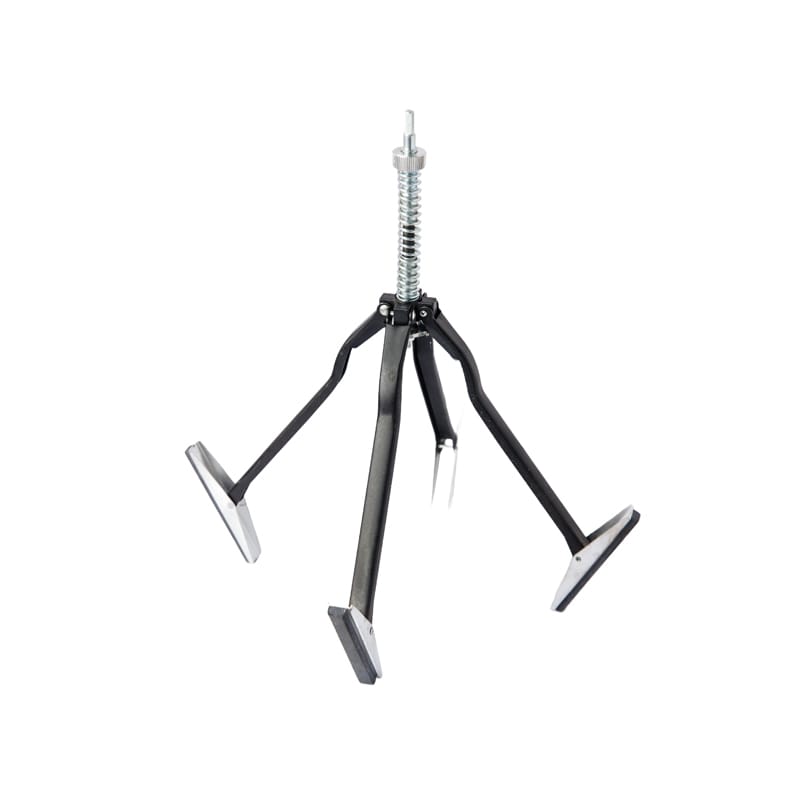
Use the mechanism on 4″ Big Size Cylinder Hone Tool as a visual reference for the kind of features to identify: the drive, expanding head and stone holders. Follow the instructions for the exact model when setting or inspecting them. Two adjustable tools may place their controls differently.
Three stones should not look like three unrelated parts
Look along the abrasive faces. One much shorter or more worn stone can alter the contact. A replacement with a different backing may tilt in its holder. Chipped edges and cracks are reasons to remove the damaged abrasive from service, not cosmetic imperfections to ignore until the next job.
Check that each retainer is fully engaged. A stone that can shift where it should be locked can change position under rotation. Do not compensate with adhesive, wire or a makeshift clip. Correct retention is part of the tool's construction, and an improvised attachment can fail inside the component.
Use the replacement arrangement specified for the hone. Mixing grit grades or combining a new stone with a differently worn set makes it harder to understand the result. If all the stones are correct but contact remains visibly unequal, return to the holders and pivots rather than replacing abrasive after abrasive.
Uneven marks do not always mean the hone is broken
The cylinder may already have uneven wear, damage or a change in material. The operator's movement can also dwell longer in one area. An obstruction may prevent a full, controlled stroke. These possibilities are why the bore should be inspected and measured before honing rather than using the new marks as the first diagnostic test.
Imagine that a narrow band near one end looks different from the rest of the wall. Repeating the pass until that band disappears might remove extra material from the surrounding cylinder without addressing the cause. The band could correspond to a ridge, a different wear pattern or a limit in the tool's travel. Identify it before continuing.
A bore gauge checks dimensional condition; it does not replace the required assessment of surface finish. Likewise, an evenly coloured wall does not substitute for a dimensional check. Keep the two questions separate: is the cylinder the right shape and size, and has the intended surface been produced?
| Symptom | Inspect first | Avoid doing automatically |
|---|---|---|
| Whole head moves off-centre | Chuck seating and drive condition | Increasing pressure |
| One stone contacts differently | Holder, pivot and matched stone set | Replacing only the easiest part |
| Tool catches near an end | Bore shoulder and available travel | Powering through the obstruction |
| Cutting becomes weak | Abrasive condition and specified process | Selecting a coarser stone by guesswork |
| Marks stay uneven despite adjustment | Original bore condition and technique | Repeating passes until every mark vanishes |
Check the setup before blaming your hands
A loose workpiece can move while the tool turns, making it difficult to maintain alignment. Support and hold the component as required for the operation. Do not try to steady a rotating workpiece with your free hand. Also check that the drill body and cable or hose do not force the drive to approach at an angle.
Room for the operator matters. If you cannot see the entry or move through the prescribed travel without hitting the bench, the setup needs changing. A flexible shaft should not be used to justify any approach angle that happens to reach. The permitted alignment and motion still come from the tool's instructions.
Avoid using a valuable cylinder as a way to discover how an unfamiliar adjustment behaves. Learn the mechanism while the tool is disconnected, and use appropriate training or a suitable practice setup before working on a component that must meet a service specification. Practising the hand movement cannot replace learning whether the repair itself is appropriate.
When to retire the tool instead of adjusting it again
A bent drive, unreliable stone retention, distorted arms or persistent looseness can make a portable hone unsuitable for further work. Replace the damaged component only if the tool maker provides the correct service part and procedure. Otherwise replace the tool. A low purchase price is not a reason to accept unstable contact inside a more expensive part.
If the tool checks out but the cylinder remains outside its limits, the next decision concerns the cylinder. It may need controlled machining, a different repair size or replacement. An adjustable hone's convenience should not trap you in a cycle of trying another setting on a job it was never meant to complete.
For context on why surface work and dimensional correction are different, consult MAHLE's cylinder workshop resources. The practical rule for a wobbling portable hone remains simple: stop, locate the movement and correct its cause. Extra pressure is not a diagnosis.
Quick answers
Should an adjustable hone run completely rigidly?
That depends on its drive design. Some flexibility is intentional on certain tools. Uncontrolled movement, unequal stone contact or new vibration should be investigated using the tool’s instructions.
Can I tighten the spring until all three stones touch?
Do not use extra pressure to compensate for a mismatched stone, stuck arm or damaged holder. Check the mechanism and set the tool only within its specified adjustment method.
Why does the hone behave differently at a smaller diameter?
The arm geometry and available clearance change as the head closes. Verify that the diameter, stones and component shape are within the tool’s permitted application.
Can I straighten a bent drive and keep using it?
Do not assume that hand straightening restores a damaged part. Use the manufacturer’s repair guidance or replace the drive or tool with the appropriate component.
Will a finer abrasive solve uneven cutting?
Not if the cause is misalignment, unequal support or an unsuitable bore. Abrasive selection and mechanical condition are separate issues, and both need to be correct.