
Tabla de contenidos
Introducción
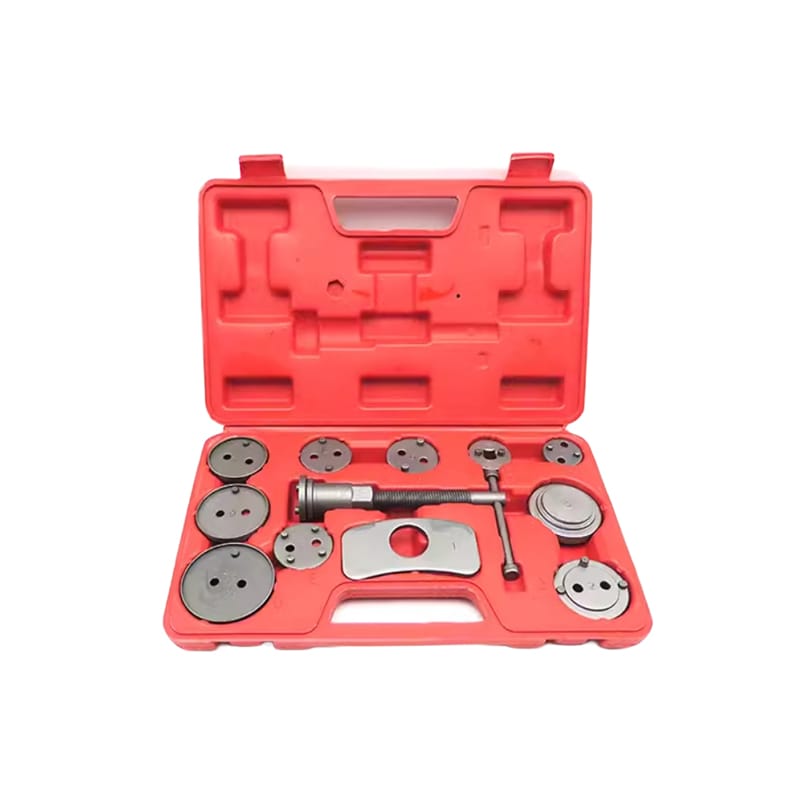
El servicio de frenos es una de las tareas de mantenimiento más comunes en un taller de automoción, pero reemplazar las pastillas de freno no siempre es tan sencillo como quitar las piezas viejas e instalar otras nuevas.
Un paso suele causar problemas: retraer el pistón de la pinza de freno.
A medida que las pastillas de freno se desgastan, el pistón de la pinza se mueve hacia afuera para mantener el contacto con la pastilla. Cuando se instalan pastillas nuevas y más gruesas, el pistón debe volver a moverse hacia la carcasa de la pinza para crear suficiente espacio libre. El correcto herramienta de pinza de freno proporciona presión controlada para este proceso y puede ayudar a prevenir daños al conjunto de pistón, guardapolvo o pinza.
El punto importante es que no todas las pinzas de freno utilizan el mismo método de retracción. Algunos pistones se pueden empujar hacia atrás, mientras que otros deben girarse mientras se aplica presión. Las pinzas traseras con mecanismos de freno de estacionamiento integrados son particularmente importantes porque forzar un pistón roscado hacia atrás puede dañar el mecanismo interno.
Para talleres de automoción, técnicos y distribuidores profesionales de herramientas, elegir la correcta herramienta de pinza de freno por lo tanto, requiere algo más que seleccionar un kit de aspecto universal.
Esta guía explica los principales tipos de herramientas de pinza, cómo funcionan, cómo elegir el diseño correcto y qué deben considerar los profesionales al crear un conjunto de herramientas de servicio de frenos confiable.
¿qué es una herramienta para pinza de freno?
A herramienta de pinza de freno es una herramienta de reparación de automóviles especializada que se utiliza para retraer o comprimir un pistón de pinza de freno durante el servicio de frenos.
La herramienta aplica una presión controlada al pistón para que pueda volver a su orificio.
Esto crea el espacio libre necesario al instalar pastillas de freno nuevas.
Dependiendo del diseño del calibrador, la herramienta puede realizar una de varias acciones:
- Compresión recta
- Empujar hacia atrás
- Rotación
- Rotación y compresión simultáneas
- Extensión multipistón
El objetivo básico es el mismo: mover el pistón de forma controlada sin ejercer tensiones innecesarias sobre los componentes de frenado.
Un profesional herramienta de pinza de freno es especialmente útil porque el pistón debe permanecer correctamente alineado durante la retracción. El uso de alicates inadecuados o un apalancamiento improvisado puede dañar la superficie del pistón o la funda protectora.
Por qué es importante la herramienta de pinza de freno adecuada
A primera vista, retraer un pistón de freno puede parecer una simple tarea mecánica.
En la práctica, el pistón forma parte de un conjunto hidráulico de precisión. A su alrededor hay sellos y componentes protectores que deben permanecer intactos.
Usar el método incorrecto puede llevar a:
- Superficies del pistón dañadas
- Botas guardapolvo rotas
- Mecanismos de pinza dañados
- Movimiento desigual del pistón
- Dificultad para instalar pastillas de freno nuevas
- Trabajos de reparación adicionales
HELLA señala específicamente que herramientas de palanca y alicates inadecuados pueden dañar la carcasa de la pinza, el pistón o la funda protectora contra el polvo.
Es por eso que los técnicos profesionales generalmente seleccionan la herramienta basándose en el diseño real de la pinza en lugar de asumir que un método de compresión funciona para cada vehículo.
Cómo funciona una herramienta de pinza de freno
El principio de funcionamiento es relativamente simple.
Una herramienta típica utiliza un mecanismo roscado para generar presión mecánica controlada.
A medida que se gira el mango o tornillo, la placa de presión se mueve hacia el pistón y lo retrae gradualmente.
Este movimiento controlado tiene varias ventajas.
Primero, reduce la fuerza repentina.
En segundo lugar, mantiene la presión centrada.
En tercer lugar, permite al técnico detener e inspeccionar el pistón durante el proceso.
Para una pinza de empuje estándar, es posible que la herramienta solo necesite aplicar presión axial.
Para una pinza de retroceso, el mecanismo debe mantener la presión y al mismo tiempo girar el pistón.
La diferencia es crítica.
Por lo tanto, se debe seleccionar una herramienta según el diseño del pistón y no simplemente según el tamaño de la pinza.
Los principales tipos de herramientas para pinzas de freno
Compresor de pistón de pinza de freno
Un compresor de pistón está diseñado para empujar el pistón de la pinza directamente hacia su orificio.
Se usa comúnmente en pinzas donde el pistón se retrae sin girar.
Estas herramientas son relativamente sencillas y pueden ser adecuadas para el reemplazo rutinario de pastillas de freno.
La principal ventaja es la presión controlada y uniforme.
Generalmente es preferible un compresor dedicado a las herramientas improvisadas porque distribuye la fuerza de manera más predecible a través del pistón.
Herramienta de respaldo para viento con pistón de freno
Una herramienta de retroceso está diseñada para pistones que deben girar mientras se retraen.
Este diseño es particularmente importante para muchas pinzas de freno traseras que incorporan mecanismos mecánicos de freno de estacionamiento.
En lugar de simplemente empujar el pistón hacia adentro, la herramienta aplica presión mientras gira el pistón.
La dirección requerida puede variar según el diseño de la pinza.
Por esta razón, los kits profesionales suelen incluir adaptadores y mecanismos para diferentes configuraciones de pistón.
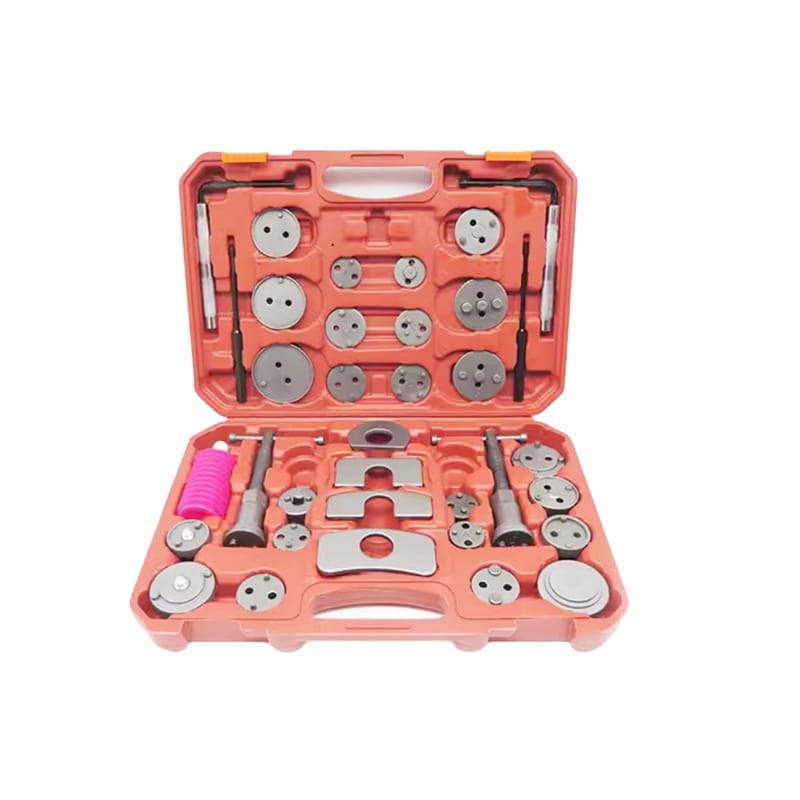
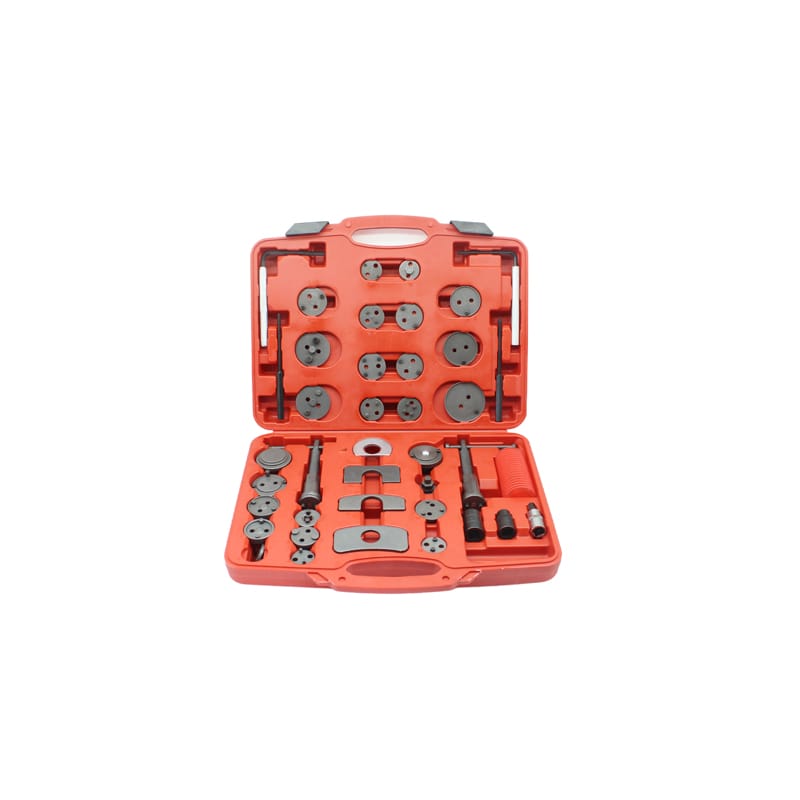
Kits de herramientas de pinza de freno universal
Los kits universales suelen combinar un mecanismo de husillo central con múltiples adaptadores.
Los adaptadores están diseñados para adaptarse a diferentes caras del pistón.
Este tipo de sistema es útil para talleres que dan servicio a una amplia variedad de vehículos.
La ventaja es la flexibilidad.
En lugar de comprar una herramienta separada para cada configuración de calibre, los técnicos pueden seleccionar el adaptador apropiado del kit.
Sin embargo, “universal” nunca debe interpretarse como “funciona sin control”
El adaptador correcto aún debe coincidir con la forma del pistón y el método de retracción requerido.
Herramientas esparcidoras de pastillas de freno
Un esparcidor de pastillas de freno es otro tipo de herramienta que se utiliza durante el servicio de frenos.
Su función generalmente es crear espacio libre aplicando presión a la pinza o pastillas.
Algunos diseños son particularmente útiles para pinzas de pistones múltiples porque pueden distribuir la presión a través de más de un pistón.
El diseño correcto depende de la configuración de la pinza.
Push-Back versus Wind-Back: ¿Cuál es la diferencia?
Esta es una de las distinciones más importantes a la hora de elegir un herramienta de pinza de freno.
Pinzas de empuje hacia atrás
Un pistón de retroceso se mueve directamente hacia la carcasa de la pinza.
La herramienta aplica presión axial.
No se requiere rotación del pistón.
Esta configuración es común en muchas pinzas hidráulicas estándar.
Pinzas de viento
Un pistón de retroceso debe girar a medida que avanza hacia adentro.
Por tanto, la herramienta tiene que realizar dos acciones al mismo tiempo:
presión + rotación
Esta configuración suele estar asociada a pinzas traseras que incorporan mecanismos de freno de estacionamiento.
Intentar empujar dicho pistón directamente hacia adentro con un compresor estándar puede causar daños mecánicos.
HELLA confirma que ciertos pistones del freno trasero deben girarse mientras se empujan hacia atrás y pueden requerir operación en el sentido de las agujas del reloj o en el sentido contrario a las agujas del reloj, según el diseño de la pinza.
Comprender esta diferencia antes de comenzar el trabajo puede ahorrar un tiempo considerable y evitar daños evitables a los componentes.
Cómo elegir la herramienta de pinza de freno adecuada
Seleccionando el derecho herramienta de pinza de freno comienza identificando el calibrador.
Identifique el tipo de pistón
Antes de seleccionar un adaptador o herramienta, determine si el pistón:
- Empuja hacia atrás
- Requiere rotación
- Requiere rotación y presión simultáneas
- Utiliza múltiples pistones
No asuma que las pinzas delantera y trasera utilizan el mismo mecanismo.
Verifique la cara del pistón
Muchos sistemas de retroceso utilizan ranuras, orificios o muescas específicas en la cara del pistón.
El adaptador debe enganchar estas funciones de forma segura.
Un adaptador mal ajustado puede deslizarse y dañar la cara del pistón.
Considere la cobertura del adaptador
Para talleres profesionales, un kit con múltiples adaptadores puede proporcionar una mayor flexibilidad.
Esto es particularmente útil cuando el taller da servicio a diferentes plataformas de vehículos.
Un bien herramienta de pinza de freno el kit debe facilitar la identificación e instalación del adaptador correcto.
Evaluar la calidad del hilo y del mecanismo
El husillo roscado es el encargado de generar la presión mecánica.
Debe funcionar sin problemas y mantener un movimiento estable bajo carga.
Las roscas rugosas o mal fabricadas pueden hacer que la retracción del pistón sea menos predecible.
Considere manejar la ergonomía
El servicio de frenos implica giros repetidos y aplicación de presión.
Un mango cómodo puede mejorar el control y reducir la fatiga innecesaria de las manos.
Para los talleres profesionales, la ergonomía cobra cada vez más importancia cuando la misma herramienta se utiliza repetidamente a lo largo del día.
Cómo utilizar correctamente una herramienta de pinza de freno
El procedimiento exacto de servicio de frenos depende del diseño del vehículo y de la pinza, por lo que las instrucciones de reparación del fabricante del vehículo siempre deben tener prioridad.
La siguiente es una descripción general del funcionamiento de la herramienta.
Asegure el vehículo
Antes de comenzar a trabajar con los frenos, asegúrese de que el vehículo esté correctamente apoyado y no pueda moverse inesperadamente.
Utilice el equipo de seguridad adecuado del taller y siga el procedimiento de servicio del fabricante del vehículo.
Retire la pinza o las almohadillas según sea necesario
Accede al pistón según el diseño específico del freno.
No permita que la pinza cuelgue de la manguera del freno.
Inspeccionar el pistón
Antes de retraer el pistón, comprobar su estado.
Așteaptă:
- Botas guardapolvo dañadas
- Corrosión
- Movimiento desigual
- Contaminación
- Daños mecánicos visibles
Si el pistón o la bota ya están dañados, simplemente forzarlo hacia atrás con una herramienta no resolverá el problema subyacente.
Seleccione el adaptador correcto
Para un sistema de retroceso, seleccione el adaptador que coincida con la cara del pistón.
Asegúrese de que el adaptador esté completamente acoplado.
Aplique presión controlada
Para un pistón de empuje hacia atrás, gire la herramienta gradualmente para aplicar presión centrada.
Para un pistón de retroceso, mantenga la presión mientras gira en la dirección especificada para la pinza.
Nunca fuerces un pistón simplemente porque no se mueve como se esperaba.
Si la resistencia parece anormal, detenga y verifique el tipo de herramienta y el procedimiento.
Inspecciona la bota antipolvo
Después de retraer el pistón, inspeccione nuevamente la bota.
Asegúrese de que no se haya torcido, desgarrado ni desplazado.
Continúe con el servicio de frenos
Una vez que el pistón se haya retraído correctamente y se hayan inspeccionado los componentes del freno, continúe de acuerdo con el procedimiento de reparación específico del vehículo.
Después del reensamblaje, se debe revisar cuidadosamente el sistema de frenos antes de que el vehículo vuelva a su funcionamiento normal.
Errores comunes al utilizar una herramienta de pinza de freno
Uso de una herramienta de empuje en un pistón Wind-Back
Este es uno de los errores más graves.
Si el pistón está diseñado para girar, empujarlo directamente hacia atrás puede dañar el mecanismo interno del freno de mano.
Identifique siempre primero el diseño de la pinza.
Usando el adaptador incorrecto
Un adaptador que no coincida correctamente con la cara del pistón puede deslizarse.
Esto puede dañar el pistón y dificultar la reparación.
Aplicando fuerza excesiva
Un pistón que se niega a retraerse puede indicar un problema con la herramienta, el adaptador, el pistón o la pinza.
Más fuerza no es necesariamente la solución.
Ignorando la bota para el polvo
El maletero protege el pistón y la pinza de la contaminación.
Si se rompe o se desplaza durante la retracción, el conjunto del freno puede requerir atención adicional.
Suponiendo que todas las pinzas traseras funcionen de la misma manera
Los diseños de los frenos traseros varían significativamente.
Algunos requieren compresión recta mientras que otros requieren operación de retroceso.
Siempre se debe verificar el procedimiento correcto para el vehículo específico.
Herramientas de pinza de freno para sistemas multipistón
Los sistemas de frenos más grandes y orientados al rendimiento pueden utilizar varios pistones.
En estas aplicaciones, la presión desigual puede convertirse en una preocupación importante.
Es posible que una herramienta que aplica presión a un solo pistón no proporcione el control deseado.
Los diseños de esparcidores especializados pueden aplicar fuerza a través de múltiples pistones o almohadillas de manera más uniforme.
Esto puede hacerlos útiles en talleres profesionales que dan servicio a diferentes configuraciones de frenos.
La consideración clave no es simplemente el número de pistones. Así es como se diseña la pinza para retraerse y cómo la herramienta transfiere fuerza.
Creación de un kit de herramientas de servicio de frenos
Un kit de herramientas de servicio de frenos profesional puede contener varias herramientas complementarias.
| Categoría de herramienta | Aplicación principal |
|---|---|
| Compresor de pistón de pinza de freno | Pistones rectos de empuje hacia atrás |
| Herramienta de retroceso | Pistones traseros giratorios |
| Conjunto de adaptadores | Diferentes diseños de caras de pistón |
| Esparcidor de pastillas de freno | Creando espacio libre para la almohadilla |
| Herramientas manuales de servicio de frenos | Eliminación de calibradores y componentes |
| Herramientas de inspección | Comprobación del estado del pistón y de los componentes del freno |
Para talleres que atienden una amplia gama de vehículos, un adaptador múltiple herramienta de pinza de freno el sistema puede proporcionar una flexibilidad útil.
El objetivo no es recolectar el mayor número posible de herramientas. Es tener disponible el mecanismo adecuado cuando el diseño de la pinza lo requiera.
Qué deben buscar los compradores profesionales de herramientas
Los talleres de reparación y distribuidores de herramientas automotrices deben evaluar más que la cantidad de adaptadores incluidos en un kit.
Durabilidad
El mecanismo central debe soportar cargas mecánicas repetidas.
Ajuste del adaptador
Los adaptadores deben encajar firmemente con la cara del pistón.
Operación suave
Un husillo liso facilita la aplicación de presión controlada.
Almacenamiento y organización
Un kit claramente organizado ayuda a los técnicos a identificar rápidamente el adaptador correcto.
Rango de aplicación
Un conjunto profesional útil debería cubrir los tipos de vehículos y diseños de pinzas más relevantes para el mercado objetivo.
Reemplazo y soporte
Para los compradores profesionales, la disponibilidad de componentes de repuesto y el soporte de los proveedores pueden ser tan importantes como el diseño inicial de la herramienta.
Las empresas que buscan soluciones de herramientas de reparación de automóviles pueden hacerlo póngase en contacto con las herramientas Fengjie discutir requisitos y aplicaciones de herramientas específicas.
Por qué los talleres profesionales deberían evitar métodos improvisados
Los métodos improvisados pueden parecer convenientes cuando una herramienta dedicada no está disponible.
Sin embargo, los componentes de los frenos son críticos para la seguridad.
HELLA advierte específicamente que herramientas de palanca y alicates inadecuados pueden dañar los componentes de la pinza.
Un profesional herramienta de pinza de freno proporciona un método más controlado para aplicar presión.
Esto no elimina la necesidad de conocimientos técnicos. En cambio, le brinda al técnico una interfaz mecánica diseñada para la tarea.
La combinación del equipo correcto y el procedimiento correcto es lo que produce una reparación confiable.
Herramientas de pinza de freno y el futuro del servicio de frenos
Los sistemas de frenos siguen evolucionando.
Los vehículos modernos pueden incluir:
- Frenos de estacionamiento electrónicos
- Pinzas multipistón
- Conjuntos de frenos más compactos
- Controles electrónicos avanzados
- Diferentes mecanismos de pistón
Los frenos de estacionamiento electrónicos son particularmente relevantes porque el sistema de frenos puede implicar procedimientos de servicio electrónicos además de la retracción mecánica del pistón.
Esto significa que los futuros técnicos de frenos necesitarán cada vez más comprender tanto la selección de herramientas mecánicas como los procedimientos de servicio específicos del vehículo.
A herramienta de pinza de freno por lo tanto, sigue siendo una parte importante del conjunto de herramientas del taller, pero debe verse como un componente de un proceso de servicio de frenos más amplio.
Preguntas frecuentes
¿Qué hace una herramienta de pinza de freno?
A herramienta de pinza de freno retrae o comprime el pistón de la pinza de freno para crear suficiente espacio para la instalación de las pastillas de freno y el servicio de frenos relacionado.
¿Todos los pistones de las pinzas de freno empujan hacia atrás?
No. Algunos pistones se retraen directamente, mientras que otros requieren rotación mientras se aplica presión. Las pinzas traseras con mecanismos de freno de estacionamiento integrados pueden requerir una herramienta de retroceso.
¿Puedo usar alicates en lugar de una herramienta para pinza de freno?
Los alicates improvisados o las herramientas de palanca inadecuadas pueden dañar el pistón, la pinza o el guardapolvo. Una herramienta dedicada proporciona una presión más controlada.
¿Por qué es necesario girar un pistón de freno?
Algunas pinzas traseras utilizan un mecanismo interno roscado conectado con la función de freno de mano. Estos pistones deben girar a medida que se retraen en lugar de simplemente empujarse hacia adentro.
¿Es una herramienta de pinza de freno universal adecuada para talleres profesionales?
Un kit de adaptadores múltiples puede resultar útil para talleres que dan servicio a diferentes vehículos, siempre que los adaptadores y mecanismos incluidos coincidan con los diseños de pinzas que se encuentran en el taller.
Conclusión
A herramienta de pinza de freno es más que una comodidad durante el reemplazo de las pastillas de freno. Proporciona una fuerza mecánica controlada para retraer los pistones de la pinza y ayuda a los técnicos a evitar daños innecesarios a los componentes sensibles de los frenos.
La consideración más importante es identificar el mecanismo de la pinza antes de seleccionar la herramienta. Los pistones de retroceso estándar requieren un enfoque diferente al de los pistones de retroceso, y los sistemas de pistones múltiples pueden requerir una consideración adicional.
Para talleres profesionales y distribuidores de herramientas automotrices, un bien diseñado herramienta de pinza de freno con adaptadores adecuados, una construcción duradera, un funcionamiento suave y una amplia cobertura de aplicaciones pueden hacer que el servicio de frenos sea más eficiente y consistente.
Elegir la herramienta correcta consiste en última instancia en hacer coincidir el mecanismo de la herramienta con el sistema de frenos, no simplemente en elegir la opción más grande o más fuerte.
Explorar Herramientas Fengjie para herramientas profesionales de reparación de automóviles, o contacta con el equipo para analizar sus requisitos de abastecimiento específicos.