
Table of Contents
Introduction
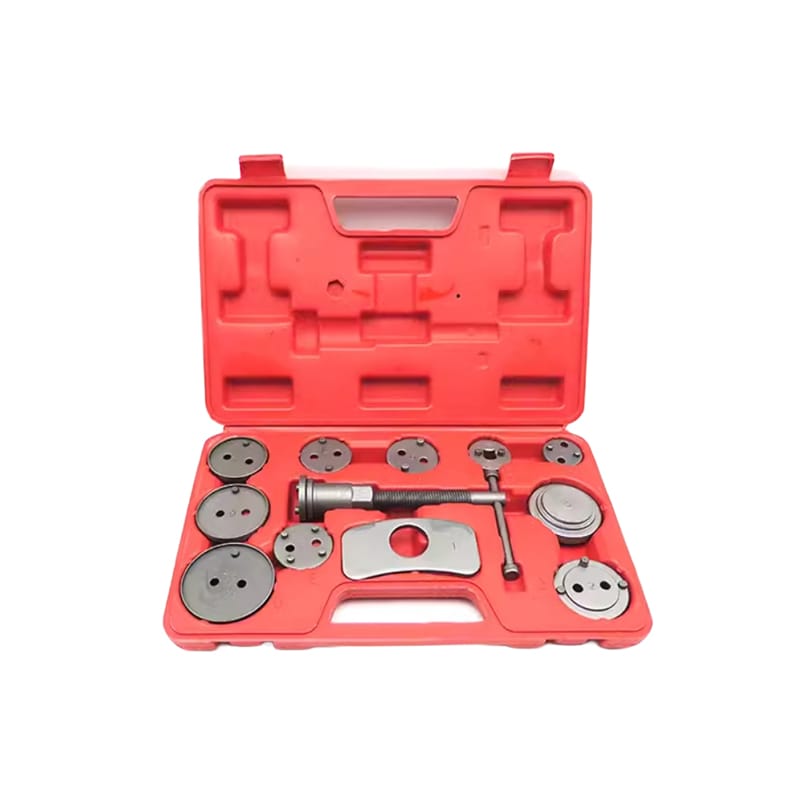
Brake service is one of the most common maintenance tasks in an automotive workshop, but replacing brake pads is not always as straightforward as removing the old parts and installing new ones.
One step often causes problems: retracting the brake caliper piston.
As brake pads wear, the caliper piston moves outward to maintain contact with the pad. When new, thicker pads are installed, the piston must be moved back into the caliper housing to create enough clearance. The correct brake caliper tool provides controlled pressure for this process and can help prevent damage to the piston, dust boot, or caliper assembly.
The important point is that not every brake caliper uses the same retraction method. Some pistons can be pushed straight back, while others need to be rotated while pressure is applied. Rear calipers with integrated parking-brake mechanisms are particularly important because forcing a threaded piston straight back can damage the internal mechanism.
For automotive workshops, technicians, and professional tool distributors, choosing the correct brake caliper tool therefore requires more than selecting a universal-looking kit.
This guide explains the major types of caliper tools, how they work, how to choose the right design, and what professionals should consider when building a reliable brake service toolkit.
What Is a Brake Caliper Tool?
A brake caliper tool is a specialized automotive repair tool used to retract or compress a brake caliper piston during brake service.
The tool applies controlled pressure to the piston so that it can move back into its bore.
This creates the clearance required when installing new brake pads.
Depending on the caliper design, the tool may perform one of several actions:
- Straight compression
- Push-back
- Rotation
- Simultaneous rotation and compression
- Multi-piston spreading
The basic objective is the same: move the piston in a controlled manner without placing unnecessary stress on the braking components.
A professional brake caliper tool is especially useful because the piston needs to remain properly aligned during retraction. Using unsuitable pliers or improvised leverage can damage the piston surface or protective boot.
Why the Right Brake Caliper Tool Matters
At first glance, retracting a brake piston may seem like a simple mechanical task.
In practice, the piston is part of a precision hydraulic assembly. Around it are seals and protective components that must remain intact.
Using the wrong method can lead to:
- Damaged piston surfaces
- Torn dust boots
- Damaged caliper mechanisms
- Uneven piston movement
- Difficulty installing new brake pads
- Additional repair work
HELLA specifically notes that unsuitable levering tools and pliers can damage the caliper housing, piston, or dust protection boot.
This is why professional technicians generally select the tool based on the actual caliper design rather than assuming that one compression method works for every vehicle.
How a Brake Caliper Tool Works
The operating principle is relatively simple.
A typical tool uses a threaded mechanism to generate controlled mechanical pressure.
As the handle or screw is turned, the pressure plate moves toward the piston and gradually retracts it.
This controlled movement has several advantages.
First, it reduces sudden force.
Second, it keeps pressure centered.
Third, it allows the technician to stop and inspect the piston during the process.
For a standard push-back caliper, the tool may only need to apply axial pressure.
For a wind-back caliper, the mechanism must maintain pressure while also rotating the piston.
The difference is critical.
A tool should therefore be selected according to the piston design rather than simply the size of the caliper.
The Main Types of Brake Caliper Tools
Brake Caliper Piston Compressor
A piston compressor is designed to push the caliper piston directly back into its bore.
It is commonly used on calipers where the piston retracts without rotation.
These tools are relatively straightforward and can be suitable for routine brake pad replacement.
The main advantage is controlled, even pressure.
A dedicated compressor is generally preferable to improvised tools because it distributes force more predictably across the piston.
Brake Piston Wind-Back Tool
A wind-back tool is designed for pistons that must rotate while being retracted.
This design is particularly important for many rear brake calipers incorporating mechanical parking-brake mechanisms.
Instead of simply pushing the piston inward, the tool applies pressure while turning the piston.
The required direction can vary depending on the caliper design.
For this reason, professional kits often include adapters and mechanisms for different piston configurations.
Universal Brake Caliper Tool Kits
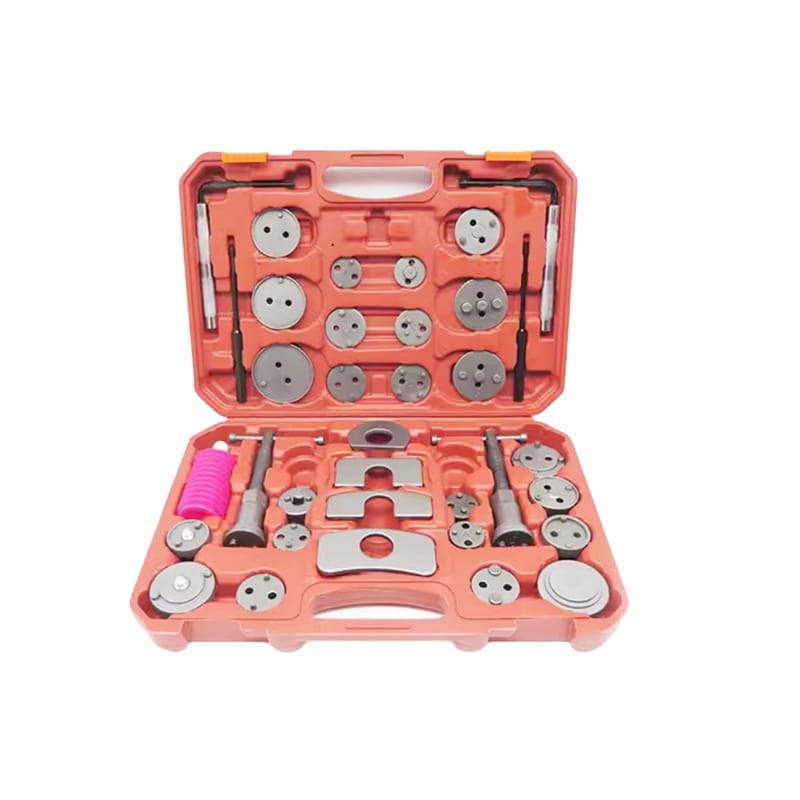
Universal kits typically combine a central spindle mechanism with multiple adapters.
The adapters are designed to match different piston faces.
This type of system is useful for workshops that service a wide variety of vehicles.
The advantage is flexibility.
Instead of purchasing a separate tool for every caliper configuration, technicians can select the appropriate adapter from the kit.
However, “universal” should never be interpreted as “works without checking.”
The correct adapter must still match the piston shape and required retraction method.
Brake Pad Spreader Tools
A brake pad spreader is another type of tool used during brake service.
Its function is generally to create clearance by applying pressure to the caliper or pads.
Some designs are particularly useful for multi-piston calipers because they can distribute pressure across more than one piston.
The correct design depends on the caliper configuration.
Push-Back vs. Wind-Back: What Is the Difference?
This is one of the most important distinctions when choosing a brake caliper tool.
Push-Back Calipers
A push-back piston moves directly into the caliper housing.
The tool applies axial pressure.
No piston rotation is required.
This configuration is common on many standard hydraulic calipers.
Wind-Back Calipers
A wind-back piston needs to rotate as it moves inward.
The tool therefore has to perform two actions at the same time:
pressure + rotation
This configuration is often associated with rear calipers incorporating parking-brake mechanisms.
Trying to push such a piston directly inward with a standard compressor can cause mechanical damage.
HELLA confirms that certain rear brake pistons must be rotated while being pushed back and may require either clockwise or counterclockwise operation depending on the caliper design.
Understanding this difference before starting the job can save considerable time and prevent avoidable component damage.
How to Choose the Right Brake Caliper Tool
Selecting the right brake caliper tool begins with identifying the caliper.
Identify the Piston Type
Before selecting an adapter or tool, determine whether the piston:
- Pushes straight back
- Requires rotation
- Requires simultaneous rotation and pressure
- Uses multiple pistons
Do not assume the front and rear calipers use the same mechanism.
Check the Piston Face
Many wind-back systems use specific grooves, holes, or notches on the piston face.
The adapter must engage these features securely.
A poor-fitting adapter can slip and damage the piston face.
Consider Adapter Coverage
For professional workshops, a kit with multiple adapters can provide greater flexibility.
This is particularly useful when the workshop services different vehicle platforms.
A good brake caliper tool kit should make it easy to identify and install the correct adapter.
Evaluate Thread and Mechanism Quality
The threaded spindle is responsible for generating the mechanical pressure.
It should operate smoothly and maintain stable movement under load.
Rough or poorly manufactured threads can make piston retraction less predictable.
Consider Handle Ergonomics
Brake service involves repeated turning and pressure application.
A comfortable handle can improve control and reduce unnecessary hand fatigue.
For professional workshops, ergonomics become increasingly important when the same tool is used repeatedly throughout the day.
How to Use a Brake Caliper Tool Correctly
The exact brake service procedure depends on the vehicle and caliper design, so the vehicle manufacturer’s repair instructions should always take priority.
The following is a general overview of the tool operation.
Secure the Vehicle
Before beginning brake work, ensure the vehicle is properly supported and cannot move unexpectedly.
Use appropriate workshop safety equipment and follow the vehicle manufacturer’s service procedure.
Remove the Caliper or Pads as Required
Access the piston according to the specific brake design.
Do not allow the caliper to hang from the brake hose.
Inspect the Piston
Before retracting the piston, check its condition.
Look for:
- Damaged dust boots
- Corrosion
- Uneven movement
- Contamination
- Visible mechanical damage
If the piston or boot is already damaged, simply forcing it back with a tool will not solve the underlying problem.
Select the Correct Adapter
For a wind-back system, select the adapter that matches the piston face.
Make sure the adapter is fully engaged.
Apply Controlled Pressure
For a push-back piston, turn the tool gradually to apply centered pressure.
For a wind-back piston, maintain pressure while rotating in the direction specified for the caliper.
Never force a piston simply because it does not move as expected.
If resistance appears abnormal, stop and verify the tool type and procedure.
Inspect the Dust Boot
After retracting the piston, inspect the boot again.
Make sure it has not twisted, torn, or become displaced.
Continue With the Brake Service
Once the piston has been properly retracted and the brake components have been inspected, continue according to the vehicle-specific repair procedure.
After reassembly, the brake system should be checked carefully before the vehicle returns to normal operation.
Common Mistakes When Using a Brake Caliper Tool
Using a Push Tool on a Wind-Back Piston
This is one of the most serious mistakes.
If the piston is designed to rotate, pushing it directly backward may damage the internal parking-brake mechanism.
Always identify the caliper design first.
Using the Wrong Adapter
An adapter that does not properly match the piston face may slip.
This can damage the piston and make the repair more difficult.
Applying Excessive Force
A piston that refuses to retract may indicate a problem with the tool, adapter, piston, or caliper.
More force is not necessarily the solution.
Ignoring the Dust Boot
The boot protects the piston and caliper from contamination.
If it becomes torn or displaced during retraction, the brake assembly may require additional attention.
Assuming All Rear Calipers Work the Same Way
Rear brake designs vary significantly.
Some require straight compression while others require wind-back operation.
The correct procedure should always be verified for the specific vehicle.
Brake Caliper Tools for Multi-Piston Systems
Performance-oriented and larger brake systems may use multiple pistons.
In these applications, uneven pressure can become an important concern.
A tool that applies pressure to only one piston may not provide the desired control.
Specialized spreader designs can apply force across multiple pistons or pads more evenly.
This can make them useful in professional workshops servicing different brake configurations.
The key consideration is not simply the number of pistons. It is how the caliper is designed to retract and how the tool transfers force.
Building a Professional Brake Service Tool Kit
A professional brake service toolkit may contain several complementary tools.
| Tool Category | Main Application |
|---|---|
| Brake caliper piston compressor | Straight push-back pistons |
| Wind-back tool | Rotating rear pistons |
| Adapter set | Different piston face designs |
| Brake pad spreader | Creating pad clearance |
| Brake service hand tools | Caliper and component removal |
| Inspection tools | Checking piston and brake component condition |
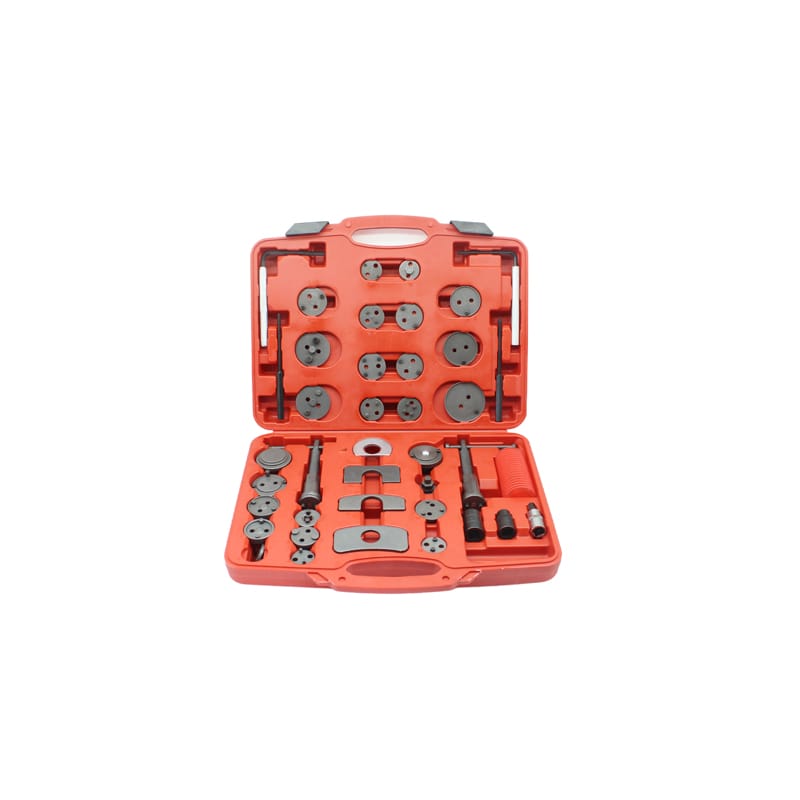
For workshops serving a broad range of vehicles, a multi-adapter brake caliper tool system can provide useful flexibility.
The objective is not to collect the largest possible number of tools. It is to have the right mechanism available when the caliper design requires it.
What Professional Tool Buyers Should Look For
Repair shops and automotive tool distributors should evaluate more than the number of adapters included in a kit.
Durability
The central mechanism should withstand repeated mechanical loads.
Adapter Fit
Adapters should engage securely with the piston face.
Smooth Operation
A smooth spindle makes controlled pressure easier to apply.
Storage and Organization
A clearly organized kit helps technicians identify the correct adapter quickly.
Application Range
A useful professional set should cover the vehicle types and caliper designs most relevant to the target market.
Replacement and Support
For professional buyers, the availability of replacement components and supplier support can be just as important as the initial tool design.
Businesses looking for automotive repair tool solutions can contact Fengjie Tools to discuss specific tool requirements and applications.
Why Professional Workshops Should Avoid Improvised Methods
Improvised methods may appear convenient when a dedicated tool is unavailable.
However, brake components are safety-critical.
HELLA specifically warns that unsuitable levering tools and pliers can damage caliper components.
A professional brake caliper tool provides a more controlled method of applying pressure.
This does not eliminate the need for technician knowledge. Instead, it gives the technician a mechanical interface designed for the task.
The combination of correct equipment and correct procedure is what produces a reliable repair.
Brake Caliper Tools and the Future of Brake Service
Brake systems continue to evolve.
Modern vehicles can include:
- Electronic parking brakes
- Multi-piston calipers
- More compact brake assemblies
- Advanced electronic controls
- Different piston mechanisms
Electronic parking brakes are particularly relevant because the brake system may involve electronic service procedures in addition to mechanical piston retraction.
This means future brake technicians will increasingly need to understand both mechanical tool selection and vehicle-specific service procedures.
A brake caliper tool therefore remains an important part of the workshop toolkit, but it should be viewed as one component of a larger brake service process.
FAQ
What does a brake caliper tool do?
A brake caliper tool retracts or compresses the brake caliper piston to create sufficient clearance for brake pad installation and related brake service.
Do all brake caliper pistons push straight back?
No. Some pistons retract directly, while others require rotation while pressure is applied. Rear calipers with integrated parking-brake mechanisms may require a wind-back tool.
Can I use pliers instead of a brake caliper tool?
Improvised pliers or unsuitable levering tools can damage the piston, caliper, or dust boot. A dedicated tool provides more controlled pressure.
Why does a brake piston need to be rotated?
Some rear calipers use a threaded internal mechanism connected with the parking-brake function. These pistons need to rotate as they retract rather than simply being pushed inward.
Is a universal brake caliper tool suitable for professional workshops?
A multi-adapter kit can be useful for workshops servicing different vehicles, provided the included adapters and mechanisms match the caliper designs encountered in the workshop.
Conclusion
A brake caliper tool is more than a convenience during brake pad replacement. It provides controlled mechanical force for retracting caliper pistons and helps technicians avoid unnecessary damage to sensitive brake components.
The most important consideration is identifying the caliper mechanism before selecting the tool. Standard push-back pistons require a different approach from wind-back pistons, and multi-piston systems may require additional consideration.
For professional workshops and automotive tool distributors, a well-designed brake caliper tool with suitable adapters, durable construction, smooth operation, and broad application coverage can make brake service more efficient and consistent.
Choosing the correct tool is ultimately about matching the tool mechanism to the brake system—not simply choosing the largest or strongest option.
Explore Fengjie Tools for professional automotive repair tools, or contact the team to discuss your specific sourcing requirements.