
A car panel removal tool set can contain four pieces, six pieces, or dozens of individual tools, but a larger number does not automatically make the set more useful. For door panels, dashboard trim, window molding, upholstery clips, speaker covers, and interior access work, the real question is whether each tool shape solves a different problem.
A well-designed car panel removal tool set should help technicians create a clean entry gap, reach hidden fasteners, release clips close to their stems, spread leverage across delicate surfaces, and work around tight corners without turning a screwdriver into the default pry tool. For distributors and private-label buyers, the same principle applies: tool variety, material, edge quality, and application logic matter more than an inflated piece count.
This guide compares compact, mixed, and larger car panel removal tool set configurations, explains which tool profiles matter most, and shows how workshops and B2B buyers can choose a set that fits real automotive repair tasks.
Table of Contents
Why Piece Count Is a Poor Way to Compare Car Panel Removal Tool Sets
The packaging of a car panel removal tool set often emphasizes piece count, but that comparison can be misleading. Several tools may have nearly identical widths, angles, and leverage points, adding little real application coverage.
A useful car panel removal tool set should answer several practical questions:
- Can it create a narrow gap around a switch bezel?
- Can it spread pressure across a large door panel?
- Can it reach a deep clip behind upholstery?
- Can it engage a push fastener close to the stem?
- Can it work around window trim and molding?
- Can it provide a stronger option when a nylon wedge flexes too much?
- Can the tools be organized so the correct profile is easy to find?
For that reason, the first step in choosing a car panel removal tool set is to evaluate functions rather than numbers.
A four-piece set containing four genuinely different profiles can provide better day-to-day coverage than a much larger kit filled with repeated shapes.
The Core Tool Shapes Every Car Panel Removal Tool Set Should Cover
A professional set does not need every possible pry profile, but it should cover the most common access conditions.
Narrow Entry Wedge
A narrow wedge is often the first tool used. Its job is to enter a tight seam around:
- Switch panels
- Speaker covers
- Dashboard bezels
- Door-handle trim
- Window-line molding
- Small decorative caps
The working edge should be thin enough to enter the gap without requiring excessive force.
A car panel removal tool set with only wide tools may work well once a panel is already open, but it can be frustrating at the first entry point.
Wide Panel Wedge
A wide wedge spreads leverage across a larger surface area.
This is useful when separating:
- Door cards
- Large dashboard sections
- Cargo trim
- Interior side panels
- Larger decorative covers
The wider contact area helps reduce local pressure.
The goal is not simply to make the tool stronger. It is to distribute force so the panel backing is less likely to crease or develop a pressure mark.
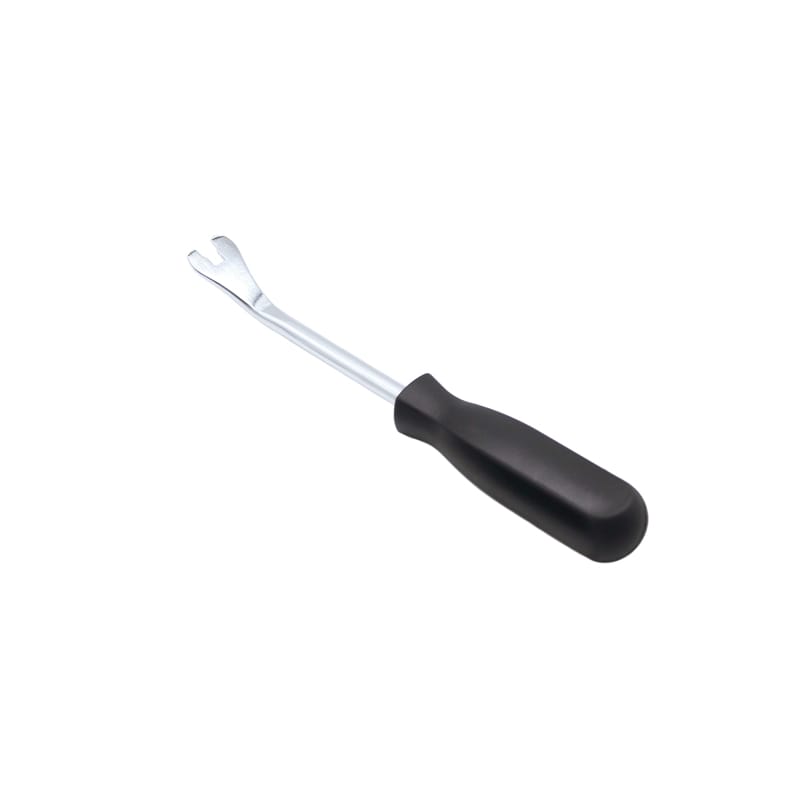
Forked Clip Remover
Once the initial gap is created, the technician often needs to move closer to the actual fastener.
A forked tool can fit around a push clip or retainer stem and apply leverage near the attachment point.
A practical car panel removal tool set should include at least one forked profile if door panels and upholstery clips are part of the intended use.
For a deeper explanation of fork width and fastener engagement, see the Trim Fastener Removal Tool Guide.
Pull-Type Remover
A pull-type or curved remover can create a different leverage direction when a flat wedge cannot approach the clip naturally.
These profiles are useful around:
- Deep door-card clips
- Upholstery fasteners
- Interior panels
- Moldings with recessed retainers
Angled Tool
An angled working end can reach areas where a straight handle would hit another component.
A car panel removal tool set designed for real vehicle interiors should consider handle clearance around doors, dashboards, seats, and consoles.
Stronger Fastener Tool
Plastic tools are useful around delicate surfaces, but some fasteners require greater rigidity.
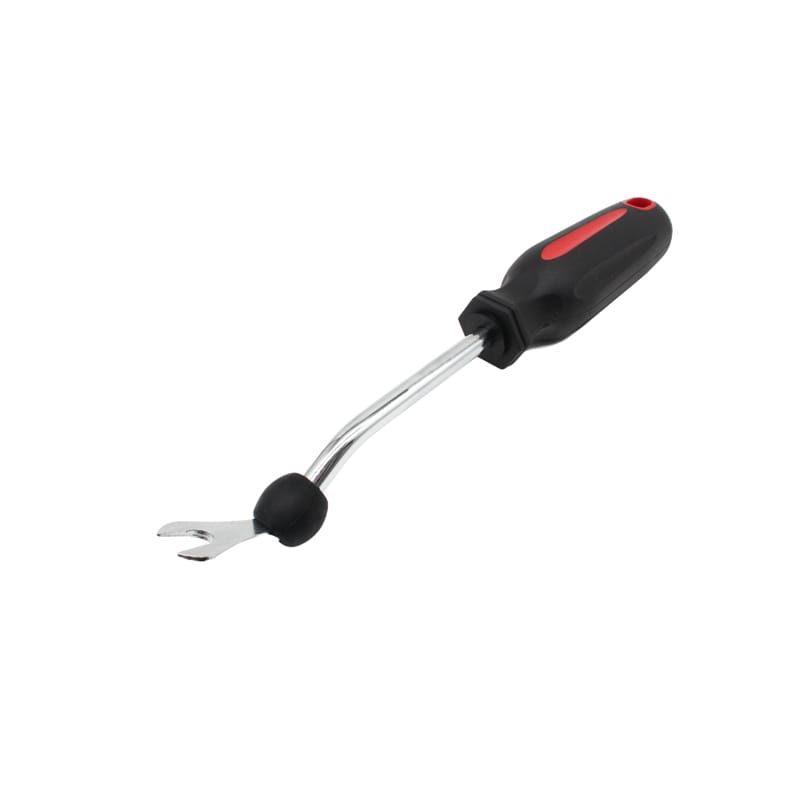
A mixed car panel removal tool set may therefore combine nylon tools with a metal upholstery remover or clip-removal pliers.
This gives the user a low-risk entry tool and a stronger extraction tool without forcing one material to do everything.
4-Piece Car Panel Removal Tool Set: When a Compact Kit Is Enough
A four-piece car panel removal tool set can be very effective when the profiles are genuinely different.
A compact set is well suited to:
- Basic door-panel removal
- Interior accessory installation
- Speaker replacement
- Light dashboard work
- Window switch access
- Occasional trim service
- Mobile technicians who want minimal storage
Fengjie’s 4pcs Plastic Auto Car Door Panel Trim Removal Tools Kit Set includes several functions for interior and exterior trim, including wide-edge, narrow-edge, pull-type, handle-style, and upholstery-clip access.
The advantage of a compact car panel removal tool set is speed and simplicity. Its limitation is coverage: a four-piece kit may not include metal fastener tools, clip pliers, or several fork widths. That can be acceptable for light use, but busy workshops may need more profiles.
A compact kit is therefore not automatically an entry-level product. If the shapes are selected carefully, it can be a highly practical everyday set for customers who already own other automotive hand tools.
6-Piece Car Panel Removal Tool Set: A Better Mixed Workshop Option
A six-piece configuration can bridge the gap between a basic plastic kit and a larger professional set.
Fengjie’s 6 PCS Trim & Upholstery Set combines five nylon trim and upholstery tools with spring-loaded trim clip removal pliers.
This changes the role of the car panel removal tool set.
Instead of providing only different pry shapes, the set gives the user two tool strategies:
- Nylon profiles for visible surfaces and initial access.
- Clip-removal pliers for fasteners that benefit from direct mechanical extraction.
That mixed structure can be useful for workshops handling door panels, upholstery, molding, and interior repair.
A six-piece car panel removal tool set is often a good middle option when the buyer wants broader functionality without moving to a large master kit.
The key advantage is not the two additional pieces. It is the addition of a different removal method.
When a Larger Car Panel Removal Tool Set Makes Sense
Large sets become useful when they add functions rather than duplicates.
A professional workshop, collision repair operation, accessory installer, or tool distributor may want a broader car panel removal tool set that covers:
- Several fork widths
- Long-reach removers
- Multiple wedge thicknesses
- Pick and hook tools
- Clip pliers
- Radio or audio access tools
- Terminal tools
- Molding tools
- Fastener removers
- Scrapers
- Storage and organization
Larger sets are useful when technicians move between door trim, dashboards, molding, upholstery, wiring, and audio work.
Buyers should still ask what each tool does that the others cannot.
If the answer is unclear, the larger car panel removal tool set may be adding marketing value rather than repair value.
For a professional product line, a larger kit works best when the individual tools are grouped logically by task rather than simply arranged to make the case look full.
Plastic, Nylon, PP, and Metal: Material Strategy Matters
The material mix of a car panel removal tool set affects both surface protection and leverage.
Nylon and PP Tools
Nylon and PP tools are commonly used around:
- Door trim
- Dashboard surfaces
- Window molding
- Decorative interior panels
- Switch bezels
- Speaker covers
- Upholstery
Their main advantage is reduced direct metal contact with finished surfaces.
However, material labels alone do not determine quality.
A nylon car panel removal tool set can still perform poorly if the working tips are too thick, the molding has sharp flash, or the tool bends permanently after normal leverage.
Buyers should inspect:
- Tip thickness
- Edge finish
- Flex recovery
- Mold quality
- Fork dimensions
- Surface smoothness
For more detail on material behavior and tool profiles, see the Plastic Trim Removal Tools Guide.
Metal Tools
Metal removers provide higher rigidity and can work better on:
- Tight push clips
- Deep retainers
- Strong upholstery fasteners
- Recessed clips
- Applications where a very thin rigid tip is required
The surrounding panel should be protected, and the tool should be positioned as close as possible to the fastener.
A professional car panel removal tool set often works best when plastic and metal tools are complementary.
The technician can begin with the lower-risk plastic profile and move to the metal tool only when the fastener requires greater rigidity.
How to Match the Set to the Actual Repair Job
A car panel removal tool set should be selected by the most common work the customer performs.
Door Panel and Window Access
For door-panel work, prioritize:
- Narrow entry wedge
- Wide panel tool
- Forked clip remover
- Pull-type remover
- Clip pliers
- Molding tool
This combination helps the technician access window switches, speakers, wiring, latches, and door-glass components.
For the actual removal sequence, the Door Panel Removal Tool Guide provides additional information on hidden fasteners, clip positions, and damage-controlled access.
Dashboard and Audio Work
For dashboard and audio installations, prioritize:
- Thin non-marring tools
- Narrow angled tools
- Small bezel wedges
- Long-reach profiles
- Cable-routing access tools
A bulky metal car panel removal tool set may be less useful here than a compact nylon kit.
Window Molding and Exterior Trim
For door-window trim and molding, prioritize:
- Narrow nylon wedges
- Angled tools
- Forked clip removers
- Controlled metal fastener tools
- Longer molding profiles
Fengjie’s 5pcs Trim Fastener & Molding Removal Tool Kit is intended for window trim, door trim, retaining clips, and molding access.
Collision and Body Repair
Collision work may require broader access because technicians remove:
- Interior door panels
- Pillar trim
- Cargo trim
- Moldings
- Clips
- Fasteners
- Wiring access panels
A larger car panel removal tool set can make sense here, especially when the kit includes both non-marring and stronger extraction tools.
How to Remove a Door Panel With a Car Panel Removal Tool Set
Vehicle-specific service information should always take priority, but a general workflow shows why several tool shapes are useful.
Inspect Before Prying
Look for:
- Screws
- Hidden caps
- Grab-handle fasteners
- Switch panels
- Speaker covers
- Door-handle trim
- Upper hooks
- Electrical connectors
The first job of a car panel removal tool set is controlled access, not maximum force.
Start With the Narrowest Suitable Tool
Use a thin plastic wedge at an appropriate entry point.
Open only enough space to identify the first fastener.
Do not try to remove the entire door card with the first movement.
Move Toward the Clip
Once the fastener is located, move a forked tool closer to the clip stem.
If the panel bends significantly while the clip remains fixed, the leverage point is too far away.
Release One Clip at a Time
Work around the panel rather than pulling one corner aggressively.
Support the panel as it becomes loose.
This keeps the remaining clips, electrical connectors, and latch cables from carrying the full weight.
Check the Final Release Direction
Many door cards hook over the upper door structure near the glass.
After the perimeter clips release, the panel may need to move upward.
A car panel removal tool set cannot protect a panel from being pulled in the wrong direction.
The retention design must still be understood.
Seven Signs a Car Panel Removal Tool Set Is Poorly Designed
Too Many Identical Profiles
If several tools have the same width, angle, and tip geometry, the piece count is misleading.
Working Edges Are Too Thick
A tool that cannot enter a normal trim seam forces the user to create a gap with something else.
Plastic Has Sharp Flash
The main purpose of a non-marring car panel removal tool set is undermined when molding flash creates sharp contact edges.
Fork Sizes Are Not Clearly Different
Different clips require different fork openings.
A set with several forked tools should provide meaningful size variation.
Handles Interfere With Tight Areas
Working geometry must include the handle, not only the tip.
A tool may have an excellent working edge but still be difficult to use in a tight door or dashboard area.
Plastic Deforms Permanently Too Easily
Controlled flex is useful.
Permanent bending after light or normal use is not.
The Case Organizes Tools by Appearance, Not Function
Storage should help the technician identify:
- Narrow entry
- Wide pry
- Clip removal
- Molding
- Long reach
- Strong extraction
A professional car panel removal tool set should save time when the technician needs to switch profiles.
What Workshops Should Check Before Buying
Workshop buyers should judge a car panel removal tool set by daily usability.
Important questions include:
- Can the narrow tools enter modern panel gaps?
- Do the wide tools spread load effectively?
- Are the fork sizes different enough?
- Is there a stronger option for difficult fasteners?
- Do the tools remain comfortable during repeated work?
- Can damaged tools be replaced individually?
- Does the storage system make sense?
The NIOSH Guide to Selecting Non-Powered Hand Tools recommends considering the actual task, grip, force, repetition, and working posture when selecting hand tools.
This is relevant because interior repair often requires repeated leverage in awkward positions; a handle that feels acceptable for one clip may become uncomfortable during a full workday.
A professional car panel removal tool set should therefore be evaluated in actual working positions, not only on a bench.
B2B Quality Checks for Distributors and Private-Label Buyers
For distributors, OEM buyers, and private-label tool brands, appearance is only the first inspection step.
Material Consistency
Confirm the stated material for each tool.
If the set includes nylon, PP, or metal components, the specification should identify them correctly.
Avoid relying only on descriptions such as “premium plastic” or “heavy duty.”
Tip Geometry
Measure representative samples for:
- Tip thickness
- Wedge width
- Fork opening
- Slot depth
- Tool length
- Working angle
A car panel removal tool set depends on small geometric differences.
If those dimensions vary significantly between batches, application consistency suffers.
Surface and Edge Finish
Inspect for:
- Flash
- Burrs
- Warping
- Rough molding lines
- Sharp unintended corners
- Coating defects on metal parts
The working edge should be controlled because it operates directly against trim surfaces.
Flex Recovery
For plastic tools, apply representative working load and check whether the tool returns close to its original shape.
A tool that remains bent may no longer fit the gap or clip correctly.
Handle and Assembly Quality
Where the car panel removal tool set contains multi-material tools, check:
- Shaft-to-handle retention
- Grip movement
- Spring alignment
- Pivot play
- Surface finish
- Repeated-cycle performance
Packaging Accuracy
The packaging should explain what the tools actually do.
A better package says:
- Narrow gap tool
- Wide panel remover
- Clip remover
- Molding tool
- Upholstery remover
rather than relying only on “professional 12-piece set.”
A Practical Sample Test for a Car Panel Removal Tool Set
B2B buyers can evaluate samples using representative trim panels and fasteners.
| Test | What to Check | Why It Matters |
|---|---|---|
| Tight-gap entry | Narrow tip enters without excessive force | Determines real access |
| Wide-panel leverage | Pressure is spread without sharp contact | Helps protect trim |
| Clip engagement | Fork centers around several fastener sizes | Reduces slipping |
| Flex recovery | Plastic returns after normal leverage | Indicates usable material behavior |
| Repeated extraction | Tool survives multiple clip cycles | Reflects workshop use |
| Edge inspection | No new sharp burrs or damage | Protects finished surfaces |
| Handle retention | Grip and shaft remain stable | Supports user control |
| Batch comparison | Several samples have similar dimensions | Supports repeat orders |
| Storage test | Tools remain organized in transport | Improves professional usability |
OSHA’s Hand and Power Tools guidance emphasizes keeping hand tools in safe condition.
For B2B approval, a car panel removal tool set should therefore be evaluated after representative repeated use rather than only when the sample is new.
How Many Pieces Should You Offer in an OEM Product Line?
For a distributor, the best answer may be more than one car panel removal tool set.
A simple product ladder can serve different customers.
Basic 4-Piece Set
Target users include DIY customers, entry-level retail buyers, occasional accessory installers, and light interior repair.
The focus should be essential plastic profiles.
Mixed 6-Piece Set
This structure suits independent workshops, car audio installers, door and window repair, and frequent trim work.
It can combine non-marring profiles with a stronger clip-removal option.
Professional Multi-Profile Set
For body shops, collision repair, high-frequency workshops, and professional installers, add:
- Long-reach tools
- Several fork sizes
- Angled profiles
- Stronger fastener removers
Master Interior Service Set
A master car panel removal tool set can combine trim tools with related interior-access accessories, but every component should have a defined function.
This product ladder is easier to understand than sets that differ only in color or arbitrary piece count.
OEM and Private-Label Opportunities
A car panel removal tool set is well suited to OEM and private-label development because many parts of the product can be differentiated.
Possible customization areas include tool color, material specification, piece count, geometry, fork sizes, handle texture, logo position, storage, retail packaging, barcodes, and multilingual instructions.
Customization should begin with the target application.
A door-and-window service car panel removal tool set should prioritize narrow gap tools, door-panel wedges, clip removers, molding profiles, and a stronger fastener tool.
Dashboard and audio kits may prioritize thinner, smaller, surface-sensitive profiles.
For wholesale, OEM, private-label packaging, or custom kit development, buyers can contact Fengjie Tools with the target market, intended applications, and preferred set structure.
FAQ
What is a car panel removal tool set used for?
A car panel removal tool set is used to remove or separate door panels, dashboard trim, clips, molding, upholstery panels, speaker covers, window trim, and other automotive interior or exterior components.
Is a 4-piece car panel removal tool set enough?
It can be enough for basic door-panel and interior trim work if the four tools have different functions.
Professional workshops may need additional fork sizes, longer tools, or metal clip removers.
Is a larger car panel removal tool set always better?
No.
Functional variety matters more than piece count.
Several identical tools add little application coverage.
Should I choose plastic or metal tools?
A professional car panel removal tool set often benefits from both.
Plastic or nylon tools are useful around visible surfaces, while metal removers can handle tight or deeply seated fasteners.
What tool shape is most important for door panels?
Door-panel work usually benefits from a narrow entry wedge, wide panel tool, forked clip remover, and a stronger fastener-removal option.
Can a car panel removal tool set be used around window trim?
Yes.
Narrow plastic and molding profiles can be useful around door-window trim, weatherstrip, and related clips.
The user should still identify how the molding is retained before applying leverage.
Why do door-panel clips break during removal?
Common causes include prying too far from the clip, hidden screws, incorrect removal direction, brittle fasteners, and tools that do not fit the clip properly.
What should a distributor inspect before bulk ordering?
Check material, tip thickness, fork dimensions, surface finish, flex recovery, handle retention, repeated-use performance, storage, packaging, and batch consistency.
Can car panel removal tool sets be customized for private label?
Yes.
Depending on manufacturing capability, buyers can specify tool colors, kit combinations, logos, cases, retail packaging, labels, barcodes, and instruction materials.
Conclusion
A car panel removal tool set should be selected by function, not by the biggest number printed on the case.
A compact four-piece kit can be ideal for basic door-panel and trim access. A mixed six-piece set can add stronger clip extraction for workshop use. Larger sets make sense when they add genuinely different fork widths, reach lengths, angles, molding tools, and fastener-removal functions.
For technicians, the most important features are access, leverage control, clip engagement, surface protection, and tool ergonomics.
For distributors and private-label buyers, quality depends on material consistency, working-edge finish, dimensional accuracy, flex recovery, assembly quality, packaging logic, and repeat-production control.
Fengjie offers several products that fit this category, including the 4pcs Plastic Auto Car Door Panel Trim Removal Tools Kit Set, 5pcs Trim Fastener & Molding Removal Tool Kit, and 6 PCS Trim & Upholstery Set.
Buyers can also explore the broader Car Body and Interior Tools range or contact Fengjie Tools to discuss a customized car panel removal tool set for workshop supply, wholesale distribution, OEM, or private-label programs.