
A car radio removal tool set is designed to solve a problem that ordinary screwdrivers and generic pry tools often make harder: releasing a factory or aftermarket head unit from a dashboard without bending the radio cage, damaging trim, scratching the fascia, or breaking the locking mechanism.
The tools may look simple, but small differences in key width, hook shape, insertion depth, material, and handle design can determine whether the radio releases smoothly or becomes more difficult to remove.
For workshops, accessory installers, distributors, and private-label buyers, the best car radio removal tool set is not necessarily the one with the largest piece count. It is the set that covers several common locking systems, keeps the keys dimensionally consistent, provides controlled dashboard access, and clearly identifies which tool profile belongs to which removal method.
This guide explains how radio removal keys work, why U-hooks and flat keys are different, how trim tools fit into the process, how to avoid common dashboard damage, and what B2B buyers should inspect before sourcing a professional car radio removal tool set.
Table of Contents
What Is a Car Radio Removal Tool Set?

A car radio removal tool set is a collection of purpose-shaped keys, hooks, wrenches, and related tools used to release radio, stereo, navigation, or head-unit locking mechanisms from vehicle dashboards.
Depending on the vehicle and audio unit, a set may contain:
- Flat release keys
- Twin-prong keys
- U-shaped hooks
- Narrow extraction keys
- Hex keys
- Special multi-sided keys
- Small dashboard trim tools
- Storage sleeves or cases
The key principle is that these tools are not simply thin pieces of metal used to pry a radio outward.
They are designed to interact with specific spring clips, locking tabs, retainers, or release channels inside the radio cage.
Fengjie’s 20pcs Radio Removal Tool Set includes stainless-steel removal keys, hex tools, and U-hooks for automotive radio removal.
That makes the product directly relevant to buyers looking for a multi-profile car radio removal tool set rather than one single extraction key.
How Radio Removal Keys Actually Work
Many removable head units are held in the dashboard by spring-loaded locking tabs or cage retainers.
A release key is inserted into a slot or opening on the face or side of the unit so the internal retainer moves away from the cage.
The technician can then withdraw the unit while the locking tabs remain disengaged.
This means a car radio removal tool set must do two things correctly:
- Reach the locking mechanism.
- Move that mechanism by the correct amount without damaging it.
A key that is too thick may not enter the slot.
A key that is too thin may slide past the retainer.
A key inserted at the wrong angle may move beside the locking mechanism instead of releasing it.
The correct tool should fit the intended release channel with controlled resistance.
Excessive force is usually a sign that the key profile, insertion depth, or removal sequence needs to be checked.
This is why radio extraction is a precision job rather than a leverage competition.
Why a Universal Car Radio Removal Tool Set Needs Several Profiles
The word “universal” can be misleading.
A single extraction key is rarely suitable for every radio or dashboard design.
A broader car radio removal tool set works by providing several profiles rather than one supposedly universal shape.
Flat Release Keys
Flat keys slide into narrow release slots and usually engage a spring retainer along one edge of the head unit.
Important characteristics include:
- Key width
- Tip shape
- Thickness
- Shoulder position
- Insertion depth
- Edge finish
The tool needs enough rigidity to move the retainer while remaining thin enough to enter the release slot.
U-Shaped Radio Hooks
U-shaped tools use two parallel legs that enter paired holes or openings.
The spacing between the legs is critical.
If a U-hook is bent or the spacing varies, the car radio removal tool set may become difficult to use even when the base material is strong.
Narrow Hook Tools
Some radio assemblies need a narrow hook or extraction profile rather than a flat release key.
These tools may engage deeper locking points or provide controlled extraction after the lock has been released.
Hex and Special Keys
Some dashboard systems require conventional hex or special-profile keys before the radio can be released.
Including these tools can make a car radio removal tool set more complete for professional users, provided the sizes and profiles actually serve different applications.
The objective should always be application coverage rather than inflated piece count.
Car Radio Removal Tool Set vs. Plastic Trim Removal Tools
Radio extraction and dashboard trim removal are related tasks, but they are not the same task.
A car radio removal tool set releases the head unit from its locking system.
Plastic trim tools remove or separate surrounding fascia, switch panels, decorative covers, or console trim when required.
| Tool Type | Main Function | Best Use |
|---|---|---|
| Radio release key | Disengages internal radio lock | Head-unit extraction |
| U-shaped hook | Releases paired locking points | Twin-hole or paired-slot systems |
| Plastic trim wedge | Separates visible dashboard trim | Fascia and bezel removal |
| Forked clip remover | Releases panel fasteners | Hidden dashboard or console clips |
| Pick or hook | Precision access | Small tabs and connector locks |
A professional technician may therefore need both a car radio removal tool set and non-marring trim tools.
If a fascia must be removed first, forcing a metal radio key underneath decorative plastic is the wrong approach.
Fengjie’s 4pcs Plastic Auto Car Door Panel Trim Removal Tools Kit Set provides several plastic profiles that can support surface-sensitive dashboard and interior access before or after the head unit itself is released.
Step-by-Step: How to Use a Car Radio Removal Tool Set
The exact removal sequence depends on the vehicle and audio unit.
Vehicle-specific service information should always take priority.
The following workflow explains the general logic.
Confirm the Correct Removal Method
Before inserting anything into the dashboard, determine whether the unit uses:
- Release slots
- Paired release holes
- Screws
- Bolts
- Hidden trim fasteners
- A removable fascia
- A combination of methods
A car radio removal tool set should be used only when the selected profile matches the actual locking system.
Protect the Dashboard
Protect visible trim before starting.
If fascia removal is required, begin with an appropriate non-marring trim tool rather than inserting a metal radio key under decorative surfaces.
Remove Required Trim or Covers
Some units cannot be accessed until a decorative surround, switch panel, or bezel has been removed.
Work slowly and locate clips before applying significant leverage.
For broader surface-sensitive access techniques, see the Plastic Trim Removal Tools Guide.
Select the Correct Key
Compare the available profiles in the car radio removal tool set with the actual release openings.
Do not select a key simply because it can be forced into the slot.
The correct profile should fit without excessive bending or scraping.
Insert Paired Keys Evenly
When two or four tools are required, insert them to similar depths.
Uneven insertion can release one side while leaving the opposite side locked.
Feel for the Locking Mechanism
A correctly positioned key may produce a change in resistance when it reaches the spring clip.
Do not continue pushing blindly after the expected engagement point has been reached.
Release Both Sides
If the radio uses paired retainers, both sides generally need to be disengaged before extraction.
Pulling hard on one side can twist the radio in its cage.
Withdraw the Radio Gradually
Once the locking mechanism releases, move the radio outward evenly.
Do not automatically treat the release keys as heavy-duty pry bars.
Support the Unit
As the head unit comes out, support its weight so the wiring harness and connectors do not become load-bearing components.
Disconnect Connectors Correctly
Identify antenna connections, wiring plugs, locking tabs, and related connectors before disconnecting anything.
Pull connectors from their housings rather than pulling the wires.
Why Stainless Steel Is a Practical Material for Radio Removal Keys
Fengjie’s current 20-piece product page lists stainless steel for the removal tools.
Stainless steel can be practical for a car radio removal tool set because radio keys need to remain thin, dimensionally stable, and reasonably resistant to corrosion during workshop storage.
However, “stainless steel” alone does not guarantee good performance.
Professional buyers should also evaluate:
- Thickness consistency
- Flatness
- Spring-back behavior
- Edge finishing
- Tip stamping
- Hole or slot accuracy
- Burr control
- Surface finish
A thin key that bends permanently after normal use can become difficult to align with the internal locking mechanism.
A rigid key with poor edge finishing can scratch a fascia or damage a release opening.
Material specification and finished geometry therefore need to be evaluated together.
Key Thickness and Width: Small Dimensions, Big Difference
A car radio removal tool set is unusually sensitive to dimensional variation because release slots can be narrow.
Key Thickness
If the key is too thick:
- It may not enter the slot.
- It may damage the opening.
- It may create excessive friction.
- The technician may force it and mark the fascia.
If the key is too thin:
- It may miss the locking tab.
- It may twist.
- It may bend during extraction.
Key Width
Width determines whether the tool contacts the intended section of the locking mechanism.
A key that is too narrow may fail to move enough of the retainer.
One that is too wide may not enter the opening correctly.
For OEM and wholesale buyers, width and thickness should be measurable incoming-inspection points rather than visual judgments.
Several samples from the same production batch should be compared with the approved dimensions.
Why U-Hook Spacing and Symmetry Matter
U-shaped tools in a car radio removal tool set depend on consistent spacing between their two legs.
Important inspection points include:
- Center-to-center spacing
- Leg parallelism
- Overall length
- Tip alignment
- Bend radius
- Handle symmetry
If the two legs are not parallel, the tool may bind in the release holes.
If one leg is longer than the other, the locking mechanisms can engage at different depths.
For distributors, simple dimensional fixtures can help verify U-hook consistency during incoming inspection.
This kind of quality control is inexpensive but important because very small geometry errors can make a seemingly simple tool frustrating to use.
Dashboard Protection: Why Edge Finish Matters
Radio removal keys are metal tools operating beside visible plastic.
Poorly finished edges can create scratches even when the correct key profile is selected.
Inspect a car radio removal tool set for:
- Burrs
- Sharp stamping residue
- Rough cut edges
- Distorted corners
- Uneven polishing
- Coating defects
The working edge should enter the intended slot without acting like a scraper against the dashboard fascia.
If a new tool needs filing or sanding before it can be used safely, the manufacturing process is not sufficiently controlled.
Good edge finishing also improves perceived quality when the product is sold through professional or retail channels.
Eight Common Mistakes During Car Radio Removal

Using the Wrong Key Profile
A tool that looks similar may not engage the actual locking tab.
Identify the release system before applying force.
Pushing the Key Too Deep
More insertion depth is not automatically better.
Once the locking mechanism is engaged, additional force can bend or damage the retainer.
Releasing Only One Side
A radio held by paired retainers should be released evenly.
Twisting the head unit can jam it in the cage.
Pulling the Unit Only by the Keys
Some tools assist with extraction, but they should not automatically become high-force handles.
Support the radio as it moves outward.
Using Metal Keys to Pry Decorative Trim
A car radio removal tool set is designed to release radio locks.
Use suitable trim tools for bezels and fascia.
Ignoring Hidden Screws
Not every radio is retained only by spring clips.
If the unit does not move as expected, stop and check the actual mounting system.
Letting the Wiring Harness Carry the Radio
Support the unit before disconnecting wiring.
Mixing Up Keys in a Large Set
A 20-piece car radio removal tool set is useful only when the technician can quickly identify the correct profile.
Clear labeling and organized storage are functional features, not just packaging details.
How to Organize a 20-Piece Car Radio Removal Tool Set
Large sets become confusing if every key is stored loose.
Professional organization should help the user identify tools by shape and purpose.
A practical storage system can group:
- Flat release keys
- U-hooks
- Narrow hooks
- Hex keys
- Special-profile tools
Useful packaging features include:
- Defined tool positions
- Printed profile diagrams
- Tool numbers
- Application-family labels
- Replacement references
- Compact pouch or case
For B2B buyers, packaging should be inspected as part of the product.
A well-organized car radio removal tool set is easier to use, easier to merchandise, and less likely to lose individual keys.
It also gives private-label buyers more opportunities to differentiate the product without making unsupported performance claims.
Where a Car Radio Removal Tool Set Fits in an Interior Repair Range
A car radio removal tool set is particularly useful for businesses performing:
- Audio installation
- Navigation replacement
- Dashboard repair
- Interior accessory installation
- Wiring upgrades
- Switch replacement
- Interior refurbishment
- Camera or accessory wiring
These jobs often require both release keys and trim tools.
This creates a natural connection with Fengjie’s broader Car Body and Interior Tools category.
A distributor can structure the interior range around workflow.
Dashboard Access
Products can include:
- Plastic trim wedges
- Panel removal tools
- Clip removers
Radio Extraction
Products can include:
- Flat radio release keys
- U-hooks
- Special keys
- Car radio removal tool sets
Precision Work
Products can include:
- Pick and hook tools
- Inspection mirrors
- Pickup tools
This product structure makes each SKU easier for buyers to understand and creates useful internal-link relationships for SEO.
Electrical and Connector Safety During Radio Removal
Mechanical extraction is only part of the job.
Modern head units may connect to:
- Power circuits
- Speakers
- Antennas
- Vehicle-data systems
- Microphones
- Cameras
- Accessory wiring
Technicians should follow the vehicle manufacturer’s procedure for power isolation and electronic precautions.
A car radio removal tool set is a mechanical tool set, not an electrical testing kit.
Do not use metal release keys as electrical probes.
When the unit has been withdrawn:
- Support it physically.
- Identify connectors before disconnection.
- Release connector locks correctly.
- Avoid pulling wires.
- Keep metal tools away from exposed electrical contacts.
The OSHA Hand and Power Tools guidance emphasizes correct hand-tool use and keeping tools in safe condition.
Bent, burred, or damaged radio keys should be removed from service instead of being forced into precision dashboard openings.
Ergonomics: Small Tools Still Need Good Control
Radio keys require less force than many automotive repair tools, but the work often occurs in a constrained position.
A technician may be leaning into the cabin while trying to insert several tools at matching depths.
The NIOSH Guide to Selecting Non-Powered Hand Tools recommends considering task, grip, force, repetition, and working posture when selecting hand tools.
For a car radio removal tool set, useful ergonomic details include:
- Enough gripping area
- Smooth edges
- Easy visual identification
- Consistent handle coating
- Comfortable U-hook grips
- Storage that reduces searching time
Good ergonomics in this category is mainly about precision and control rather than maximum torque.
A tool that is difficult to grip encourages the user to squeeze harder or insert it less accurately.
What Workshops Should Look for Before Buying
A workshop should choose a car radio removal tool set based on the range of dashboard systems it actually services.
Useful questions include:
- Does the set include several flat-key widths?
- Are the U-hooks dimensionally consistent?
- Are the tools rigid enough for repeated use?
- Are the working edges smooth?
- Are special profiles clearly identifiable?
- Does the storage system make sense?
- Can missing tools be replaced?
- Are there unnecessary duplicates?
A professional kit should make the correct profile easier to find rather than creating a guessing game.
For high-frequency installers, tool identification can be just as important as piece count because time is often lost comparing similar-looking keys.
What B2B Buyers Should Inspect Before Bulk Ordering
For distributors and private-label buyers, incoming inspection should focus on the small dimensions that control actual fit.
Material Verification
Confirm the material used for the keys and any handle coatings.
Fengjie’s current 20-piece product specifies stainless steel.
Key Dimensions
Measure representative samples for:
- Width
- Thickness
- Length
- Shoulder position
- Tip geometry
U-Hook Dimensions
Check:
- Leg spacing
- Parallelism
- Overall length
- Tip position
- Bend consistency
Flatness and Straightness
Keys should not arrive twisted, bowed, or permanently bent.
Edge Finish
Inspect for burrs and sharp stamping residue.
Handle or Coating Quality
If the car radio removal tool set includes dipped or coated grip sections, verify adhesion, coverage, and consistency.
Storage and Labeling
Every tool should have a logical location.
Users should not need to compare the entire set manually every time they need one key.
Practical Sample Test Plan for B2B Buyers
| Test Area | What to Check | Why It Matters |
|---|---|---|
| Slot fit | Keys enter representative release slots | Confirms useful dimensions |
| Lock engagement | Key contacts the intended retainer | Confirms profile accuracy |
| Key recovery | Tool remains straight after use | Supports repeated service |
| U-hook spacing | Both legs engage evenly | Reduces binding |
| Edge inspection | No burrs damage dashboard openings | Protects trim |
| Extraction control | Unit releases without excessive twisting | Validates real function |
| Storage test | Keys stay organized in transport | Reduces tool loss |
| Label check | Profiles are easy to identify | Improves user experience |
| Batch comparison | Multiple sets match approved dimensions | Supports repeat supply |
A car radio removal tool set should be tested against representative release mechanisms rather than approved only from photographs.
Private-label buyers should retain an approved reference set so future batches can be checked against the original key dimensions and finish.
OEM and Private-Label Product Planning
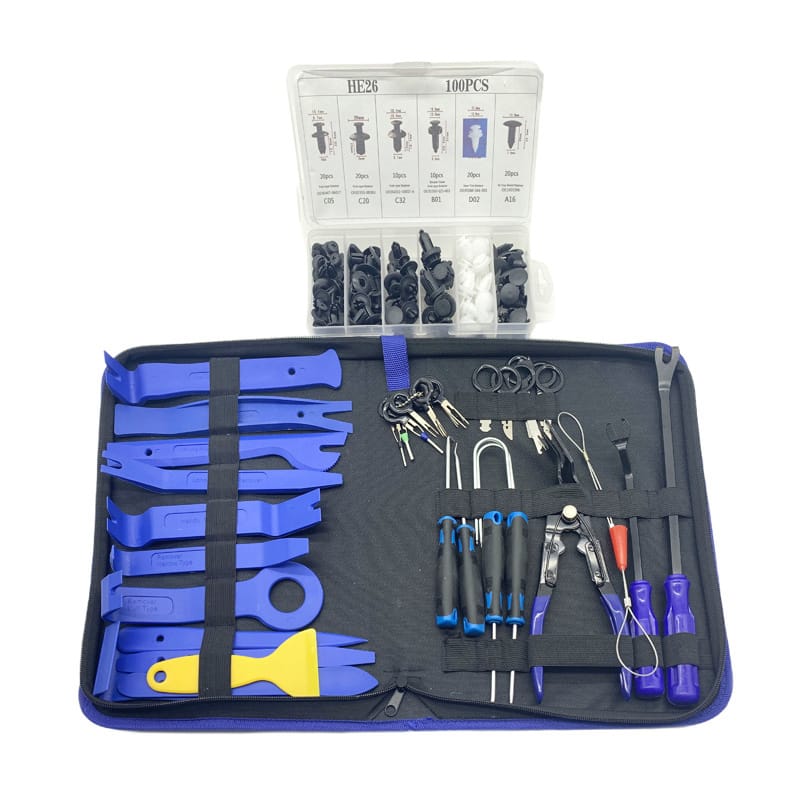
A radio removal kit is well suited to private-label development because the tools, storage, labeling, and packaging can all be configured for different channels.
A buyer may specify:
- Piece count
- Key profiles
- Stainless-steel thickness
- Handle coating
- Tool numbering
- Storage pouch
- Molded case
- Logo
- Printed application chart
- Instruction card
- Barcode
- Retail packaging
- Outer carton
- Inspection requirements
The key question should always be: which release systems does the target customer need?
A 20-piece car radio removal tool set should provide meaningful profile coverage rather than repeating similar tools only to increase the advertised number.
Fengjie’s 20pcs Radio Removal Tool Set combines flat keys, U-hooks, hex tools, and other removal profiles using stainless steel.
For wholesale, OEM, private-label packaging, or customized kit development, buyers can contact Fengjie Tools with the intended market, applications, tool profiles, and packaging requirements.
FAQ
What is a car radio removal tool set used for?
A car radio removal tool set is used to release and remove automotive radios, stereos, navigation units, and head units that use dedicated locking keys, hooks, or release mechanisms.
Why are there so many different radio removal keys?
Different dashboard and radio systems use different locking mechanisms.
Different key widths, hooks, hole spacing, and special profiles are therefore needed to engage those systems correctly.
Can I use a screwdriver instead of a radio removal key?
A screwdriver is not a direct substitute for a dedicated release key.
It can damage the radio cage, fascia, locking mechanism, or visible dashboard trim.
What should a 20-piece car radio removal tool set include?
A useful car radio removal tool set may include flat release keys, U-shaped hooks, narrow extraction profiles, hex tools, and special keys, together with clear storage and identification.
Are plastic trim tools needed with a radio removal set?
Often, yes.
If dashboard fascia or decorative trim needs to be removed before the head unit is accessible, non-marring plastic tools are usually more suitable than metal radio keys.
Why does the radio not release after the keys are inserted?
Possible reasons include:
- Wrong key profile
- Incorrect insertion depth
- Only one side released
- Hidden fasteners
- Bent locking tabs
- Dashboard trim still blocking the unit
Stop and confirm the mounting system before increasing force.
Is stainless steel suitable for radio removal keys?
Yes, when the material and dimensions are appropriate.
The finished tool also needs consistent thickness, straightness, edge quality, and profile accuracy.
What should distributors inspect before ordering?
Buyers should inspect material, key dimensions, U-hook spacing, edge finish, straightness, handle coating, storage, labeling, repeated-use performance, and batch consistency.
Can car radio removal tool sets be customized?
Depending on manufacturing capability, buyers can customize piece count, key profiles, handle coating, numbering, storage, logo, packaging, application charts, and instruction materials.
Conclusion
A car radio removal tool set is a precision-access product rather than a general pry kit.
Its job is to match the locking mechanism inside a radio or head-unit installation closely enough to release the unit without damaging the dashboard, cage, or retainer.
For technicians, the most important steps are identifying the release system, protecting surrounding trim, selecting the correct key, inserting paired tools evenly, withdrawing the unit gradually, and supporting it before disconnecting wiring.
For workshops, the best car radio removal tool set is one that covers several genuinely different release profiles and keeps those tools clearly organized.
For distributors and private-label buyers, the most important sourcing factors include stainless-steel quality, key thickness, profile accuracy, U-hook spacing, flatness, edge finish, coating quality, labeling, storage design, and repeat-production consistency.
Fengjie’s 20pcs Radio Removal Tool Set provides stainless-steel radio keys, U-hooks, hex tools, and other removal profiles for automotive radio service.
The product can also be positioned alongside Car Body and Interior Tools and Plastic Trim Removal Tools to create a broader interior-disassembly and accessory-installation tool range.
For wholesale, OEM, private-label packaging, or customized car radio removal tool set programs, contact Fengjie Tools with the target applications, preferred set structure, and packaging requirements.