
A magnetic pickup tool solves a very specific workshop problem: a steel screw, nut, washer, clip, or small fastener has fallen somewhere your fingers cannot reach. In automotive door and window repair, that can mean the bottom of a hollow door shell, beneath a windshield cowl, behind dashboard trim, under a seat rail, or inside a narrow body cavity.
Unlike a flexible claw, a magnetic pickup tool does not need to physically close around the part. If the dropped component is ferromagnetic and the magnetic head can get close enough, the tool can lift it with minimal contact. That makes it especially useful for steel hardware in confined areas where gripping space is limited.
This guide explains how a magnetic pickup tool works, where it helps most in automotive door and glass service, why magnet strength is not the only specification that matters, how to choose between fixed, telescoping, and flexible designs, and what workshops, distributors, and private-label buyers should inspect before sourcing a professional product.
What Is a Magnetic Pickup Tool?
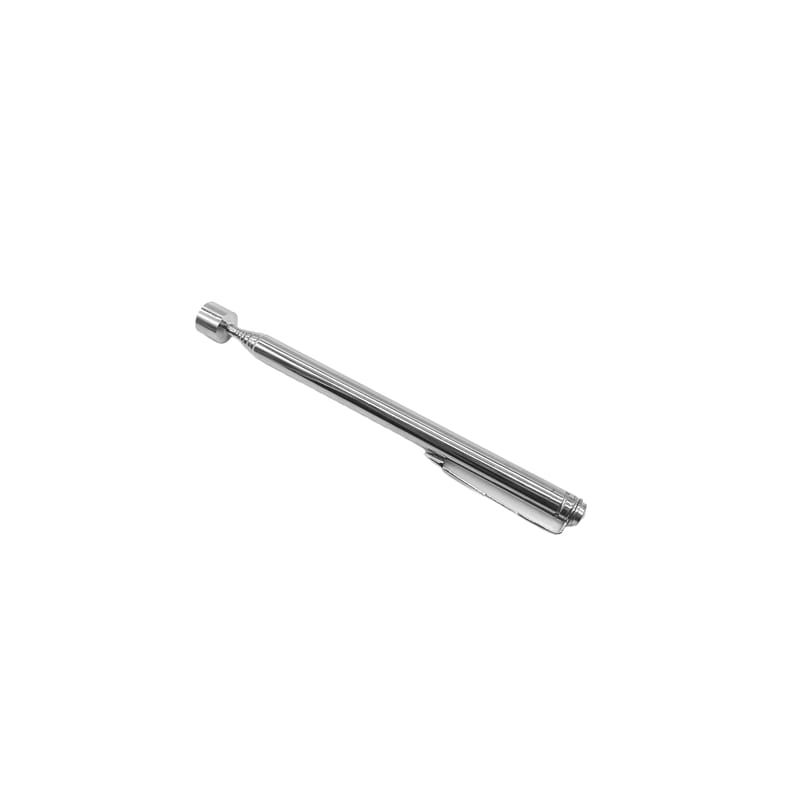
A magnetic pickup tool is a hand tool with a permanent magnet at the working end, designed to retrieve ferrous metal objects from places that are difficult to reach directly.
Common designs include:
- Fixed-shaft pickup tools
- Telescoping pickup tools
- Flexible-shaft pickup tools
- Swivel-head pickup tools
- LED-assisted magnetic pickup tools
- Magnetic pickup and inspection-mirror combination kits
The basic principle is simple. The tool is extended or guided toward a steel object, the magnet attracts the part, and the technician withdraws the tool while keeping the object attached.
Fengjie’s Magnetic Tool category currently includes a 1LB Magnetic Pick Up Tool along with related magnetic workshop products.
The important point is that a magnetic pickup tool is designed for retrieval, not prying, probing, or high-force extraction. If a fastener is still installed, use the correct socket, clip remover, trim tool, or other service tool first.
Why a Magnetic Pickup Tool Is Useful in Door and Window Repair
Automotive door and glass work creates many opportunities for small metal parts to disappear into inaccessible cavities.
Technicians regularly handle:
- Door-panel screws
- Speaker screws
- Small nuts
- Washers
- Window-channel fasteners
- Cowl hardware
- Wiper-arm nuts
- Retaining screws
- Metal clips
- Small brackets
Once one of these parts falls into a hollow section, recovering it by hand can require additional disassembly.
A magnetic pickup tool can often reach through the existing service opening, collect the fastener, and prevent the technician from removing more trim than necessary.
That makes the tool valuable not only because it retrieves hardware, but because it can reduce unnecessary work.
Job 1: Retrieving Door-Panel Screws From a Door Cavity
Door-panel removal often begins with several screws around the armrest, switch bezel, inner handle, lower panel edge, or speaker area.
A screw that falls through a service opening can land at the bottom of the door shell.
If the screw is steel, a magnetic pickup tool can be inserted through the nearest safe opening to recover it.
A good process is:
- Stop moving the door or glass mechanism.
- Use a light or inspection mirror to locate the screw.
- Check that wiring and window components are clear.
- Extend the magnetic pickup tool toward the fastener.
- Let the magnet make contact rather than sweeping the cavity.
- Withdraw slowly so the screw does not strike another component and fall off.
This is much safer than shaking the door or moving the window regulator in hopes that the screw will roll into view.
Job 2: Recovering Speaker and Switch Hardware
Door speakers and switch panels often use small steel screws that are easy to drop.
A magnetic pickup tool works well here because the target hardware is usually compact and strongly magnetic enough for direct retrieval.
When working near speakers, wiring, or electronic components, guide the tool deliberately. The magnet may be attracted to nearby steel structures, which can make a lightweight screw detach if the magnetic head bumps another metal surface.
Use an Automotive Inspection Mirror when the dropped part is not directly visible.
The best workflow is often “locate first, retrieve second.”
Job 3: Picking Up Wiper and Cowl Fasteners
Windshield-related service often requires removing wiper arms, cowl panels, clips, or associated hardware.
Small steel nuts or washers can fall into the cowl or plenum area.
A magnetic pickup tool can help recover them without forcing the technician to remove additional trim.
Before inserting the tool:
- Identify the dropped part.
- Confirm that the path does not interfere with wiring or washer hoses.
- Use only the reach required.
- Keep the magnetic head away from sensitive finished surfaces.
For wiper-arm removal itself, use a dedicated tool such as the Universal Windshield Wipe Arm Puller rather than using the pickup tool as a lever.
Job 4: Retrieving Window-Channel Nuts and Washers
Side-window service can expose bolts, nuts, washers, and brackets around the glass guide or regulator system.
If a steel fastener drops inside the door, a magnetic pickup tool can sometimes recover it through the service opening.
The technician should avoid moving the glass or regulator while the tool is inside the door.
A magnetic head can also attach itself to nearby steel reinforcement, so controlled movement matters.
For the larger side-glass workflow, see Fengjie’s Car Window Removal Tool Guide.
Job 5: Finding Hardware Behind Dashboard Trim
Dashboard and audio work often involves small metal screws and brackets.
Once a screw falls behind a bezel or console section, direct access may be poor.
A telescoping magnetic pickup tool can reach deeper without requiring the whole dashboard section to be dismantled.
Use an inspection light to identify the fastener first.
If the tool repeatedly sticks to nearby structural steel instead of the target, adjust the angle or use a flexible mechanical claw where appropriate.
This is one of the main differences between a magnetic pickup tool and a claw tool: the magnet may attach to any nearby ferrous surface, while the claw grips only what its jaws physically engage.
Job 6: Retrieving Metal Clips Around Trim and Molding
Some trim and molding systems use small metal spring clips.
If a clip is already loose and falls into a cavity, a magnetic pickup tool may retrieve it quickly.
Do not use the magnet to remove a clip that is still installed.
Installed retainers should be released with the correct trim or fastener tool.
Fengjie’s Trim Fastener Removal Tool Guide explains why clip geometry and release direction matter during removal.
The pickup tool belongs after the clip is loose, not before.
Job 7: Recovering Hardware Under Seats and Rails
Interior repair work can send screws or washers beneath seats and seat rails.
A telescoping magnetic pickup tool can reach between narrow gaps where fingers cannot fit.
Before reaching into the area, verify that the target is not close to wiring, connectors, or moving seat mechanisms.
Use the tool for retrieval only.
Do not use it to probe around electrical connectors blindly.
Job 8: Retrieving Steel Parts From Engine-Bay Gaps During Glass Service
Windshield and cowl work often takes place close to the rear of the engine compartment.
A dropped fastener may fall between brackets, hoses, shields, or body structures.
A magnetic pickup tool can save time if the steel hardware is visible and there is a clear access path.
Keep the magnetic head away from rotating components and do not reach into an area while machinery is operating.
The vehicle should be in a safe service condition before retrieval begins.
Job 9: Recovering Nuts and Washers From Body Cavities
Body repair and interior trim work can expose structural cavities where steel hardware disappears easily.
A long or flexible magnetic pickup tool may reach through an existing access hole and recover the part without enlarging the opening.
The limiting factor is not only reach.
The tool also needs enough head clearance to pass through the opening and enough magnetic holding force to carry the object back out.
Job 10: Checking for Forgotten Steel Hardware Before Reassembly
A magnetic pickup tool can also be used as a final retrieval aid before panels are closed.
After door, cowl, or dashboard work, technicians should confirm that no loose screws or washers remain in hidden cavities.
Loose hardware can create rattles later.
An inspection mirror can locate suspicious objects, and the magnet can retrieve ferrous pieces before the trim is reinstalled.
Magnetic Pickup Tool vs. Flexible Claw Pickup Tool
These tools often appear in the same workshop, but they solve different retrieval problems.
| Factor | Magnetic Pickup Tool | Flexible Claw Pickup Tool |
|---|---|---|
| Steel screw retrieval | Excellent | Good |
| Plastic clip retrieval | No | Yes |
| Rubber part retrieval | No | Yes |
| Requires physical grip around object | No | Yes |
| Can retrieve from very narrow gap | Often | Depends on claw size |
| May stick to nearby steel structure | Yes | No magnetic attraction |
| Best for loose ferrous hardware | Yes | Yes, but slower |
| Best for irregular non-magnetic objects | No | Yes |
The magnetic pickup tool is usually faster for a steel screw or nut because the head only needs to approach the target.
The Flexible Claw Pickup Tool Guide covers non-magnetic parts such as plastic clips, rubber components, and irregular objects.
A complete workshop retrieval setup benefits from both.
Fixed, Telescoping, or Flexible Magnetic Pickup Tool?
Tool structure determines where the magnet can reach.
Fixed-Shaft Magnetic Pickup Tool
A fixed tool offers good control and minimal movement in the shaft.
It works well where the target is close and the access path is straight.
The limitation is reach.
Telescoping Magnetic Pickup Tool
A telescoping magnetic pickup tool can extend into deep cavities while remaining compact in storage.
Important qualities include:
- Smooth extension
- Stable locking friction
- Shaft straightness
- Low side play
- Corrosion resistance
- Stable handle attachment
Maximum length is not the only important specification.
The shaft should remain controllable when extended.
Flexible Magnetic Pickup Tool
A flexible-shaft design can curve around obstacles.
This is useful inside doors, cowls, or dashboard structures where the target is not in a direct line from the opening.
However, a very flexible shaft can be harder to aim.
A good magnetic pickup tool balances bendability with directional control.
How Much Magnetic Holding Force Do You Need?
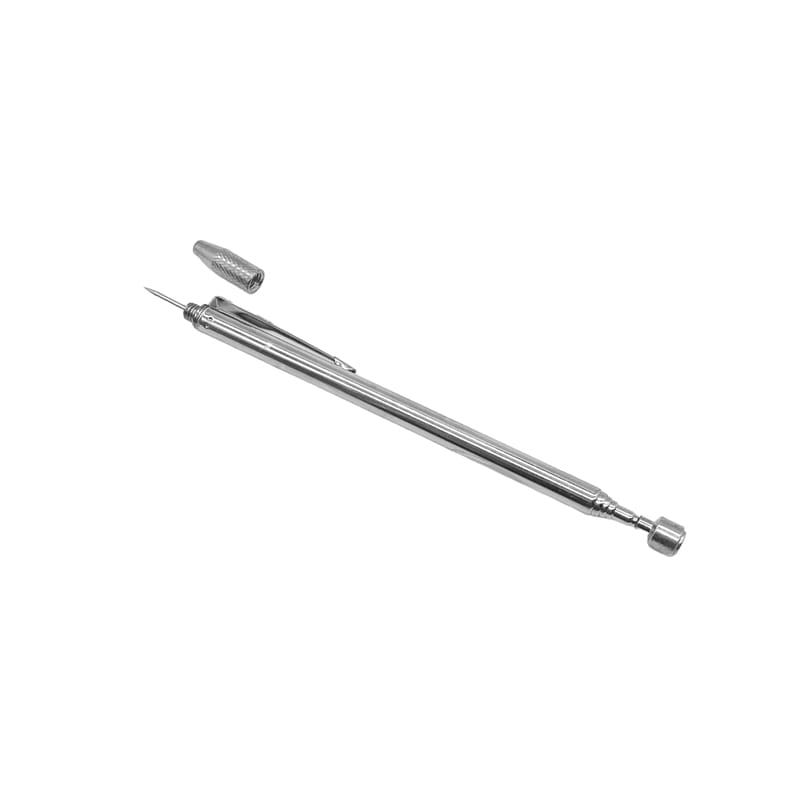
Fengjie currently lists a 1LB Magnetic Pick Up Tool, giving buyers a clear holding-force reference in the product name.
For workshop buyers, magnetic force should be matched to the intended hardware.
A small pickup tool designed for screws and washers does not need the same holding force as a heavy magnetic lifter.
More force is not always better.
An overly strong magnet can:
- Stick aggressively to nearby steel structures
- Make precise positioning harder
- Pull the tool away from a small target
- Collect multiple loose steel particles
The useful specification is enough magnetic holding force to retrieve the intended part while keeping the tool easy to control.
For OEM buyers, holding force should be tested under defined conditions rather than compared only by marketing labels.
Why Magnet Head Diameter Matters
The magnetic head needs to fit through the access opening.
A larger magnet may provide greater holding force but can be too wide for:
- Door service holes
- Narrow dashboard gaps
- Tight cowl openings
- Small trim cavities
A smaller magnetic pickup tool head provides better access but may have lower holding capacity.
This creates a practical tradeoff:
Smaller head = better access
Larger head = potentially stronger holding force
A product range can solve this by offering more than one head size instead of treating one design as universal.
Telescoping Shaft Quality: What Professionals Should Check
A telescoping shaft is one of the most common failure points in a low-quality magnetic pickup tool.
Buyers should inspect:
- Tube straightness
- Section fit
- Extension smoothness
- Side play
- Surface finish
- Corrosion resistance
- Retraction control
- Handle connection
The shaft should extend without binding and should not collapse unexpectedly during use.
At full extension, the magnetic head should remain controllable enough to reach a small fastener accurately.
Magnet Retention Matters as Much as Magnet Strength
A strong magnet is useless if it becomes loose from the tool head.
During repeated sample testing, inspect:
- Magnet-to-head attachment
- Head-to-shaft connection
- Adhesive or mechanical retention
- Rotation
- Cracking
- Corrosion around the head
A professional magnetic pickup tool should keep its magnet securely attached after repeated pickup cycles and normal workshop storage.
How to Use a Magnetic Pickup Tool Safely
Locate the Object First
Do not sweep a magnetic tool blindly through a door or dashboard cavity.
Identify the target using:
- Work light
- Inspection mirror
- Camera when appropriate
Confirm the Object Is Magnetic
A magnetic pickup tool will not reliably retrieve plastic, aluminum, rubber, or many non-ferrous materials.
If the part does not respond, use a claw or other retrieval method.
Use the Shortest Necessary Reach
Longer extension reduces control.
Extend only enough to reach the target.
Approach Slowly
The magnet may jump toward nearby steel before reaching the dropped part.
Slow movement makes this easier to control.
Confirm the Pickup
After contact, lift slightly and confirm that the target is attached before withdrawing.
Withdraw Along a Clear Path
A screw can be knocked off the magnet if it hits another bracket.
Guide the tool carefully out of the cavity.
Seven Common Mistakes With Magnetic Pickup Tools
1. Assuming Every Metal Part Is Magnetic
Aluminum, copper, brass, and some stainless materials may not respond strongly enough.
2. Buying by Holding Force Alone
Access, head diameter, shaft control, and magnet retention are equally important.
3. Extending the Shaft Fully for a Short Job
Unnecessary reach reduces accuracy.
4. Sweeping Blindly Around Wiring
Locate the object first.
5. Trying to Remove Installed Fasteners
A magnetic pickup tool is for loose-part retrieval.
6. Ignoring Nearby Steel Structures
The magnetic head may attach to door reinforcement or brackets before reaching the target.
7. Using a Damaged Telescoping Shaft
Bent sections and excessive play make accurate retrieval more difficult.
Safety and Ergonomics
A magnetic pickup tool requires little force, but technicians may still use it in awkward positions inside doors, under dashboards, or beneath cowls.
The NIOSH Guide to Selecting Non-Powered Hand Tools recommends matching tools to the task while considering force, repetition, grip, and posture.
For pickup tools, useful ergonomic features include:
- Comfortable handle size
- Low overall weight
- Stable telescoping sections
- Smooth extension
- Enough grip for precise aiming
The OSHA Hand Tools standard states that unsafe hand tools should not be permitted for use.
A bent shaft, loose magnet, or damaged handle should therefore be removed from service.
What B2B Buyers Should Inspect Before Bulk Ordering
A magnetic pickup tool is inexpensive compared with many automotive service tools, but quality variation can still create complaints and returns.
Verify Holding Force
Test representative samples using a defined steel load and repeatable contact condition.
Do not rely only on the number printed on the package.
Measure Magnet Head Diameter
Head size determines access.
The approved specification should include diameter and overall head length.
Test Telescoping Action
Extend and retract the shaft repeatedly.
Look for:
- Binding
- Excessive looseness
- Unexpected collapse
- Scraping
- Tube deformation
Inspect Magnet Attachment
Confirm that the magnet remains securely fixed after repeated retrieval cycles.
Check Handle Retention
Twist and pull the grip during sample testing.
It should remain secure.
Inspect Surface Finish
Look for:
- Burrs
- Sharp tube edges
- Plating defects
- Corrosion
- Loose components
Practical Sample Test Plan
| Test Area | What to Check | Why It Matters |
|---|---|---|
| Holding-force test | Tool lifts specified steel load | Confirms performance |
| Small-screw retrieval | Magnet picks up light hardware accurately | Reflects common use |
| Head-access test | Magnet enters representative door/cowl openings | Confirms fit |
| Telescoping cycle | Shaft extends repeatedly without binding | Indicates durability |
| Full-extension control | Head remains aimable | Supports real use |
| Magnet retention | Magnet stays fixed after cycles | Prevents failure |
| Handle test | Grip remains secure | Improves control |
| Corrosion check | Finish remains acceptable | Supports workshop life |
| Batch comparison | Multiple samples perform similarly | Supports repeat supply |
A magnetic pickup tool should be tested on more than one heavy steel object.
Professional buyers should include the small screws, washers, and nuts that represent actual automotive use.
How to Position Magnetic Pickup Tools in an Automotive Tool Range
A magnetic pickup tool works well inside a broader “inspect and retrieve” category.
A logical product family can include:
Visual Inspection
- Telescoping inspection mirrors
- Lighted mirrors
Magnetic Retrieval
- Compact magnetic pickup tools
- Telescoping magnetic pickup tools
- Flexible magnetic pickup tools
Mechanical Retrieval
- Flexible claw pickup tools
Precision Access
- Pick and hook sets
Hardware Control
- Magnetic trays and bowls
Fengjie’s Magnetic Tool category currently includes the 1LB Magnetic Pick Up Tool as well as magnetic trays, bowls, and related products.
This makes the category useful for distributors who want a connected workshop accessory range instead of isolated SKUs.
OEM and Private-Label Opportunities
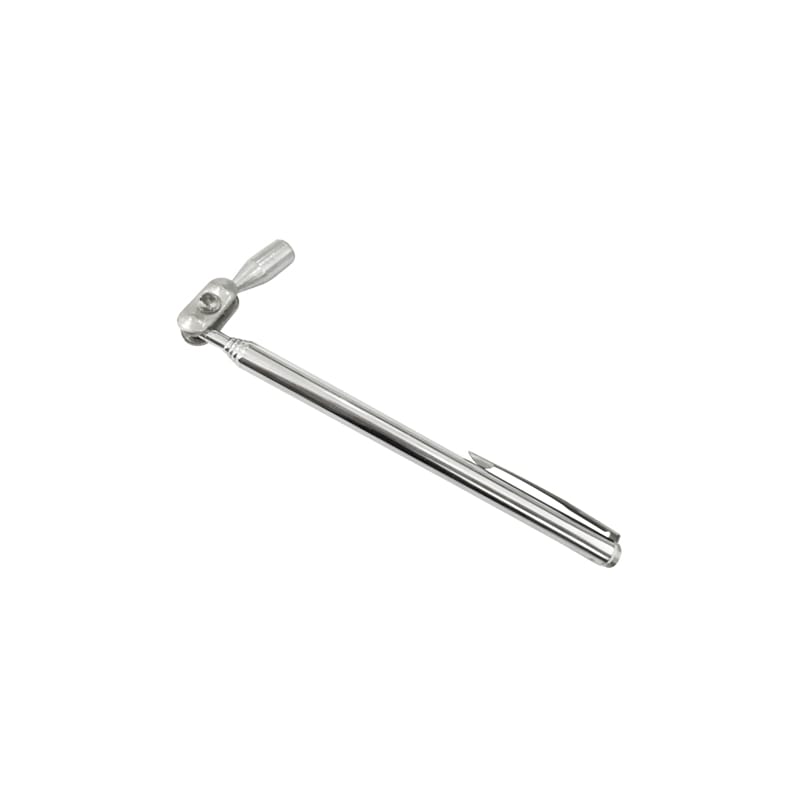
A magnetic pickup tool is well suited to private-label development because buyers can differentiate both the tool and its packaging.
Possible specifications include:
- Magnetic holding force
- Head diameter
- Fixed or telescoping shaft
- Maximum extension
- Collapsed length
- Flexible or rigid construction
- Handle color
- Grip material
- Pocket clip
- Surface finish
- Logo
- Retail card
- Blister packaging
- Barcode
- Inspection requirements
For a professional automotive program, buyers should define the intended retrieval job first.
A compact door-service tool may prioritize a narrow head.
A general workshop magnetic pickup tool may prioritize greater reach.
An inspection-and-retrieval kit may combine the magnet with an inspection mirror and flexible claw.
For wholesale, OEM, private-label packaging, or customized pickup-tool programs, buyers can contact Fengjie Tools with the intended market and performance requirements.
FAQ
What is a magnetic pickup tool used for?
A magnetic pickup tool retrieves loose ferrous objects such as steel screws, nuts, washers, clips, and small hardware from confined areas.
Can a magnetic pickup tool be used inside a car door?
Yes, when the dropped part is ferrous and the tool can be inserted without interfering with glass, wiring, or moving components.
Is a magnetic pickup tool better than a flexible claw?
For steel screws and nuts, the magnet is often faster because it does not need to grip around the object. For plastic, rubber, aluminum, or irregular non-magnetic parts, a flexible claw is usually more appropriate.
What does 1LB mean on a magnetic pickup tool?
It normally refers to a stated magnetic holding capacity. Actual performance should be verified under defined test conditions because contact area, material, orientation, and surface condition can affect holding force.
Is a telescoping magnetic pickup tool better?
A telescoping design provides adjustable reach and compact storage. The shaft should remain stable and controllable when extended.
Why does magnet head size matter?
A smaller head can enter tighter automotive cavities, while a larger magnet may provide stronger attraction. The correct size depends on the intended application.
What should distributors test before ordering?
Buyers should verify holding force, head size, magnet retention, shaft stability, extension quality, handle retention, surface finish, corrosion resistance, and batch consistency.
Can magnetic pickup tools be customized?
Depending on manufacturing capability, buyers may customize holding force, shaft length, head size, handle, finish, logo, packaging, and kit configuration.
Conclusion
A magnetic pickup tool is a small workshop accessory that can prevent a dropped steel screw or nut from turning into unnecessary disassembly.
Around car doors, windows, cowls, dashboards, and windshield-service areas, loose hardware often lands in cavities where fingers cannot reach. When that hardware is ferrous, a magnet provides a simple retrieval method with very little physical gripping space.
For technicians, the most effective workflow is to locate the target first, confirm that it is magnetic, use only the reach required, approach slowly, and withdraw the part along a clear path.
For workshops, a magnetic pickup tool complements inspection mirrors, flexible claw tools, pick-and-hook tools, and magnetic trays.
For distributors and private-label buyers, the main sourcing factors include real holding force, magnet head diameter, telescoping stability, magnet retention, shaft finish, handle security, corrosion resistance, and repeat-production consistency.
Fengjie’s Magnetic Tool category includes a 1LB Magnetic Pick Up Tool together with related magnetic workshop products.
For wholesale, OEM, private-label packaging, or customized magnetic pickup tool programs, contact Fengjie Tools with the target application, preferred reach, magnetic capacity, and packaging requirements.