
Table of Contents
A ball hone follows the existing cylinder wall to condition its surface. A spring-loaded three-stone hone holds straight abrasive stones against the wall. A rigid honing system controls the cutting tools more precisely and can be part of a machining process that corrects bore size and shape. These are different jobs, even though all three tools can leave a crosshatched pattern.
For someone rebuilding an engine for the first time, the important question is not which tool looks most substantial. It is whether the cylinder needs a new surface texture or needs its dimensions repaired. A portable hone cannot turn an unsuitable bore into a serviceable one simply by making it look clean. Start with that distinction and the different cylinder hone types become much easier to understand.
First, separate the cylinder's shape from its surface
Imagine a drinking glass that is slightly wider at the top than at the bottom. Polishing its inside changes how the surface looks and feels, but does not necessarily make the glass straight-sided. A worn cylinder presents a similar distinction. Its diameter may change along its length, and measurements taken across different directions may not agree.
The change from top to bottom is called taper. A difference between directions at the same height is called out-of-round. Neither can be judged reliably from a photograph of the wall. A bore gauge and the engine's service specifications tell a machinist whether the shape is acceptable. A dark stain, a shiny patch and a deep groove also mean different things; treating all three as “glaze” can lead to the wrong repair.
The ball hone: flexible contact with an existing bore
A ball hone looks like a bottle brush with abrasive beads on flexible stems. The individual beads can move as they contact the wall. That flexibility helps the tool follow the surface rather than forcing the cylinder into a new shape. It is commonly associated with surface conditioning and deglazing within an approved rebuilding process.
Its forgiving appearance can be misleading. Flexible does not mean harmless to every coating, and it does not mean that any size or grit will work. The tool still removes material. The cylinder material, ring requirements and tool maker's instructions determine the abrasive and operating method. For example, BRM identifies its flexible tools by the nominal bore they are intended to finish; do not apply that brand's sizing convention automatically to a different tool design.
A ball hone is therefore best understood as a finishing tool, not a rescue device for a badly worn engine. If the bore already exceeds its wear limit, adding a fresh-looking pattern does not restore the lost material. If you are unsure whether a visible coating can be honed, identify the cylinder first rather than assuming that a gentle tool must be safe.
The three-stone hone: straight stones on movable arms
The familiar drill-driven design has three long abrasive stones supported on arms. A spring or adjustment mechanism presses them outward. Its straight stones and replaceable abrasive sets make it easy to recognise, and the mechanism often accommodates a range of diameters.
This design can be used for suitable surface-finishing work, but a typical spring-loaded model is not the same thing as a rigid machine hone. The stones, arms and operator can move. More spring pressure does not automatically create a straighter cylinder. Uneven tool movement can remove more material from one area than another, especially near an end where the stones are less supported.
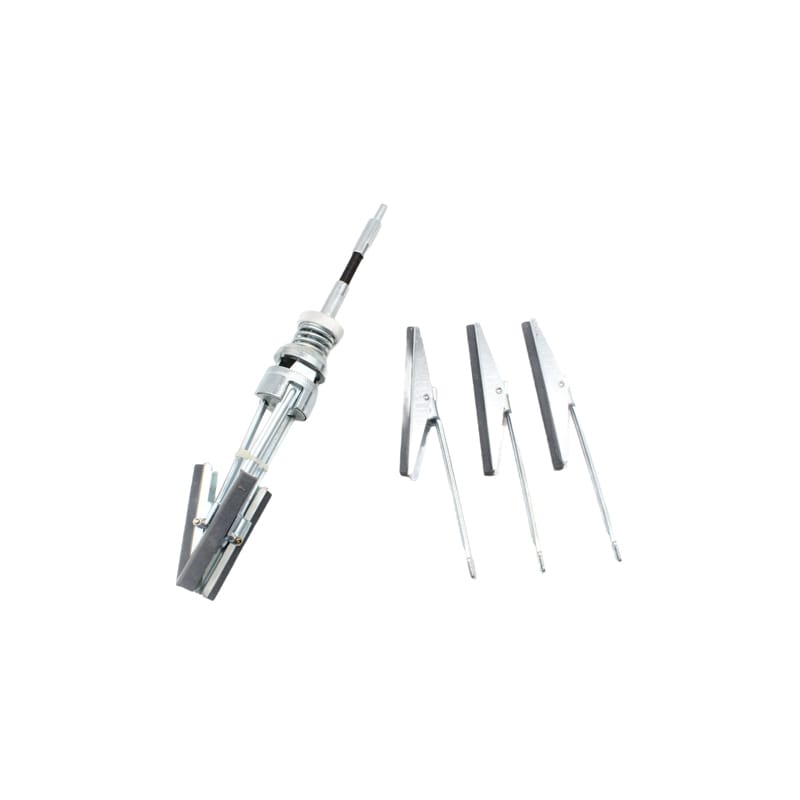
The photographs in a listing can help you identify the design. Look for straight stone holders, expanding arms and the drive connection. A product such as Three-in-one Cylinder Hone Kit illustrates a portable honing arrangement; the presence of several heads in the case does not establish that it can perform every kind of engine-bore correction.
A rigid hone belongs to a different kind of job
A rigid honing setup holds and adjusts the abrasive tooling with greater control. In a machine shop, the operator combines the tooling with measurement, suitable workholding and a planned machining process. The aim may include bringing a bore to a specified size and correcting geometric errors before producing the final surface.
That does not mean the word “rigid” on a listing guarantees a finished result. Setup and measurement still matter. It does mean that the method should not be confused with waving a spring-loaded tool through a worn cylinder. If your engine needs an oversize piston or a replacement liner, the appropriate work is decided around those parts and the engine specifications, not around whichever portable hone is already in the garage.
Ask a machine shop what it found, in plain language: Is the bore still within size limits? Is it tapered? Is the damage too deep for the proposed finish operation? What piston and ring combination will the finished cylinder use? Those answers are more useful than asking whether the shop uses a particular-looking hone.
| Tool family | Easy way to recognise it | Main distinction for the reader |
|---|---|---|
| Flexible ball hone | Abrasive beads on flexible stems | Follows an existing bore for appropriate finishing work |
| Spring-loaded stone hone | Straight stones on expanding arms | Portable abrasive contact; not a substitute for controlled bore correction |
| Rigid honing system | Abrasives held and adjusted in a controlled arrangement | Used with measurement and setup for dimensional and finishing work |
Three cylinder conditions, three different conversations
Consider an engine that is apart for new rings and has bores measured within the required limits. Its service information permits a particular surface preparation. The discussion can then focus on the correct finish process and abrasive. Choosing between suitable finishing tools makes sense only after that first condition has been established.
Now consider a cylinder with a groove that catches a fingernail. That observation is a reason for closer inspection, not a measurement of how much material must be removed. Running a hone until the mark disappears could make the bore too large. A machinist needs to assess the damage and the available repair sizes before anyone decides to keep cutting.
Finally, consider a cylinder with a special plated or coated surface. Advice for an ordinary cast-iron bore may not apply. An apparently similar engine can use a different construction. Identify the exact cylinder and its repair instructions; otherwise, a cheap attempt to “freshen it up” can turn a reusable part into one needing specialist repair.
What grit and crosshatch cannot tell you on their own
Grit describes an abrasive's grading, not a complete cylinder-finishing recipe. Two tools with the same printed grit can use different abrasive materials and behave differently. The ring manufacturer may require a particular finish, while the cylinder construction limits which processes are suitable. There is no single grit that is correct for every engine rebuild.
A useful next step before spending money
Write down the engine identification, cylinder construction if known, measured condition and the rings you intend to install. If one of those is unknown, resolve it before buying a hone. You may discover that the sensible purchase is a finishing tool, or that the sensible next step is a machine-shop inspection. Both are better outcomes than buying a versatile-looking kit and finding out its limitations inside an expensive component.
For a visual explanation of flexible-tool sizing and abrasive selection, see BRM's tool-selection guide. Its recommendations concern its own tools. Use it to understand the questions involved, then follow the instructions for the cylinder and hone you actually have.
Questions readers ask
Is a ball hone the same as a cylinder boring tool?
No. A ball hone is a flexible finishing tool. Boring is a different machining operation used to alter a bore’s dimensions. A worn cylinder may need boring and subsequent finishing rather than a surface-only treatment.
Can a three-stone hone remove taper?
Do not assume a portable spring-loaded hone will correct it. Taper needs measurement and an appropriate machining plan. Making the wall look uniform does not demonstrate that its diameter is uniform.
Does a shiny cylinder always need honing?
Appearance alone is insufficient. The repair being performed, the bore measurements, the surface condition and the engine or ring instructions determine whether honing is appropriate.
Can I use one hone on iron and coated cylinders?
Only if the particular tool, abrasive and process are explicitly suitable for both. A similar bore diameter does not establish material compatibility, especially where a thin surface coating is involved.
Should I buy the coarsest stones to finish faster?
No. Coarser abrasives change the cutting action and resulting surface. Choose from the specified process rather than speed alone; unnecessary material removal can leave the cylinder outside its allowable dimensions.