
An automotive pick and hook set is easy to overlook because each tool is small, but these precision hand tools solve problems that larger trim removers cannot. Around car doors, windows, weatherstrips, wiring, clips, seals, and narrow trim gaps, technicians often need to reach behind a component, lift a retaining tab, guide a seal, pull a small clip, or reposition a wire without forcing the surrounding panel apart.
That is where an automotive pick and hook set becomes valuable. A straight pick, 90-degree hook, full hook, offset hook, and long-reach pick each provide a different approach angle. Instead of adding leverage across a wide surface, these tools give the technician localized access to components hidden behind door panels, window trim, rubber seals, and interior assemblies.
This guide explains the tool shapes that matter most, nine practical door-and-window repair jobs, common mistakes, safety considerations, and what workshops, distributors, and private-label buyers should check before choosing an automotive pick and hook set.
Table of Contents
What Is an Automotive Pick and Hook Set?
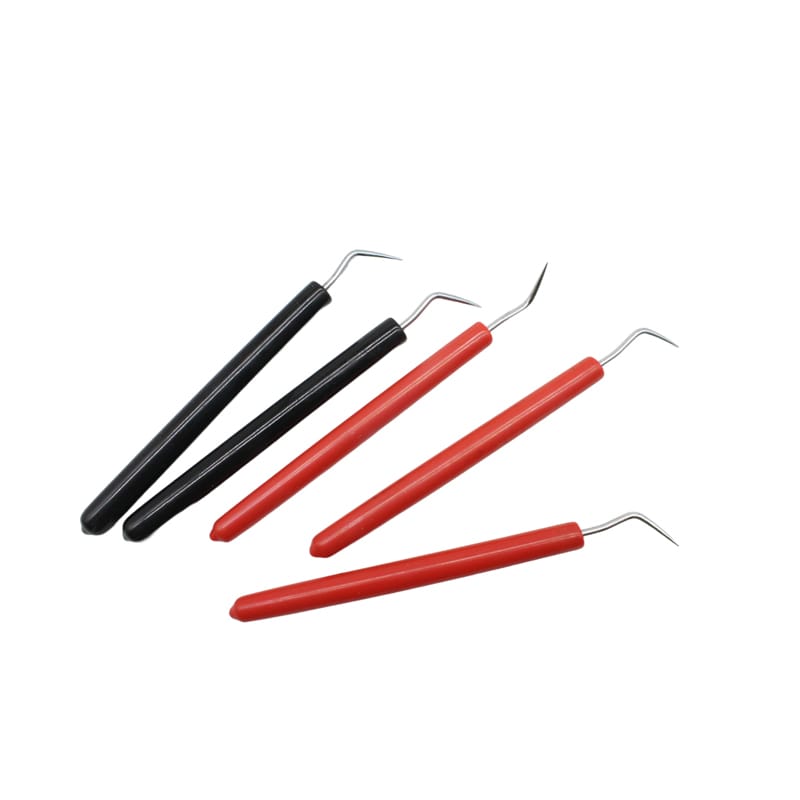
An automotive pick and hook set is a group of small hand tools with straight, angled, curved, or hooked metal tips designed for precision pulling, positioning, separating, probing, and retrieving work in confined vehicle areas.
Common profiles include:
- Straight pick
- 45-degree pick
- 90-degree hook
- Full hook
- Offset hook
- Curved pick
- Extra-long pick
- Small seal hook
Unlike a broad pry tool, an automotive pick and hook set is not intended to spread load across a large panel. Its strength is precision. The small tip can enter spaces where a door-panel wedge or molding tool is too wide.
Fengjie’s Pick & Hook category currently includes 10-piece and 11-piece hook-and-pick kits, 2-piece and 4-piece mini sets, 6-piece extra-long-reach sets, and other related hook tools.
The most important purchasing principle is that each shape should provide a genuinely different access angle. A larger automotive pick and hook set is useful only when the extra tools expand reach or application coverage.
Why Pick and Hook Tools Matter in Door and Window Repair
Door and window repair often begins with trim removal, but larger trim tools cannot solve every detail task.
Once the door panel or molding has been opened, technicians may encounter:
- Wiring connectors
- Small locking tabs
- Rubber weatherstrips
- Window-run channels
- Hidden clips
- Cable retainers
- Seals
- Small springs
- Interior grommets
- Adhesive edges
- Tight molding corners
An automotive pick and hook set helps with these smaller operations after the main panel has been separated.
It should therefore be treated as a precision companion to panel removers, clip tools, molding tools, and scrapers rather than as a replacement for them.
The Five Tool Shapes That Matter Most
A useful automotive pick and hook set normally contains several tip geometries. Understanding what each shape does makes it easier to choose a kit by function instead of piece count.
Straight Pick
A straight pick is useful when the technician needs direct access into a narrow hole or seam.
Typical uses include:
- Aligning a small clip
- Guiding a wiring retainer
- Clearing debris from a narrow recess
- Locating a hidden hole
- Separating a small seal edge
A straight pick gives excellent directional control, but its pointed tip concentrates force. It should not be pushed blindly toward wiring, upholstery, glass, or restraint-related components.
45-Degree Pick
The angled tip helps when a straight approach is blocked.
A 45-degree tool in an automotive pick and hook set can be useful around:
- Door-handle assemblies
- Window-channel areas
- Connector tabs
- Weatherstrip corners
- Tight molding retainers
The angle allows the handle to remain clear of the panel while the tip reaches around an obstruction.
90-Degree Hook
The 90-degree hook is one of the most versatile profiles.
It can reach behind:
- Small clips
- Rubber seals
- Wire retainers
- Grommets
- Spring tabs
- Interior trim details
The key is to pull on the intended component rather than hook the nearest wire or soft material.
Full Hook
A full hook wraps farther around a component and can provide more secure engagement when pulling small seals or retainers.
It is especially useful when the target is partially hidden.
Because the curved tip can grab deeply, the technician should know exactly what is behind the component before applying force.
Extra-Long Pick or Hook
An extra-long tool increases reach into door cavities and other confined areas.
Fengjie’s Pick & Hook product range includes a 6-piece Extra Long Reach Pick and Hook set, showing how length can be used as a separate product direction within an automotive pick and hook set range.
Job 1: Working Around Door Weatherstrips
Weatherstrips and rubber seals often sit in channels or around clips that are difficult to reach with fingers.
An automotive pick and hook set can help technicians:
- Lift a small seal edge
- Locate a hidden retention point
- Guide rubber into a channel
- Pull a seal gently around a corner
- Check whether a weatherstrip is seated evenly
The goal is not to pierce or stretch the rubber.
A sharp hook should be used carefully and should contact a reinforced edge or intended retention feature whenever possible.
For broader window-trim work, Fengjie’s Window Trim Removal Tool Guide explains how larger wedges and molding removers fit into the same workflow.
The trim tool creates access; the automotive pick and hook set handles the fine detail work.
Job 2: Releasing Small Wiring and Connector Tabs
Modern vehicle doors contain switches, speakers, mirror wiring, lock wiring, and other electrical connections.
After the main panel is removed, some connector locks are difficult to reach with fingers.
A small tool from an automotive pick and hook set can help access a locking tab when there is enough visibility and the vehicle service procedure permits it.
Important precautions include:
- Confirm the connector design before probing.
- Do not pull on wires.
- Do not puncture insulation.
- Avoid restraint-system connectors unless the approved service procedure specifically requires work in that area.
- Do not use a pointed tool when a plastic release tool would be safer.
The pick should release the locking feature rather than become a general-purpose electrical probe.
Job 3: Guiding Window Run Channels and Rubber Seals
Movable side glass travels through front and rear run channels.
During door-glass or trim service, these channels may need inspection, repositioning, or careful guidance.
An automotive pick and hook set can assist with:
- Checking a channel edge
- Guiding a rubber lip
- Repositioning a small seal section
- Reaching behind a tight corner
- Removing trapped debris
The tool should never be used to force the glass sideways.
If the window is binding, technicians should inspect the full mechanism rather than using a hook to compensate for poor alignment.
For the broader door-glass workflow, the Car Window Removal Tool Guide covers panel access, clip removal, molding, and glass support.
Job 4: Accessing Hidden Trim Clips and Retainers
A panel may already be partly separated but still held by a clip that cannot be seen directly.
A hook can sometimes reach behind the panel and help identify or release the retainer.
However, an automotive pick and hook set should not replace a proper clip remover when significant extraction force is required.
Use the pick to:
- Locate the clip
- Move a locking tab
- Pull a small retainer
- Guide the correct clip tool into position
Use a dedicated forked remover or clip pliers when the fastener needs stronger leverage.
This division of labor reduces the chance of bending a thin pick or concentrating too much force on one small point.
Job 5: Removing Small Seals, O-Rings, and Grommets
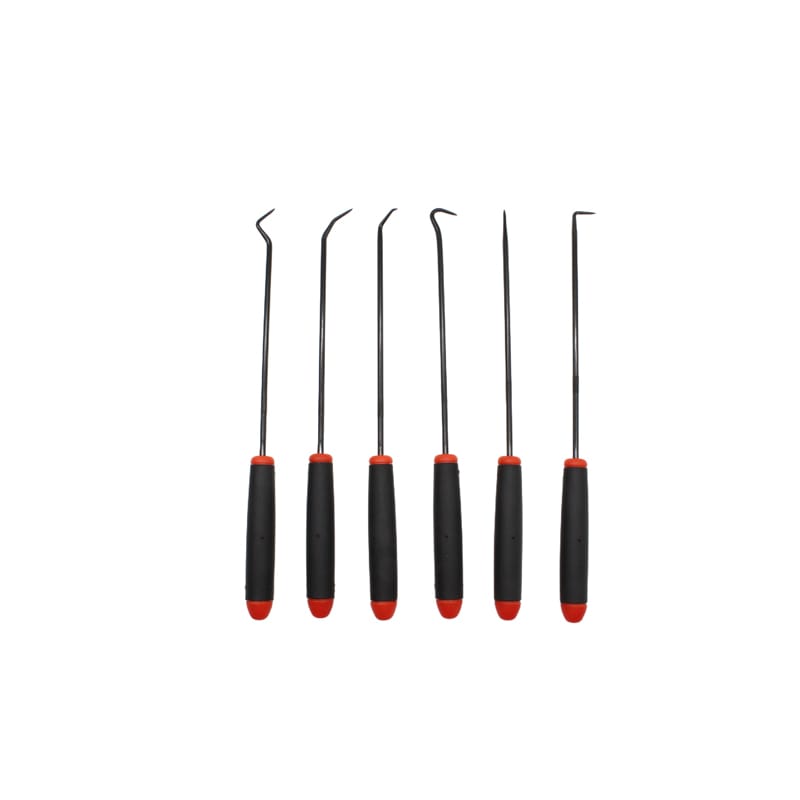
Pick-and-hook tools are widely used for small seals and O-rings.
Around doors and windows, similar precision is useful for:
- Small rubber grommets
- Sealing rings
- Washer-system seals
- Connector seals
- Interior plugs
- Small rubber retainers
If a seal must remain undamaged, avoid piercing the sealing surface.
A blunt or rounded profile may be safer than a sharp hook.
The correct tool should be chosen according to the component’s material, accessibility, and whether it will be reused.
Job 6: Working Around Windshield Molding and Cowl Details
Before windshield adhesive is cut, technicians may need to remove wiper-related components, cowl trim, molding, clips, and weatherstrip sections.
Large trim tools handle most of the separation work.
An automotive pick and hook set becomes useful for smaller details such as:
- Hidden retaining tabs
- Small rubber edges
- Tight molding corners
- Wiring clips
- Washer-hose retainers
- Small cowl fasteners
The Windshield Molding Removal Tool Guide covers the larger trim-removal stage.
Pick tools should be used only where their precision adds control.
A pointed hook should never be dragged blindly along the windshield edge or painted pinchweld.
Job 7: Retrieving Dropped Clips and Small Hardware
One of the least glamorous but most useful roles of an automotive pick and hook set is retrieving small parts from narrow cavities.
Door shells can trap:
- Clips
- Washers
- Small springs
- Fasteners
- Connector locks
- Trim pieces
A curved hook may retrieve a component when fingers cannot reach it.
The technician should work carefully around wiring and moving mechanisms rather than sweeping the hook through the cavity blindly.
Job 8: Routing Wires for Accessories and Interior Electronics
Door and trim work sometimes involves routing wires for cameras, audio equipment, lighting, or other accessories.
An automotive pick and hook set can help guide a small wire or pull a loop into position, but care is essential.
Do not use the sharp tip to push directly into insulation.
A safer method is to:
- Create the route with an appropriate trim tool.
- Confirm that no moving glass, regulator, latch, or restraint component will interfere.
- Use a rounded or controlled hook to guide the wire.
- Restore factory retainers where possible.
- Check that the wire cannot rub against a sharp metal edge.
Job 9: Cleaning Narrow Grooves and Detail Areas
Dirt, old adhesive fragments, and small debris can collect in narrow trim grooves.
A straight or angled tool from an automotive pick and hook set can help loosen material in areas where a larger scraper cannot fit.
Typical areas include:
- Trim channels
- Clip recesses
- Weatherstrip grooves
- Small molding corners
- Fastener holes
The tip should be selected according to the surface.
A sharp steel pick can scratch paint, plastic, or glass-adjacent coatings.
Where the surface is delicate, use a plastic tool or another non-marring cleaning method.
Automotive Pick and Hook Set vs. Trim Removal Tools
These categories overlap in door and window service but serve different functions.
| Tool Type | Best Use | Main Advantage | Main Limitation |
|---|---|---|---|
| Nylon trim wedge | Opening panel gaps | Lower surface-marking risk | Too wide for small details |
| Forked clip remover | Extracting panel clips | Leverage close to fastener | Needs access around clip stem |
| Automotive pick and hook set | Precision pulling, guiding, probing | Reaches confined details | Pointed tips can damage soft surfaces |
| Clip-removal pliers | Controlled extraction | Strong mechanical action | Requires handle clearance |
| Scraper | Residue removal | Good on flat surfaces | Not intended for hidden clips |
The automotive pick and hook set works best after the larger trim or panel tool has already created safe access.
How to Choose the Right Tool Length
Length changes both access and control.
Mini Pick and Hook Tools
Mini tools are useful when:
- The target is visible.
- The working area is close to the surface.
- Fine control matters more than reach.
- The hand needs to stay close to the tip.
Fengjie’s Pick & Hook category includes 2-piece and 4-piece mini sets for this type of work.
Standard-Length Tools
A standard automotive pick and hook set provides a balance between reach and hand control.
This configuration is useful for general workshop maintenance, door trim, seals, connectors, and under-hood service.
Extra-Long Tools
Extra-long tools are useful when the target sits deep inside a cavity.
Potential applications include:
- Deep door structures
- Hard-to-reach wiring
- Recessed seals
- Behind larger trim assemblies
The longer the shaft, the more important visibility and tip control become.
Shaft Material, Heat Treatment, and Tip Quality
The shaft of an automotive pick and hook set needs a combination of stiffness, toughness, and tip retention.
B2B buyers should inspect more than the material name.
Important factors include:
- Steel specification
- Heat treatment
- Shaft diameter
- Straightness
- Tip-forming consistency
- Surface treatment
- Corrosion resistance
- Tip hardness
- Handle-to-shaft retention
For professional or private-label sourcing, test several pieces from the same batch rather than approving only one sample.
Tip Finish Matters Around Automotive Surfaces
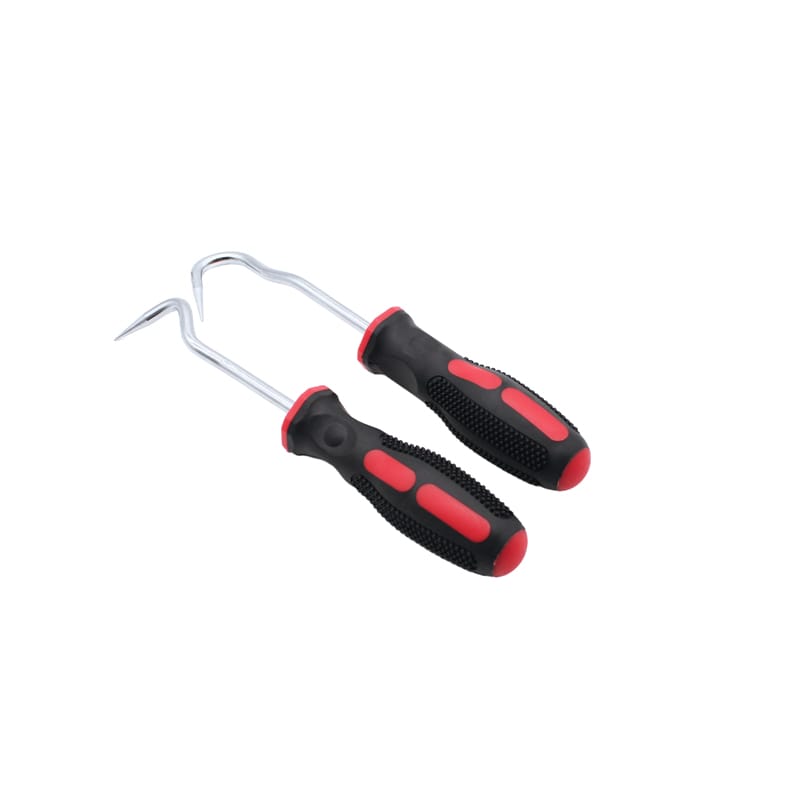
A working tip should be intentional.
Poorly finished tools can have:
- Burrs
- Rough grinding marks
- Inconsistent hook shapes
- Sharp transitions
- Uneven plating
- Surface defects
Because these tools operate near rubber seals, wiring, trim, and glass, tip finish is a functional quality point rather than merely a cosmetic detail.
Handle Design and Technician Control
The handle should give the technician enough grip to control a small tip accurately.
Important design points include:
- Handle diameter
- Grip texture
- Finger clearance
- Shaft alignment
- Balance
- Resistance to rotation
- Handle-to-shaft retention
The NIOSH Guide to Selecting Non-Powered Hand Tools recommends matching hand-tool design to the task while considering force, grip, repetition, and working posture.
That guidance is directly relevant to an automotive pick and hook set, especially when technicians perform repeated detail work in door cavities or under dashboards.
Safety: Small Tools Can Still Cause Serious Damage
An automotive pick and hook set contains pointed tools, so safe handling matters.
Before use:
- Inspect the tip for damage.
- Confirm the shaft is straight.
- Check that the handle is secure.
- Keep the free hand away from the expected tool path.
- Wear appropriate eye protection when clips or springs may release.
- Do not use the tool as an electrical test probe.
- Do not work blindly around wiring or restraint-system components.
- Store pointed tips so they cannot injure a technician reaching into a toolbox.
OSHA’s Hand and Power Tools guidance emphasizes keeping hand tools in safe condition and using the correct tool for the task.
A bent hook or loose handle should be removed from service.
Seven Common Mistakes With Pick and Hook Tools
1. Using a Pick as a Pry Bar
A thin shaft is not designed for heavy panel leverage.
If large force is required, switch to a trim remover or pry tool.
2. Pulling on Wiring
A hook may fit behind a wire, but that does not mean the wire should carry the pulling force.
3. Piercing Reusable Seals
If a rubber seal must be reused, work around the edge or use a blunter tool where possible.
4. Working Without Visibility
An automotive pick and hook set should be used for precision.
If the tip cannot be seen and the surrounding components are unknown, create better access first.
5. Choosing the Longest Tool Automatically
Extra reach is useful only when needed.
Shorter tools usually provide better tip control in accessible areas.
6. Ignoring Tip Damage
A bent or burred tip can scratch or puncture components.
7. Buying by Piece Count Alone
Ten nearly identical hooks do not necessarily create a better automotive pick and hook set.
Useful variation should come from tip angle, hook radius, shaft length, and intended application.
How Workshops Should Build a Practical Pick-and-Hook Selection
A workshop does not need every possible hook profile at each workstation.
A compact professional selection can include:
- Straight pick
- 45-degree pick
- 90-degree hook
- Full hook
- Offset hook
- Extra-long hook
For door and window work, the automotive pick and hook set should sit alongside:
- Plastic trim tools
- Clip removers
- Molding tools
- Inspection mirror
- Magnetic pickup tool
- Scraper tools
This creates a workflow-based tool station rather than a drawer full of unrelated hand tools.
What B2B Buyers Should Inspect Before Bulk Ordering
A distributor or private-label buyer should evaluate an automotive pick and hook set at both the tool and kit level.
Check Tip Geometry
Measure and compare:
- Hook angle
- Hook radius
- Tip length
- Tip diameter
- Offset
- Shaft length
The profiles should be visibly and functionally different.
Test Shaft Recovery
Apply representative load within the intended use range.
The shaft should not remain permanently bent after ordinary precision tasks.
Test Handle Retention
Pull and twist the handle under realistic use.
Look for rotation or movement between the shaft and grip.
Inspect Surface Finish
Check several units for:
- Burrs
- Plating defects
- Rough tips
- Corrosion
- Inconsistent grinding
Compare Multiple Samples
Multiple samples should match the approved dimensions and working profiles closely enough to provide consistent repeat-order performance.
A Practical Sample Test Plan
| Test Area | What to Check | Why It Matters |
|---|---|---|
| Tip accuracy | Hook angles and radii match specification | Determines application coverage |
| Tight-space access | Tools reach representative confined areas | Confirms practical geometry |
| Seal manipulation | Hook can lift or guide with control | Reflects precision use |
| Shaft strength | Tool resists abnormal permanent bending | Supports durability |
| Handle security | Grip does not rotate or pull loose | Improves control |
| Repeated cycles | Tip shape remains stable | Reflects workshop use |
| Surface finish | No burrs or rough edges | Reduces damage risk |
| Batch comparison | Multiple tools match key dimensions | Supports repeat supply |
| Packaging | Tips remain protected during transport | Reduces damage and injury risk |
An automotive pick and hook set should be tested on representative clips, seals, hoses, grommets, and confined access points rather than evaluated only by appearance.
OEM and Private-Label Product Planning
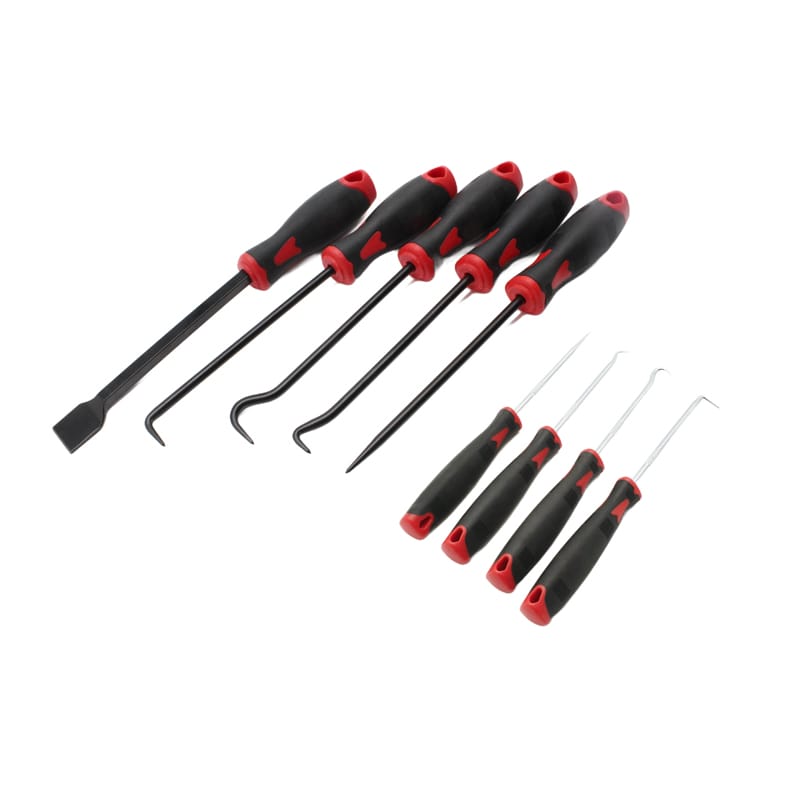
Fengjie’s Pick & Hook category already includes multiple kit sizes, from mini sets to 10-piece, 11-piece, and extra-long-reach configurations.
That makes the category suitable for a tiered private-label range.
Compact Precision Set
A 4-piece configuration can include:
- Straight pick
- 45-degree pick
- 90-degree hook
- Full hook
This is suitable for retail buyers and general repair work.
Professional 6-Piece Set
Add:
- Offset hook
- Extra-long profile
This gives workshops broader access.
Extended 10- or 11-Piece Set
A larger automotive pick and hook set can combine:
- Multiple hook radii
- Standard and long shafts
- Seal-oriented profiles
- Different offsets
Private-label buyers should define:
- Tool count
- Tip geometry
- Shaft material
- Heat treatment
- Shaft length
- Handle material
- Handle color
- Logo method
- Storage tray or pouch
- Packaging
- Barcode
- Safety information
- Inspection criteria
For wholesale, OEM, and custom tool programs, buyers can contact Fengjie Tools with the target user, required kit structure, and packaging requirements.
FAQ
What is an automotive pick and hook set used for?
An automotive pick and hook set is used for precision access around seals, clips, O-rings, grommets, wiring retainers, small springs, hoses, weatherstrips, and other confined automotive components.
Can pick and hook tools be used for car door repair?
Yes. They can help with small clips, seals, wiring tabs, weatherstrips, and hidden retainers after the main door panel has been opened.
Are pick tools safe around window glass?
They can be used around door and window assemblies when the technician controls the tip carefully, but pointed steel tools should not be dragged against glass edges, painted surfaces, or soft seals.
What is the difference between a pick set and a trim removal kit?
A trim kit is designed to separate panels and release larger fasteners.
An automotive pick and hook set is designed for smaller detail work in confined spaces.
Should I buy mini or extra-long pick tools?
Mini tools give better control when the target is close and visible.
Extra-long tools provide reach when components are deep inside a door, dashboard, or engine area.
What should distributors test before ordering?
Check tip geometry, shaft strength, handle retention, surface finish, corrosion resistance, repeated-use performance, batch consistency, and packaging.
Can automotive pick and hook sets be customized?
Depending on manufacturing capability, buyers may customize tool count, tip combinations, shaft length, handle color, logo, storage, packaging, labels, and instructions.
Is a larger set always better?
No.
An automotive pick and hook set is more useful when every tool provides a different angle, hook radius, or reach length.
Repeated shapes add piece count without adding much application coverage.
Conclusion
An automotive pick and hook set fills the precision gap between broad trim removers and larger mechanical tools.
Around car doors, windows, weatherstrips, seals, wiring, clips, and molding details, the small tips can reach locations that conventional pry tools cannot.
For technicians, the most important rule is to match the tool to the detail task. Use trim tools for panel separation, clip removers for stronger fasteners, and an automotive pick and hook set for controlled pulling, guiding, probing, and retrieval work.
For workshops, a practical selection should include straight, angled, 90-degree, full-hook, offset, and long-reach profiles rather than many duplicates.
For distributors and private-label buyers, sourcing quality depends on tip geometry, shaft material, heat treatment, handle retention, surface finish, dimensional consistency, packaging, and repeat-production control.
Fengjie’s Pick & Hook category includes 10-piece, 11-piece, mini, and extra-long-reach options that can support different retail and professional tool programs.
Buyers can also connect the category with door-panel tools, molding tools, clip removers, scraper tools, and automotive glass service products to build a broader door-and-window repair tool range.
For wholesale, OEM, private-label packaging, or custom automotive pick and hook set development, contact Fengjie Tools with your target market, preferred tool profiles, and packaging requirements.