
An automotive inspection mirror is one of the simplest ways to answer an important repair question before more trim, glass, or hardware is removed: what is actually hidden behind the part you are about to disturb?
Around car doors, window channels, windshield cowls, dashboard edges, weatherstrips, and interior trim, technicians often work in areas that are partly blocked from direct view. A clip may be hidden behind the panel. A screw may sit inside a recess. A wiring connector may be closer to the pry point than expected. A dropped fastener may be visible only from an angle. In these situations, an automotive inspection mirror can reduce guesswork before the next tool is inserted.
This guide explains where inspection mirrors add the most value in door and window repair, how mirror size and swivel design affect visibility, how to combine a mirror with trim tools and pickup tools, and what workshops, distributors, and private-label buyers should inspect before sourcing an automotive inspection mirror.
What Is an Automotive Inspection Mirror?
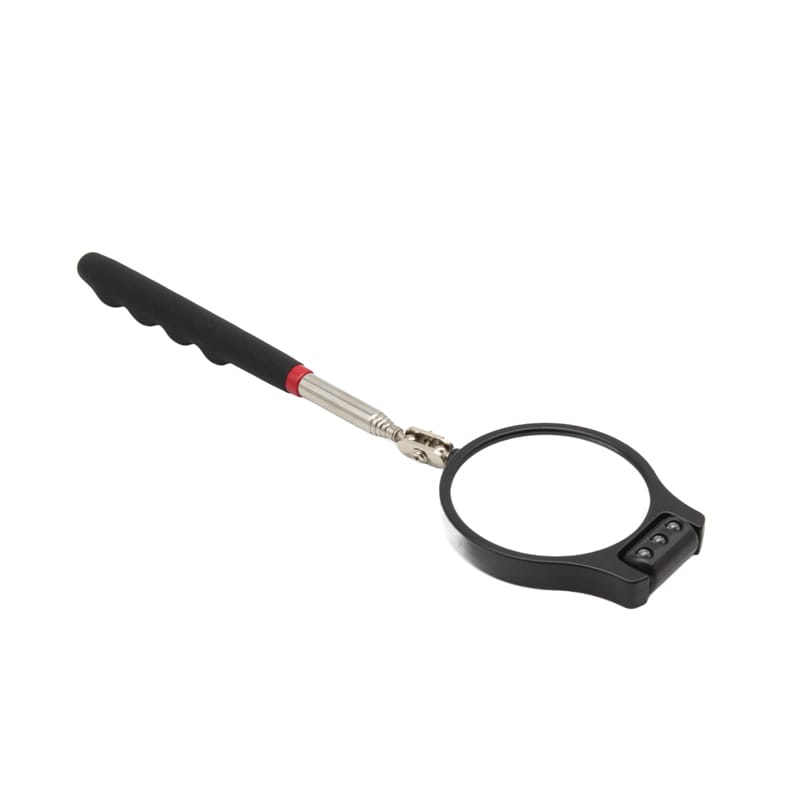
An automotive inspection mirror is a small mirror mounted on a fixed, flexible, or telescoping shaft so technicians can see areas that are difficult or impossible to view directly.
Common features include:
- Round, oval, or rectangular mirror heads
- Telescoping stainless-steel or plated shafts
- Single-joint or multi-joint swivel heads
- Fixed or adjustable mirror angles
- Pocket clips
- Cushion or textured grips
- Optional integrated lighting
The tool does not remove a fastener or cut adhesive. Its job is visual access.
That makes an automotive inspection mirror especially useful before using a pry tool, pick, clip remover, scraper, or retrieval tool in an area where hidden components could be damaged.
Fengjie lists Inspection Mirror & Pickup Tools as a dedicated hand-tool category alongside Pick & Hook, Scraper Tools, Pry Bar, and Magnetic Tool products.
That product structure makes inspection mirrors a logical support tool for a broader automotive door, window, glass, and interior repair range.
Why Inspection Before Disassembly Saves Time
Many repair delays begin with unnecessary disassembly.
A technician may remove three extra trim pieces simply because the actual clip position cannot be seen. Another may apply leverage near a wiring harness because the connector is hidden behind the panel. A dropped screw may lead to more panel removal even though it is already visible from another angle.
An automotive inspection mirror helps answer questions such as:
- Where is the next clip?
- Is there another screw behind this cover?
- Does the molding use a hook or push retainer?
- Is wiring routed behind this pry point?
- Has the glass fully cleared the guide?
- Is a dropped fastener reachable from the current opening?
- Is a rubber seal seated evenly?
- Is the lower windshield area clear before cutting or scraping?
The mirror does not replace vehicle-specific service information.
Instead, it helps the technician confirm what is physically present on the vehicle before applying force.
10 Hidden Areas an Automotive Inspection Mirror Can Check
1. Behind Door Panels Before the First Strong Pry
Door panels often combine screws, clips, upper hooks, switch wiring, latch cables, speakers, and decorative trim.
Once a narrow plastic tool creates the first small gap, an automotive inspection mirror can help locate the nearest fastener before the panel is pulled farther away from the door.
This is useful because the safest leverage point is usually close to the clip, not in the middle of the panel.
A mirror can also reveal whether:
- A screw was missed
- The panel has a molded hook
- The clip is positioned higher or lower than expected
- A wiring harness runs close to the opening
- A speaker or module limits movement
For the main separation work, Fengjie’s Car Door Panel Removal Tool Guide explains how trim tools and clip removers fit into door access.
The automotive inspection mirror supports that workflow by helping the technician see before applying more leverage.
2. Inside the Door Shell During Window Service
Once the trim panel and moisture barrier are opened, the inside of a door still contains many hidden components:
- Window glass
- Regulator rails
- Cable systems
- Wiring
- Latch rods
- Speakers
- Side-impact structure
- Glass clamps
- Run channels
An automotive inspection mirror can be positioned through service openings to confirm the location of these parts before a hook, retrieval tool, or socket extension is inserted.
This is particularly useful during side-glass work.
A technician may need to verify whether the glass clamp is fully released or whether a guide is still contacting the glass.
The Car Window Removal Tool Guide covers the broader side-glass workflow.
The mirror adds visual confirmation in areas where direct line of sight is poor.
3. Behind Window Belt Molding
Inner and outer belt moldings sit close to the lower edge of side glass.
Depending on the vehicle, they may use:
- Clips
- Hooks
- Screws
- Press-fit structures
Before lifting aggressively, an automotive inspection mirror can help the technician inspect the underside of the molding from the available gap.
The mirror may reveal:
- Clip spacing
- Retainer direction
- Hidden hooks
- Whether the glass is too close to the tool path
- Whether a plastic or metal removal tool is more appropriate
This reduces the temptation to treat every molding as a simple upward-pull component.
4. Under the Windshield Cowl
The lower windshield area can contain:
- Wiper pivots
- Washer hoses
- Cowl fasteners
- Clips
- Drains
- Wiring
- Molded channels
After wiper arms or cowl pieces are loosened, an automotive inspection mirror can help verify what remains attached before the panel is forced upward.
It can also help locate small hardware dropped during cowl disassembly.
For preparation work, Fengjie’s Wiper Arm Puller Guide explains controlled wiper-arm removal before cowl access.
5. Along Windshield Molding Retainers
Windshield molding may use hidden clips or channel-mounted retainers that cannot be seen from above.
An automotive inspection mirror can help identify where the molding is actually retained before a clip remover or molding tool is inserted.
This matters because pulling an unsupported section of trim can bend or crack the molding even when the correct removal tool is available.
The Windshield Molding Removal Tool Guide covers the larger removal process.
The mirror is most useful when the technician needs to understand the hidden retention point first.
6. Around the Lower Windshield Adhesive Area
Before using a cold knife or another bonded-glass removal method, technicians need to understand available clearance around the adhesive path.
An automotive inspection mirror can help check lower areas where the dashboard, cowl, brackets, or previous adhesive may limit access.
The mirror can support visual checks for:
- Irregular old urethane
- Interior clearance
- Molding remnants
- Clip locations
- Debris
- Previous repair evidence
It should not be pushed blindly into the adhesive path, and it does not replace approved vehicle and glass-service procedures.
7. Behind Dashboard and Switch Trim
Dashboard trim often hides:
- Clips
- Screws
- Connectors
- Narrow retaining tabs
A small automotive inspection mirror can provide a view behind a partially released bezel without forcing the opening wider.
This is useful around:
- Window switches
- Mirror controls
- Small displays
- Audio trim
- Climate-control bezels
- Decorative dashboard strips
The mirror can show whether the component needs to lift, slide, or pivot before the technician chooses the next tool.
8. Inside Pillar and Interior Trim Gaps
A-, B-, and C-pillar areas can contain wiring, trim hooks, clips, and vehicle systems that require careful handling.
An automotive inspection mirror is useful when a small visual check can prevent unnecessary probing behind the trim.
Technicians should still follow vehicle-specific procedures, especially in areas related to restraint systems.
The mirror is for observation, not for disturbing hidden components.
9. Locating Dropped Hardware Before Retrieval
A dropped screw or clip is easier to recover when the technician knows exactly where it landed.
An automotive inspection mirror pairs naturally with the Flexible Claw Pickup Tool Guide.
A practical sequence is:
- Use the mirror to locate the part.
- Identify nearby wiring or moving components.
- Choose a magnetic pickup tool or flexible claw according to the material.
- Retrieve the part through the safest access path.
This is better than sweeping a retrieval tool blindly through a door cavity.
10. Checking Reassembly Before the Panel Is Closed
Inspection mirrors are not only for disassembly.
Before reinstalling a door panel, cowl, molding, or trim component, an automotive inspection mirror can help verify:
- Wiring is routed correctly
- A connector is fully seated
- A clip is aligned with its mounting hole
- The moisture barrier is positioned correctly
- A glass channel is seated
- A loose fastener has not been left inside
- A seal is not folded or trapped
This final check can prevent reopening a finished repair because of a hidden mistake.
Mirror Size: Bigger Is Not Always Better
A larger mirror gives a wider field of view, but it also needs more room to enter and rotate.
A professional automotive inspection mirror should match the spaces it is expected to inspect.
Small Mirror Heads
Small mirror heads are useful for:
- Door service holes
- Tight dashboard gaps
- Narrow molding areas
- Behind switch panels
- Confined cowl openings
The tradeoff is a smaller field of view.
The technician may need to move the mirror more often to understand the entire area.
Medium Mirror Heads
A medium-size automotive inspection mirror offers a balance between access and visibility.
This size works well for general workshop use, including:
- Door cavities
- Engine-bay inspection
- Dashboard access
- Cowl structures
- Underbody checks
Large Mirror Heads
Large mirrors are useful when there is enough space and the technician wants a broader view.
They may be less suitable inside narrow door structures or closely packed trim cavities.
For distributors, a product line can include more than one mirror size rather than trying to make one mirror head cover every application.
Round, Oval, or Rectangular Inspection Mirror?
Mirror shape affects how much area is visible and how easily the head moves through a narrow opening.
Round Mirror
A round automotive inspection mirror is compact and easy to rotate.
It is useful when the head needs to swivel freely inside a confined space.
Oval Mirror
An oval design can provide a wider horizontal view without becoming as large as a rectangular mirror.
It can work well around door cavities and dashboard spaces.
Rectangular Mirror
A rectangular mirror offers a broader field of view but may require more clearance to rotate.
This shape can be useful where the opening is large enough and wider visual coverage is valuable.
There is no universally best shape.
The choice depends on access dimensions and the type of inspection.
Why the Swivel Joint Matters
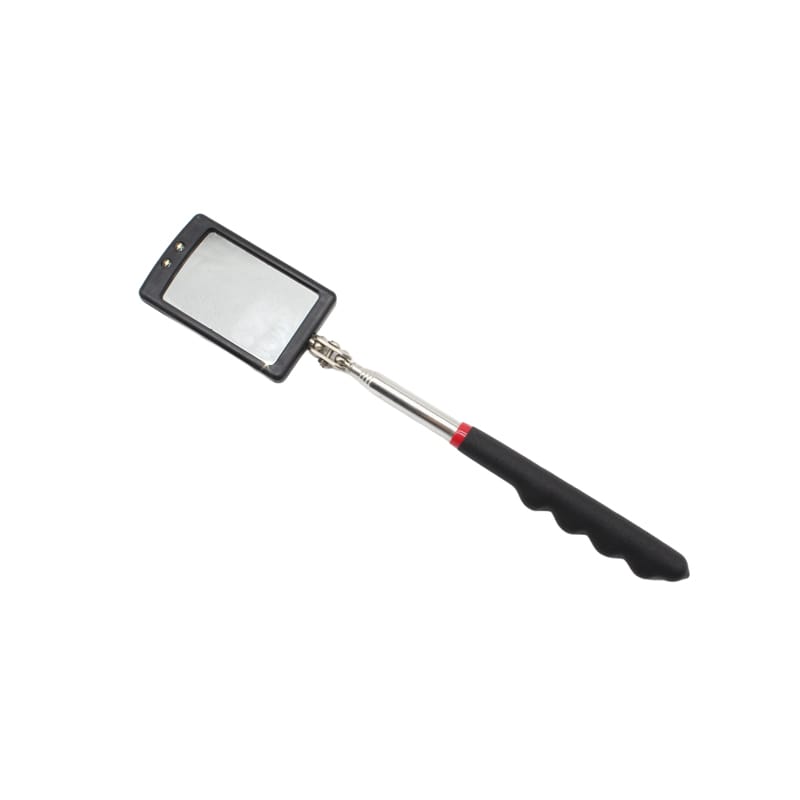
A mirror without useful angular adjustment forces the technician to reposition the entire shaft every time the viewing direction changes.
A swivel joint allows the head to be aimed while the handle remains in a more convenient position.
A good automotive inspection mirror should have enough friction to hold the selected angle while remaining easy to adjust.
Important checks include:
- Range of motion
- Joint smoothness
- Angle retention
- Side play
- Fastener security
- Durability after repeated adjustment
If the mirror head droops under its own weight, the tool becomes frustrating in deep cavities.
If the joint is too stiff, positioning becomes difficult.
Telescoping Shaft Length and Stability
Many inspection mirrors use a telescoping shaft so the tool can remain compact in storage and extend for deeper access.
A telescoping automotive inspection mirror should be evaluated by more than maximum reach.
Collapsed Length
A shorter collapsed tool is easier to keep in a pocket, mobile toolkit, or compact drawer.
Maximum Reach
Longer extension helps around:
- Deep door cavities
- Engine compartments
- Under-dash areas
- Cowl structures
- Underbody inspection
Extended Stability
A telescoping shaft that becomes excessively loose or flexible at full extension makes the mirror difficult to aim.
The best automotive inspection mirror is not simply the one that extends the farthest.
It is the one that remains controllable at the working length.
Inspection Mirror vs. Camera Scope
Digital inspection cameras can provide excellent visual access, but a simple mirror still has several advantages.
| Factor | Automotive Inspection Mirror | Inspection Camera |
|---|---|---|
| Setup time | Very fast | Requires device setup |
| Power | None | Battery or power required |
| Complexity | Low | Higher |
| Live orientation | Direct reflection | Screen-based |
| Tight-space access | Depends on mirror size | Depends on camera head |
| Image capture | No | Often yes |
| Maintenance | Simple | Electronics require care |
An automotive inspection mirror is useful when the technician needs a quick look rather than a recorded inspection.
Many workshops benefit from both tools: the mirror for immediate visual confirmation and the camera for deeper or documentable inspections.
Inspection Mirror vs. Pick and Hook Tools
A mirror helps the technician understand what is hidden.
A pick or hook physically moves something.
That distinction matters.
The Automotive Pick and Hook Set Guide covers precision tools used to guide seals, release tabs, and manipulate small components.
A better workflow is often:
- Inspect with the automotive inspection mirror.
- Identify the component.
- Select the correct pick, clip remover, or retrieval tool.
- Manipulate only the intended part.
This reduces blind probing around wiring, seals, glass, and trim.
Lighting: The Mirror Is Only as Useful as the View
A mirror cannot reflect useful detail if the target area is dark.
Good inspection technique may require:
- Workshop light
- Small flashlight
- Headlamp
- Integrated inspection light
- Side lighting positioned to reduce glare
Do not aim a bright light directly into the mirror unless the angle produces a useful reflection.
Side lighting often reveals more detail with less glare.
A lighted automotive inspection mirror can be convenient, but integrated lighting adds batteries, switches, wiring, and additional quality-control points.
For a simple wholesale or OEM product, a non-lighted mirror may offer easier maintenance and fewer failure modes.
How to Use an Automotive Inspection Mirror More Effectively
Clean the Mirror First
Fingerprints, adhesive mist, dust, and workshop residue can reduce image clarity.
Use a cleaning method suitable for the mirror surface.
Establish the Viewing Angle Outside the Cavity
Set the approximate mirror angle before inserting the tool.
This reduces unnecessary contact with surrounding parts.
Move Slowly
Small movements can change the reflected view significantly.
Slow rotation is easier to interpret than rapid sweeping.
Use a Stable Reference Point
Identify a known component, such as:
- Clip hole
- Panel edge
- Bolt
- Bracket
Use it to understand orientation.
Remember that the reflected image reverses left and right.
Avoid Contact With Glass Edges and Finished Surfaces
An automotive inspection mirror is a visual tool, not a pry tool.
Do not use the mirror head to push molding, seals, wiring, or trim out of the way.
Inspect Before and After the Main Task
Use the mirror before disassembly to locate hidden features and after repair to confirm routing, seating, and missing hardware.
Seven Common Mistakes With Inspection Mirrors
1. Choosing the Largest Mirror for Every Job
A large mirror can block its own access.
Use the smallest head that provides enough field of view.
2. Extending the Shaft Fully When It Is Not Necessary
More length can mean less control.
Use only the reach required.
3. Ignoring Mirror Orientation
Reflections reverse direction.
Move slowly until the technician understands how tool movement relates to the reflected image.
4. Using the Mirror as a Lever
The swivel joint and mirror backing are not designed for trim removal.
5. Working With a Dirty Mirror
Poor image quality can lead to incorrect conclusions about clip or wiring positions.
6. Letting the Mirror Head Hit Glass or Painted Trim
A metal-backed mirror can still damage surrounding components.
7. Inspecting Without Enough Light
An inspection mirror cannot compensate for a completely dark cavity.
Ergonomics and Visibility in Repetitive Inspection Work
Although an automotive inspection mirror requires little force, technicians may hold it in awkward positions while leaning through a door opening or reaching beneath a dashboard.
The NIOSH Guide to Selecting Non-Powered Hand Tools recommends considering grip, posture, force, and repetition when selecting hand tools.
For an inspection mirror, useful ergonomic features include:
- Comfortable handle diameter
- Stable grip texture
- Light overall weight
- Predictable swivel friction
- Telescoping sections that do not collapse unexpectedly
- Enough shaft stiffness to reduce hand correction
The goal is precise positioning with minimal effort.
What Workshops Should Check Before Buying
Workshop buyers should evaluate an automotive inspection mirror in realistic spaces rather than only judging the mirror surface on a workbench.
Useful questions include:
- Does the head fit through common door access openings?
- Does the swivel hold its angle?
- Does the shaft remain stable when extended?
- Is the image clear enough for small clips and wiring?
- Can the handle be controlled with gloves?
- Does the mirror clean easily?
- Can it survive normal toolbox storage?
- Is replacement practical if the mirror cracks?
A mirror that is visually clear but impossible to keep aimed will not save much time in actual repairs.
B2B Quality Checks for Automotive Inspection Mirrors
For distributors and private-label buyers, several small details affect the performance of an automotive inspection mirror.
Mirror Clarity
Inspect for:
- Distortion
- Scratches
- Poor edge finishing
- Coating defects
- Uneven reflective surfaces
The mirror should provide a clear image across its usable area.
Mirror Head Security
Check whether the mirror is firmly mounted to its backing and swivel mechanism.
The head should not loosen after repeated angle changes.
Swivel Performance
Test:
- Smooth adjustment
- Holding force
- Full range of motion
- Side play
- Joint durability
Telescoping Shaft
Inspect:
- Section straightness
- Extension smoothness
- Collapse resistance
- Surface finish
- Corrosion protection
The shaft should extend and retract without binding.
Handle and Pocket Clip
If the tool includes a pocket clip, check that it remains secure.
The handle should provide a stable grip without loose sleeves or sharp transitions.
A Practical Sample Test Plan
| Test Area | What to Check | Why It Matters |
|---|---|---|
| Mirror clarity | Image remains sharp across the surface | Supports accurate inspection |
| Head access | Mirror fits representative vehicle openings | Confirms application range |
| Swivel retention | Head stays at selected angle | Improves usability |
| Shaft extension | Sections move smoothly | Supports fast setup |
| Full-length stability | Tool remains controllable when extended | Critical for deep access |
| Repeated cycles | Swivel and shaft remain stable | Reflects workshop use |
| Corrosion check | Shaft and joints resist surface deterioration | Supports durability |
| Handling check | Mirror mounting remains secure after normal use | Reduces returns |
| Batch comparison | Multiple units show similar performance | Supports repeat supply |
An automotive inspection mirror should be approved based on function, not only appearance.
OEM and Private-Label Product Planning
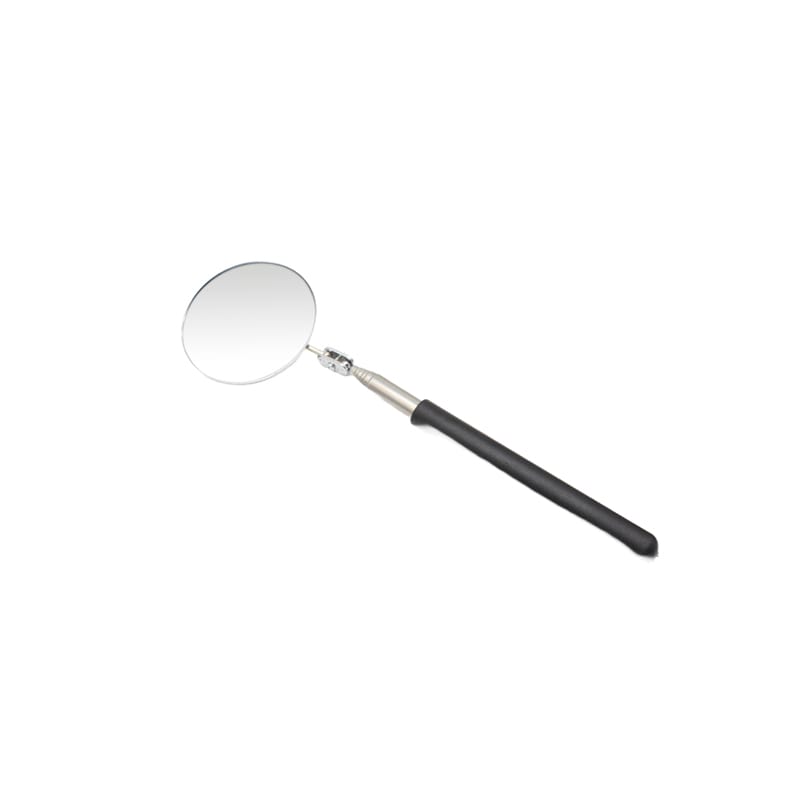
Inspection mirrors can be positioned as standalone tools or combined with related workshop products.
Compact Pocket Mirror
Suitable for technicians who need quick visual checks and easy storage.
Long-Reach Telescoping Mirror
Useful for:
- Door cavities
- Cowl areas
- Underbody work
- Deep engine compartments
Inspection Mirror and Pickup Set
Combining an automotive inspection mirror with magnetic or claw retrieval tools creates a useful “find and retrieve” kit.
Door and Window Service Kit
The mirror can be paired with:
- Plastic trim tools
- Clip removers
- Pick and hook tools
- Flexible claw pickup tool
- Molding tools
This is especially relevant to Fengjie’s broader door, window, and interior repair tool strategy.
Private-label buyers should define:
- Mirror shape
- Mirror size
- Shaft length
- Telescoping range
- Swivel design
- Handle color
- Grip material
- Pocket clip
- Logo
- Packaging
- Instruction card
- Barcode
- Storage format
- Inspection criteria
Fengjie currently lists Inspection Mirror & Pickup Tools as a dedicated hand-tool category.
FAQ
What is an automotive inspection mirror used for?
An automotive inspection mirror is used to see hidden or hard-to-reach areas around car doors, dashboards, engine bays, window channels, cowls, trim panels, wiring, and other vehicle components.
Is a telescoping inspection mirror better than a fixed mirror?
A telescoping mirror provides adjustable reach and compact storage.
A fixed mirror can be more rigid.
The better design depends on the inspection distance and working space.
What mirror size is best for automotive work?
Small and medium mirror heads are usually more practical for tight vehicle spaces.
Larger mirrors provide a wider view but need more clearance.
Can an automotive inspection mirror be used inside a car door?
Yes.
It can help locate clips, wiring, glass clamps, channels, and dropped hardware through service openings, provided the mirror is inserted carefully around moving and electrical components.
Is a lighted inspection mirror necessary?
Not always.
A separate work light or headlamp can provide excellent illumination.
Integrated lighting is convenient but adds electronic components and maintenance requirements.
How should distributors evaluate an inspection mirror?
Check:
- Mirror clarity
- Swivel retention
- Head security
- Telescoping action
- Shaft stability
- Corrosion resistance
- Handle quality
- Packaging
- Batch consistency
Can automotive inspection mirrors be customized?
Depending on manufacturing capability, customization may include mirror size, head shape, shaft length, handle color, grip design, logo, packaging, pocket clip, and kit configuration.
Can inspection mirrors be sold with pickup tools?
Yes.
An automotive inspection mirror pairs naturally with magnetic pickup tools and flexible claw tools because technicians often need to locate an object before retrieving it.
Conclusion
An automotive inspection mirror is a low-complexity tool that can prevent high-cost mistakes by giving technicians visual information before they pry, cut, pull, or retrieve anything.
Around car doors, windows, molding, cowls, dashboards, and windshield service areas, hidden fasteners and components often determine the correct next step.
A mirror helps the technician locate those components without unnecessary disassembly.
For technicians, the most useful habits are simple: choose a mirror head that fits the opening, use only the reach required, position adequate lighting, move slowly, and inspect again before closing the repair.
For workshops, a telescoping automotive inspection mirror works best alongside trim tools, pick-and-hook tools, clip removers, and retrieval tools.
For distributors and private-label buyers, the most important sourcing factors are mirror clarity, head attachment, swivel retention, telescoping stability, shaft finish, corrosion resistance, handle quality, packaging, and batch consistency.
Fengjie lists Inspection Mirror & Pickup Tools as part of its hand-tool range, alongside Pick & Hook and other precision service tools.
For wholesale, OEM, private-label packaging, or customized automotive inspection mirror programs, buyers can contact Fengjie Tools with the target application, mirror size, reach, and packaging requirements.